Skip to content
Epomedicine

Mnemonics, Simplified Concepts & Thoughts

Epomedicine

Mnemonics, Simplified Concepts & Thoughts

intercellular junctions

Cell-Cell or Interceullular Junctions

Epomedicine, May 22, 2019May 22, 2019
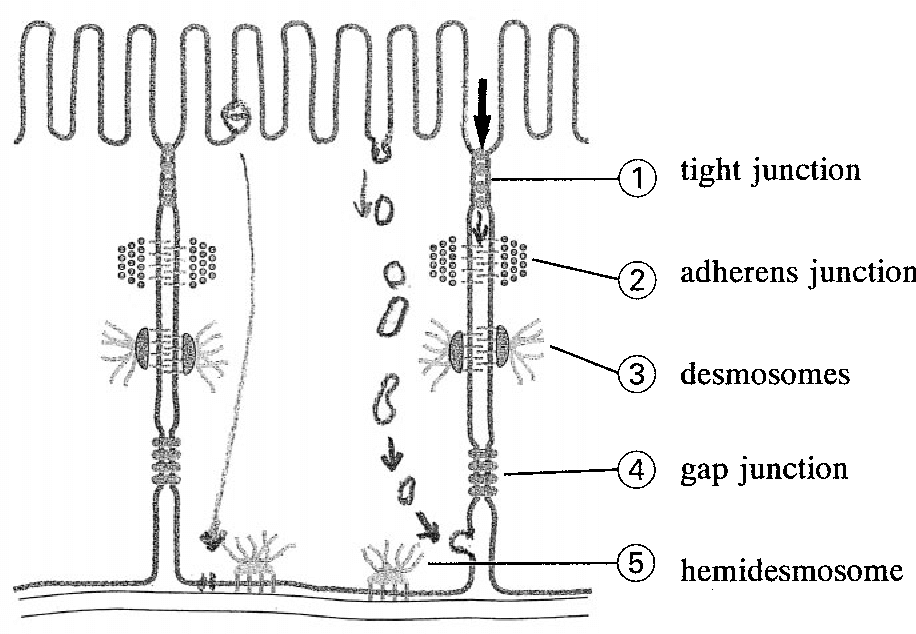
Intercellular junction
JunctionLocationCompositionFunctionRemarks
Tight junction (Zonula occludens)Epithelial cell-Epithelial cellClaudin and Occludin (attaches to cytoskeleton – actin filament)Prevents paracellular movement of solutes and diffusion
Adherens junction (Zonula adherens)Epithelial cell-Epithelial cellE-cadherin (attaches to cytoskeleton – actin filament)Belt desmosome (Anchoring)Cadherins are Ca2+ depndend adhesion proteins

Loss of E-cadherin promotes metastasis
DesmosomeEpithelial cell-Epithelial cellCadherins – Desmoglein, Desmocollin and Desmoplakin (attaches to cytoskeleton – intermediate filaments)Desmoglein – connects keratinocytes in Stratum spinosum

Structural support
Autoantibody to:

1. Desmoglein-1: Pemphigus foliaceous (only skin lesion)

2. Desmogelin-1 (skin) and/or Desmoglein-3 (mucosal): Pemphigus vulgaris
Gap junctionEpithelial cell-Epithelial cellConnexonsElectrical and chemical communicationConnexin-43 are the main gap-junction proteins in myocardium and myometrium
HemidesmosomeEpithelial cell-Basement membraneIntegrins (attaches to laminim or fibronectin and type IV collagen)Integrity of basolateral membraneAutoantibodies to hemidesmosome (BP-Ag1 and BP-Ag2): Bullous pemphigoid
  • Facebook
  • Twitter
PGMEE, MRCS, USMLE, MBBS, MD/MS DermatologyGeneral conceptsPhysiology

Post navigation

Previous post
Next post

Related Posts

PGMEE, MRCS, USMLE, MBBS, MD/MS

Pedicle Screw Insertion Simplified

Oct 30, 2021Oct 30, 2021

Anatomy of Vertebral Pedicle Width (narrowest transverse diameter): Narrowest at T4-T5 (4-5 mm) Above and below this level, the width gradually increases to almost double at T1 and T11 (8 mm) Narrowest for lumbar at L2 (two for tiny; 2 X 3 = 6 mm) Increases gradually to L5 (5…

Read More
PGMEE, MRCS, USMLE, MBBS, MD/MS

Morel Lavallee Lesion

May 22, 2025May 22, 2025

Definition: Post-traumatic closed degloving injury, in which the skin and subcutaneous tissue is detached from the underlying fascia by a shearing force which can disrupt perforating vessels and nerves, creating a potential space that fills with blood, lymph, debris and fat (necrotic and/or viable). Clinical features: The diagnosis can be…

Read More
PGMEE, MRCS, USMLE, MBBS, MD/MS fetal circulation schematic

Fetal Circulation Made Easy

Aug 8, 2016Jun 2, 2020

Following are the important features of fetal circulation: 1. Placenta plays the role of lungs; lungs are not functional: Like pulmonary veins, left umbilical vein carries highly oxygenated blood from placenta to heart. Like pulmonary artery, right and left umbilical arteries braing deoxygenated blood to placenta. 2. Mixing potentially occurs…

Read More

Leave a Reply Cancel reply

Your email address will not be published. Required fields are marked *

This site uses Akismet to reduce spam. Learn how your comment data is processed.

Pre-clinical (Basic Sciences)

Anatomy

Biochemistry

Community medicine (PSM)

Embryology

Microbiology

Pathology

Pharmacology

Physiology

Clinical Sciences

Anesthesia

Dermatology

Emergency medicine

Forensic

Internal medicine

Gynecology & Obstetrics

Oncology

Ophthalmology

Orthopedics

Otorhinolaryngology (ENT)

Pediatrics

Psychiatry

Radiology

Surgery

RSS Ask Epomedicine

  • What to study for Clinical examination in Orthopedics?
  • What is the mechanism of AVNRT?

Epomedicine weekly

  • About Epomedicine
  • Contact Us
  • Author Guidelines
  • Submit Article
  • Editorial Board
  • USMLE
  • MRCS
  • Thesis
©2026 Epomedicine | WordPress Theme by SuperbThemes