Skip to content
Epomedicine

Mnemonics, Simplified Concepts & Thoughts

Epomedicine

Mnemonics, Simplified Concepts & Thoughts

carpal bones ossification

Carpal Bones Ossification: Mnemonic

Epomedicine, Oct 29, 2017

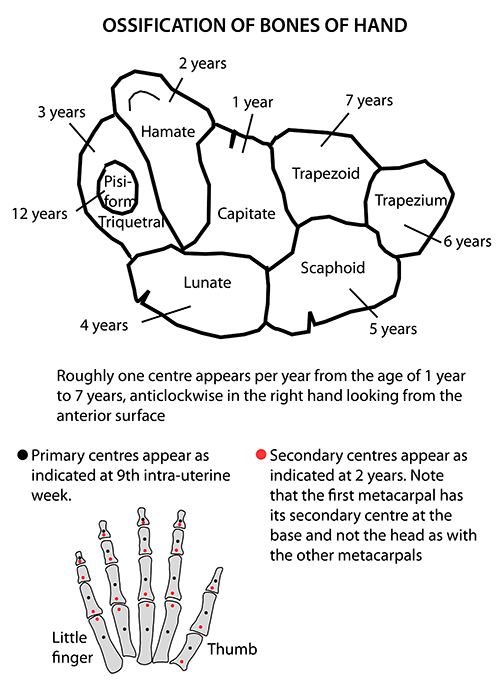
Roughly one center appears per year from the age of 1 year to 7 years, anti-clockwise in right hand and clock-wise in left hand looking from the anterior surface, i.e. from ulnar side to radial side. Pisiform, being a sesamoid bone it gets left behind and only develops years later.

  1. capitate: 1-3 months
  2. hamate: 2-4 months
  3. triquetrum: 2-3 years
  4. lunate: 2-4 years
  5. scaphoid: 4-6 years
  6. trapezium: 4-6 years
  7. trapezoid: 4-6 years
  8. pisiform: 8-12 years

Also it’s nice to know the appearance of ossification center of:

  1. Distal radius: 1 year
  2. Distal ulna: 4-5 years

carpal bones ossification

A video mnemonic:

If this visual mnemonic doesn’t help you, here’s another mnemonic to help you remember.

Camera Has Three Lens, So Take Three Photos.

  1. Capitate
  2. Hamate
  3. Triquetral
  4. Lunate
  5. Scaphoid
  6. Trapezium
  7. Trapezoid
  8. Pisiform

Also, if you’ve been having hard time remembering if the location of trapezium and trapezoid, just remember that the trapeziUM is towards thUMb and trapezoID is insIDe.
122 shares
  • Facebook18
  • Twitter
PGMEE, MRCS, USMLE, MBBS, MD/MS AnatomyForensicMusculoskeletal systemOrthopedics

Post navigation

Previous post
Next post

Related Posts

PGMEE, MRCS, USMLE, MBBS, MD/MS

Muscles of Back – Simplified

Oct 18, 2020Oct 18, 2020

A. Superficial Group (Appendicular group) Arise from vertebral column and attach to shoulder (assist in movement of limbs) a. Most superficial: Trapezius (From external occipital protuberance, ligamentum nuchae and spinous process C7-T12) Latissimus dorsi (From spinous process T7-T12, thoracolumbar fascia and iliac crest) b. Covered by trapezius: Levator scapulae (From…

Read More
PGMEE, MRCS, USMLE, MBBS, MD/MS

Kanavel Sign for Pyogenic Flexor Tenosynovitis

Sep 30, 2020Sep 30, 2020

1. Exquisite tenderness over the course of the sheath, limited to the sheath Present in 64% cases Late sign of proximal extension of pyogenic tenosynovitis Most important sign as described by Kanavel 2. Flexion of the finger (‘hook’ sign) Present in 69% cases 3. Exquisite pain on extending the finger,…

Read More
PGMEE, MRCS, USMLE, MBBS, MD/MS

Surgical Site Infection (SSI) : CDC Definitions Simplified

Jan 18, 2021Jan 18, 2021

Superficial Incisional SSI Stab wound, pin site infection or stitch abscess alone is not considered an SSI. a. Time: Occurs within 30 days after any operative procedure (where day 1 = the procedure date) AND b. Site: Involves only skin and subcutaneous tissue of the incision AND c. Infection: At…

Read More

Comment

  1. Alinani Sinkala says:
    Apr 17, 2023 at 5:32 am

    It is very much helpful

    Reply

Leave a Reply Cancel reply

Your email address will not be published. Required fields are marked *

This site uses Akismet to reduce spam. Learn how your comment data is processed.

Pre-clinical (Basic Sciences)

Anatomy

Biochemistry

Community medicine (PSM)

Embryology

Microbiology

Pathology

Pharmacology

Physiology

Clinical Sciences

Anesthesia

Dermatology

Emergency medicine

Forensic

Internal medicine

Gynecology & Obstetrics

Oncology

Ophthalmology

Orthopedics

Otorhinolaryngology (ENT)

Pediatrics

Psychiatry

Radiology

Surgery

RSS Ask Epomedicine

  • What to study for Clinical examination in Orthopedics?
  • What is the mechanism of AVNRT?

Epomedicine weekly

  • About Epomedicine
  • Contact Us
  • Author Guidelines
  • Submit Article
  • Editorial Board
  • USMLE
  • MRCS
  • Thesis
©2026 Epomedicine | WordPress Theme by SuperbThemes