Skip to content
Epomedicine

Mnemonics, Simplified Concepts & Thoughts

Epomedicine

Mnemonics, Simplified Concepts & Thoughts

carpal bones ossification

Carpal Bones Ossification: Mnemonic

Epomedicine, Oct 29, 2017

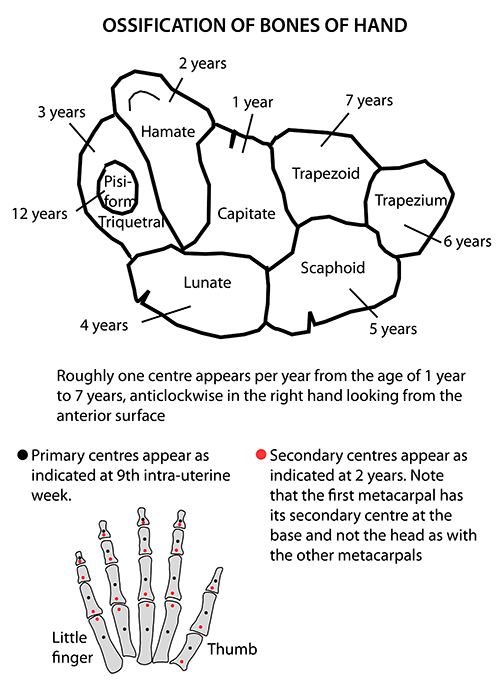
Roughly one center appears per year from the age of 1 year to 7 years, anti-clockwise in right hand and clock-wise in left hand looking from the anterior surface, i.e. from ulnar side to radial side. Pisiform, being a sesamoid bone it gets left behind and only develops years later.

  1. capitate: 1-3 months
  2. hamate: 2-4 months
  3. triquetrum: 2-3 years
  4. lunate: 2-4 years
  5. scaphoid: 4-6 years
  6. trapezium: 4-6 years
  7. trapezoid: 4-6 years
  8. pisiform: 8-12 years

Also it’s nice to know the appearance of ossification center of:

  1. Distal radius: 1 year
  2. Distal ulna: 4-5 years

carpal bones ossification

A video mnemonic:

If this visual mnemonic doesn’t help you, here’s another mnemonic to help you remember.

Camera Has Three Lens, So Take Three Photos.

  1. Capitate
  2. Hamate
  3. Triquetral
  4. Lunate
  5. Scaphoid
  6. Trapezium
  7. Trapezoid
  8. Pisiform

Also, if you’ve been having hard time remembering if the location of trapezium and trapezoid, just remember that the trapeziUM is towards thUMb and trapezoID is insIDe.
122 shares
  • Facebook18
  • Twitter
PGMEE, MRCS, USMLE, MBBS, MD/MS AnatomyForensicMusculoskeletal systemOrthopedics

Post navigation

Previous post
Next post

Related Posts

PGMEE, MRCS, USMLE, MBBS, MD/MS Hypothalamus mnemonic

Nuclei of Hypothalamus – Mnemonic

Jul 28, 2016Jul 28, 2016

Hypothalamus is composed of several nuclei with different important functions – hence, it is important and confusing at the same time. I have devised a pictorial or visual mnemonic to make things easier for you. Hypothalamus is a Cow Imagine a Crying and Farting Cow when recalling the Hypothalamus. Preoptic:…

Read More
PGMEE, MRCS, USMLE, MBBS, MD/MS heart sounds area

Heart Sounds – Clinically Explained

Oct 19, 2017Jun 12, 2020

Auscultation (to listen), a clinical procedure done on a daily basis as an aid in diagnosing many disorders, dates back centuries since the Egyptians.  It was then an unaided auscultation (i.e. directly applying the ear to the body).  In 1800’s Dr. Rene Laennec introduced the “Stethoscope” (Chest Scope), rolled paper…

Read More
PGMEE, MRCS, USMLE, MBBS, MD/MS

Phases of Clinical Trial : Mnemonic

Sep 7, 2023Sep 7, 2023

Clinical trials conduct ‘human experiments’. Three fundamental principles apply: Blinding: Phases: Mnemonic: I SWIM Phase Purpose Name Sample Blinding and control 0 Initial (Pharmacokinetics and Pharmacodynamics) Microdosing studies Healthy volunteers (smaller) No I Safe? (Safe maximum dose and tolerability) Human pharmacology and safety Healthy volunteers (larger) No II Works? (Efficacy)…

Read More

Comment

  1. Alinani Sinkala says:
    Apr 17, 2023 at 5:32 am

    It is very much helpful

    Reply

Leave a Reply to Alinani Sinkala Cancel reply

Your email address will not be published. Required fields are marked *

This site uses Akismet to reduce spam. Learn how your comment data is processed.

Pre-clinical (Basic Sciences)

Anatomy

Biochemistry

Community medicine (PSM)

Embryology

Microbiology

Pathology

Pharmacology

Physiology

Clinical Sciences

Anesthesia

Dermatology

Emergency medicine

Forensic

Internal medicine

Gynecology & Obstetrics

Oncology

Ophthalmology

Orthopedics

Otorhinolaryngology (ENT)

Pediatrics

Psychiatry

Radiology

Surgery

RSS Ask Epomedicine

  • What to study for Clinical examination in Orthopedics?
  • What is the mechanism of AVNRT?

Epomedicine weekly

  • About Epomedicine
  • Contact Us
  • Author Guidelines
  • Submit Article
  • Editorial Board
  • USMLE
  • MRCS
  • Thesis
©2026 Epomedicine | WordPress Theme by SuperbThemes