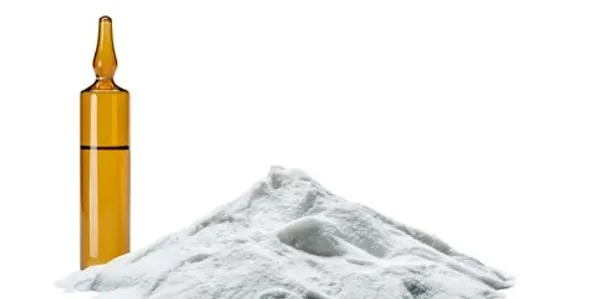
COMPOSITION
| Powder | Liquid |
| Polymer: PMMA | Monomer: MMA |
| Initiator: BPO | Accelerator: NN-DMPT (Dimethyl paratoluidine; encourage polymer and monomer to polymerize at room temperature) |
| Radiopacifier: BaSO4/ZrO2 | Stabilizer: Hydroquinone (prevent premature polymerization) |
| Antibiotics: Gentamicin | +/- Cross-linking agent (improves mechanical strength): e.g., ethylene glycol dimethacrylate (EGDMA) |
POLYMERIZATION MECHANISM
Free radical polymerization: Initiator in powder (BPO) + Accelerator in liquid (DMPT) → Free radicals → Activates polymerization at room temperature → Exothermic reaction with temperatures reaching 70°C-120°C.
2-6% monomers remain: Totally exhaled by lungs or metabolized in TCA cycle
4 phases of polymerization/curing process
Higher the temperature, shorter the phases
- Mixing: From mixing liquid and powder to when dough is homogenous & stirring becomes effortless (only constant phase – not ambient temperature dependent)
- Sticky/Waiting: Ends when cement is neither sticky, nor hairy (dough is tested with gloved fingers every 5 seconds)
- Working: Ends when cement does not join without folds during continuous kneading by hand; implant can no longer be inserted (must be inserted before the end of working phase)
- Golden window for implantation
- Hardening: Cures to a hard consistency; temperature reaches its peak – if implant inserted at this stage, may result in cement delaminating or separating from the bone &/or prosthesis
Dough time (until no longer sticky): 2-3 minutes
Working time (end of dough time to until cement is too stiff to manipulate): 5-8 minutes
Setting time (beginning of mixing until time at which exothermic heat reaction heats the cement temperature to exactly halfway between ambient temperature and maximum temperature; dough time + working time): 8-10 minutes
The cement is ready for implantation when 2 cement balls are touched to each other and they stick to each other.
VISCOSITY
- Low viscosity: Long mixing phase and short working phase
- Medium viscosity
- High viscosity: Short mixing phase and long working phase
Ideal viscosity will be high enough to avoid any cementmixing with blood or fat/bony material from the implantationregion yet low enough to penetrate the bone adequately.
PRESSURIZATION
Pressure must be >BP until viscosity is high enough to resist BP
Sweating trochanter sign: Marrow extrusion in GT (positive sign of pressurization)
ANTIBIOTICS
Hanssen classified antibiotic loaded bone cement into high dose (> 2 g antibiotic per 40 g of cement) and low dose (< 2 g antibiotic per 40 g of cement) and recommended high dose for use as beads or spacers and low dose for prosthesis fixation. It is postulated that mixing high doses of powdered antibiotics considerably increases cement porosity and facilitates increased elution of antibiotics.

He is the section editor of Orthopedics in Epomedicine. He searches for and share simpler ways to make complicated medical topics simple. He also loves writing poetry, listening and playing music. He is currently pursuing Fellowship in Hip, Pelvi-acetabulum and Arthroplasty at B&B Hospital.