Skip to content
Epomedicine

Mnemonics, Simplified Concepts & Thoughts

Epomedicine

Mnemonics, Simplified Concepts & Thoughts

antigenic shift and drift

Antigenic Shift and Drift

Epomedicine, Apr 5, 2017

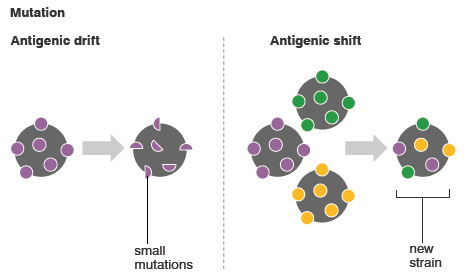
Antigenic Drift

Nature of antigenic variation: Minor

Mechanism:

  1. Gradual accumulation of amino acid substitutions due to point mutation in the hemagglutinin (H) and neuraminidase (N) genes.
  2. As mutations accumulate, antibodies generated by exposure to previous strains do not neutralize current strains to the same extent, resulting in only limited or partial immunity to the new strains.

Gives rise to: Epidemics

Shown by: Influenza A and B viruses
antigenic shift and drift

Antigenic Shift

Nature of antigenic variation: Major

Mechanism: Expression of a new allele of hemagglutin or neuraminidase through the following mechanism –

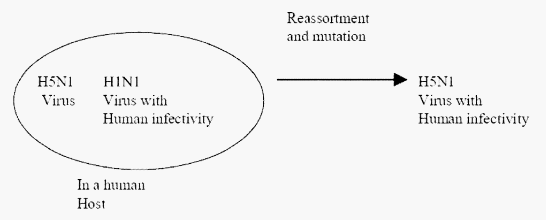
  1. Genetic reassortment: Non-human influenza is selective in its tropism, and cannot easily replicate in humans. However, avian influenza viruses may replicate in non-avian, non-human reservoirs (like swine). A pig that was co-infected with both avian and human strains of influenza might result in a genetic reassortment that produces a novel virus capable of replication in and transmission between humans.
  2. Mutation: Mutations may occur directly in a non-human virus, such as an avian virus, that allow the virus to readily spread from person to person.
reassortment

Gives rise to: Pandemics and Epidemics

Shown by: Influenza A virus
17 shares
  • Facebook17
  • Twitter
PGMEE, MRCS, USMLE, MBBS, MD/MS MicrobiologyRespiratory system

Post navigation

Previous post
Next post

Related Posts

PGMEE, MRCS, USMLE, MBBS, MD/MS

Achondroplasia Mnemonic

Jul 25, 2021Jul 25, 2021

A: Autosomal dominant C: “Champange glass” pelvis in X-rays H: Hypotonia O: Ossification affected (Enchondral > Appositional) N: Nasal bridge small D: Disproportionate Dwarfism R: Rhizomelic (proximal i.e. humerus and femur shortening) O: Out knees (varus deformity) P: Proliferative zone quantitative defect L: Little phalanx (brachydactyly) and metacarpals with Leister…

Read More
PGMEE, MRCS, USMLE, MBBS, MD/MS eye schematic

Embryology of Eye : Mnemonic

Mar 3, 2019Mar 3, 2019

Surface ectoderm derivatives Mnemonic: LEVeL Lens Epithelium All ocular adnexa including mebomian gland and glands of Zeis and Moll Skin Cornea Conjunctiva Vitreous (portion) Lacrimal glands and drainage system Neuro-ectoderm (Optic vesicle and cup) derivatives Mnemonic: MORE Muscles of pupil (constrictor and dilator pupillae) Optic nerve Retinal pigment epithelium Epithelium…

Read More
PGMEE, MRCS, USMLE, MBBS, MD/MS

Golden Rules of Anesthesia : Mnemonic

Jul 3, 2025Jul 3, 2025

The “golden rules of anesthesia” are a set of principles and practices designed to ensure patient safety during anesthesia administration. These rules emphasize careful pre-operative preparation, vigilant intraoperative monitoring, and prompt management of potential emergencies. Mnemonic: ANESTHESIA

Read More

Leave a Reply Cancel reply

Your email address will not be published. Required fields are marked *

This site uses Akismet to reduce spam. Learn how your comment data is processed.

Pre-clinical (Basic Sciences)

Anatomy

Biochemistry

Community medicine (PSM)

Embryology

Microbiology

Pathology

Pharmacology

Physiology

Clinical Sciences

Anesthesia

Dermatology

Emergency medicine

Forensic

Internal medicine

Gynecology & Obstetrics

Oncology

Ophthalmology

Orthopedics

Otorhinolaryngology (ENT)

Pediatrics

Psychiatry

Radiology

Surgery

RSS Ask Epomedicine

  • What to study for Clinical examination in Orthopedics?
  • What is the mechanism of AVNRT?

Epomedicine weekly

  • About Epomedicine
  • Contact Us
  • Author Guidelines
  • Submit Article
  • Editorial Board
  • USMLE
  • MRCS
  • Thesis
©2026 Epomedicine | WordPress Theme by SuperbThemes