Skip to content
Epomedicine

Mnemonics, Simplified Concepts & Thoughts

Epomedicine

Mnemonics, Simplified Concepts & Thoughts

ALI and ARDS : Mnemonics

Epomedicine, May 20, 2024May 20, 2024

Diagnosis (Berlin Criteria)

MnemonicARDS
Acute Lung Injury (ALI)Acute onset (<7 days)Ratio PaO2/FiO2 ≤300 mmHg or 40 kPaDiffuse bilateral pulmonary infiltrates on CXRSwan-Ganz pulmonary wedge pressure ≤18 mmHg or No evidence of Left atrial hypertension
Acute Respiratory Distress Syndrome (ARDS)Acute onset (<7 days)Ratio PaO2/FiO2 ≤200 mmHg or 26.6 kPaDiffuse bilateral pulmonary infiltrates on CXRSwan-Ganz pulmonary wedge pressure ≤18 mmHg or No evidence of Left atrial hypertension

Causes of ALI and ARDS

Mnemonic: ARDS

  1. A
    • Aspiration pneumonia
    • Air embolism
    • Amniotic fluid embolism
  2. R
    • Radiation-Trauma-Burns
  3. D
    • DIC
    • Drugs (chemotherapy, heroin)
    • near Drowning
    • Dialysis
    • Dysregulation of metabolic pathways (pancreatitis, uremia, ingestion of paraquat)
  4. S
    • Shock
    • Sepsis
    • Smoke inhalation

Phases of ALI and ARDS
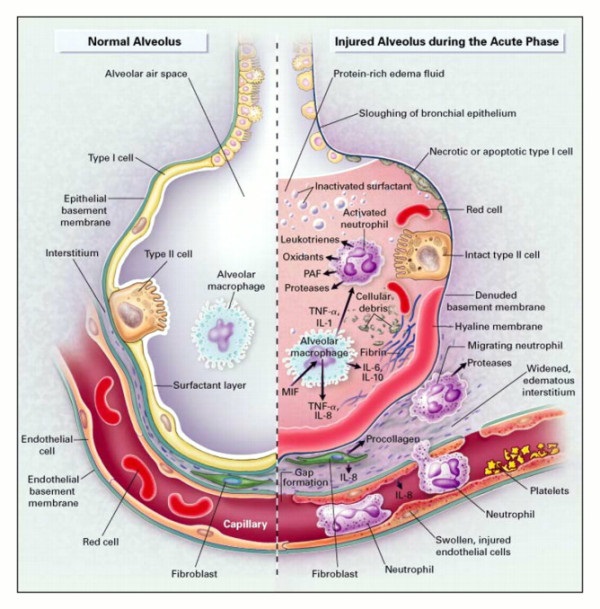
ARDS stages
Bakowitz, Magdalena & Bruns, Brandon & McCunn, Maureen. (2012). Acute lung injury and the acute respiratory distress syndrome in the injured patient. Scandinavian journal of trauma, resuscitation and emergency medicine. 20. 54. 10.1186/1757-7241-20-54. [CC BY-SA 4.0.]
Phase (Mnemonic: EPF)OnsetEventPathologyTreatment principles
1. Exudative<1 weekIL-1 & other inflammatory mediatorsInterstitial alveolar edema
Hyaline membrane
1. Primarily supportive
2. Treatment of cause
3. PEEP ventilation
4. Inverse ventilation (Inspiration : Expiration ratio = 2:1)
5. Prone ventilation
2. Proliferative1-3 weeksType II pneumocyte + myofibroblast proliferationAlveolar exudate resolves or organizesInhaled NO (Vasodilation may improve V/Q at ventilated areas)
3. Fibrotic>3 weeksCollagen III to I conversionAlveolar ducts & spaces undergo fibrosisSteroids
  • Facebook
  • Twitter
PGMEE, MRCS, USMLE, MBBS, MD/MS PathologyRespiratory system

Post navigation

Previous post
Next post

Related Posts

PGMEE, MRCS, USMLE, MBBS, MD/MS

Hypertrophic Scar vs Keloid

May 21, 2024May 21, 2024

Hypertrophic scars and keloids are both raised, firm scars formed from excess fibrinogen production and collagen during healing. Mnemonic: BAD SCARS Mnemonic Basis Hypertrophic scar Keloid B Behavior Natural regression No spontaneous regressio A Acuteness Appears in weeks Appears over months to years D Demographic All races affected More prevalent…

Read More
PGMEE, MRCS, USMLE, MBBS, MD/MS pediatric fractures

General Principles – Pediatric Fracture Management

Apr 4, 2020Apr 4, 2020

Children are not just mini-adults • Higher head to torso ratio: Head injury & Upper C-spine fractures • Light weight – projectile when struck • BSA to Wt. ratio – higher (rapid hypothermia) • Large cardiopulmonary reserves – normal SBP in significant hypovolemia Growth contribution by Proximal & Distal Physes…

Read More
PGMEE, MRCS, USMLE, MBBS, MD/MS dexamethasone suppression

Understanding Dexamethasone Suppression Test

Jan 30, 2017Aug 8, 2023

The Dexamethasone Suppression Test (DST) is based on the principle of negative feedback exerted by steroids on pituitary gland’s ACTH secretion. Negative feedback with exogenous steroid works if the cause is excessive ACTH secretion from pituitary: 1. Cushing’s disease (pituitary ACTH dependent Cushing’s syndrome): Excessive ACTH secretion by pituitary adenoma…

Read More

Leave a Reply Cancel reply

Your email address will not be published. Required fields are marked *

This site uses Akismet to reduce spam. Learn how your comment data is processed.

Epomedicine. ALI and ARDS : Mnemonics [Internet]. Epomedicine; 2024 May 20 [cited 2026 Jan 1]. Available from: https://epomedicine.com/medical-students/ali-and-ards-mnemonics/.

Pre-clinical (Basic Sciences)

Anatomy

Biochemistry

Community medicine (PSM)

Embryology

Microbiology

Pathology

Pharmacology

Physiology

Clinical Sciences

Anesthesia

Dermatology

Emergency medicine

Forensic

Internal medicine

Gynecology & Obstetrics

Oncology

Ophthalmology

Orthopedics

Otorhinolaryngology (ENT)

Pediatrics

Psychiatry

Radiology

Surgery

RSS Ask Epomedicine

  • What to study for Clinical examination in Orthopedics?
  • What is the mechanism of AVNRT?

Epomedicine weekly

  • About Epomedicine
  • Contact Us
  • Author Guidelines
  • Submit Article
  • Editorial Board
  • USMLE
  • MRCS
  • Thesis
©2026 Epomedicine . All rights reserved.