Skip to content
Epomedicine

Mnemonics, Simplified Concepts & Thoughts

Epomedicine

Mnemonics, Simplified Concepts & Thoughts

pulse sbp correlation

ATLS 80/70/60 Rule for Palpable Blood pressure

Epomedicine, May 22, 2018Apr 12, 2020

ATLS’ 80/70/60 rule

Pressure pulse correlation

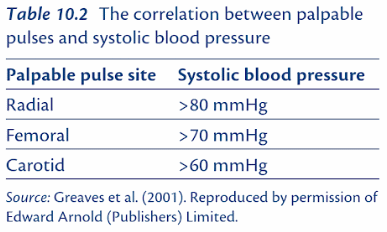
On the basis of location of pulse palpable, minimum systolic blood pressure can be predicted as follows:

  • Radial/Dorsalis pedis/Popliteal pulse: >80 mmHg
  • Femoral pulse: >70 mmHg
  • Carotid pulse: >60 mmHg

Overestimation of SBP by Pulses

Pulse characteristics are an unreliable sign and “should be used only as a last resort.”

The 80/70/60 rule taught by the prehospital medicine and older editions of ATLS courses tend to overestimate the patient’s blood pressure. This has been shown by two different studies.1Deakin CD, Low JL. Accuracy of the advanced trauma life support guidelines for predicting systolic blood pressure using carotid, femoral, and radial pulses: observational study. BMJ. 2000 Sep 16;321(7262):673-4. doi: 10.1136/bmj.321.7262.673. PMID: 10987771; PMCID: PMC27481. 2Poulton TJ. ATLS paradigm fails. Ann Emerg Med. 1988 Jan;17(1):107. PubMed PMID: 3337405.

Although the radial pulse always disappears before the femoral, which always disappears before the carotid, most patient’s BP is lower than that predicted by these guidelines.

Note: These rules have been ommited in the newer editions of ATLS course.

Reference: Wilderness Medicine E-Book: Expert Consult Premium Edition – By Paul S. Auerbach
36 shares
  • Facebook35
  • Twitter
Emergency Medicine Cardiovascular systemGeneral SurgeryOrthopedics

Post navigation

Previous post
Next post

Related Posts

Emergency Medicine PE algorithm

Well’s and PERC Criteria for Pulmonary Embolism : Mnemonic

Oct 25, 2017Oct 2, 2021

Well’s Criteria (Modified and Simplified) Mnemonic: CHADS (Remember, this is not the CHADS2 score for Atrial Fibrillation) Clinical features of DVT Cancer Heart rate > 100/min Hemoptysis Alternative diagnosis less likely DVT/PE in past Surgery in past 4 weeks or Immobilization for 3 days Well’s criteria Original score Simplified score…

Read More
Emergency Medicine gustilo anderson type III

Open fractures : Mnemonics

Apr 17, 2017Oct 9, 2022

Gustilo Anderson Classification Mnemonics:1. Parameters: ABCD’S (Area, Bone, Circulation, Dirt, Soft tissue)2. Classification: I, II, III then A, B, C Progression for grade I to III C implies a higher degree of energy involved in the injury, higher soft tissue and bone damage, and higher potential for complications. Type I:…

Read More
Emergency Medicine

Bier Block

Jan 11, 2022Jan 11, 2022

Named after: German Surgeon August Bier (first introduced the block in 1908) Definition: It is a peripheral intravenous local anesthetic block (IVRA; Intravenous Regional Anesthesia) of the upper limb using a pneumatic cuff technique Mechanism of action: Local anesthesia diffuses into the small veins surrounding the nerves and then into…

Read More

Leave a Reply Cancel reply

Your email address will not be published. Required fields are marked *

This site uses Akismet to reduce spam. Learn how your comment data is processed.

Epomedicine. ATLS 80/70/60 Rule for Palpable Blood pressure [Internet]. Epomedicine; 2018 May 22 [cited 2025 Nov 29]. Available from: https://epomedicine.com/emergency-medicine/correlation-between-palpable-pulses-and-systolic-blood-pressure/.

Pre-clinical (Basic Sciences)

Anatomy

Biochemistry

Community medicine (PSM)

Embryology

Microbiology

Pathology

Pharmacology

Physiology

Clinical Sciences

Anesthesia

Dermatology

Emergency medicine

Forensic

Internal medicine

Gynecology & Obstetrics

Oncology

Ophthalmology

Orthopedics

Otorhinolaryngology (ENT)

Pediatrics

Psychiatry

Radiology

Surgery

RSS Ask Epomedicine

  • What to study for Clinical examination in Orthopedics?
  • What is the mechanism of AVNRT?

Epomedicine weekly

  • About Epomedicine
  • Contact Us
  • Author Guidelines
  • Submit Article
  • Editorial Board
  • USMLE
  • MRCS
  • Thesis
©2025 Epomedicine . All rights reserved.