Skip to content
Epomedicine

Mnemonics, Simplified Concepts & Thoughts

Epomedicine

Mnemonics, Simplified Concepts & Thoughts

Acetaminophen (Paracetamol) Poisoning: Mnemonic Approach

Dr. Sulabh Kumar Shrestha, MS Orthopedics, Aug 24, 2019Aug 24, 2019

Rule of 150 and 4

a. Begin treatment if: Paracetamol is ingested at a dose >150 mg/kg

Threshold to begin treatment is half the dose (75 mg/kg) in high risk cases:

1. Regular ethanol consumption: >21 Units/week in male and >14 Units/week in female

2. Regular use of enzyme inducing drugs: carbamazepine, phenytoin, phenobarbitone, rifampicin

3. Conditions causing glutathion depletion: malnutrition, HIV, eating disorder, cystic fibrosis

Remember the 3 E – Ethanol, Enzyme inducer, Eating disorder

b. Within 4 hours of ingestion: Oral/NG/OG Activated Charcol (1/50, i.e. 1 gm/kg or 50 gm)

c. Send Serum APAP level after 4 hours post-ingestion and Start NAC if: Serum APAP level >150 microgram/ml at 4 hours post-ingestion (or use Rumack-Matthew normogram for acute ingestion upto 24 hours) OR Ingested dose >150 mg/kg and Serum APAP level cannot be obtained within 8 hours post-ingestion or patient presents after 8 hours or if the dosing is staggered
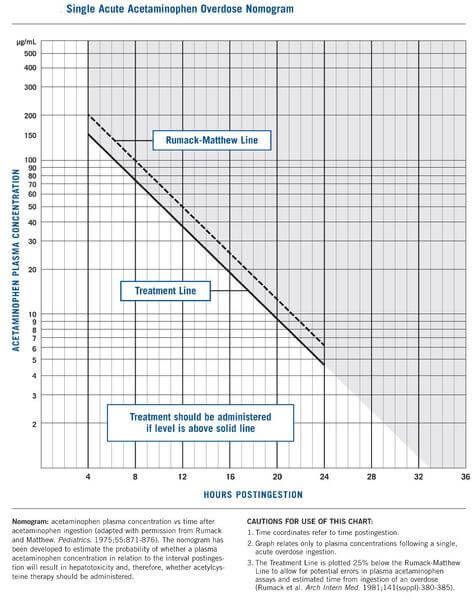
rumack matthew normogram
Merlin Cyrstal [CC BY-SA 3.0], via Wikimedia Commons

d. NAC dosing:

  1. Loading: 150 mg/kg IV in 200 ml (3 ml/kg) 5%DW over 1 hour
  2. Maintenance: 150 mg/kg IV in (21 ml/kg) 1500 ml 5%DW over 20 hours.
    • 1/3rd in 1st 4 hours
    • 2/3rd in later 16 hours

Oral dose of NAC:
1. Loading: 140 mg/kg
2. Maintenance: 70 mg/kg every 4 hours for 17 doses

Rechecking serum APAP level:
1. IV NAC dosing: at 20 hours
2. Oral NAC dosing: at 24 hours

NAC can be started empirically if serum APAP level is not obtained within 8 hours and it can be stopped prior to completion of total regimen if:
a. APAP level returns to 0
b. INR <2
c. AST normalizes

King’s college Criteria

It is used for predicting fulminant hepatic failure and referral to the transplant center.

Mnemonic: A or B, C and D

a. Acidosis: Arterial pH <7.3 or lactate >3 OR

b. All of the following:

  1. Bleeding risk: PT >100s or INR >6.5
  2. Creatinine: >3.4 mg/dl
  3. Drowsiness: Hepatic Encephalopathy Grade III or IV

References:

  1. Wallace CI, Dargan PI, Jones ALParacetamol overdose: an evidence based flowchart to guide managementEmergency Medicine Journal 2002;19:202-205.
  2. The Washington Manual of Medical Therapeutics – By Hemant Godara

dr. sulabh kumar shrestha
Dr. Sulabh Kumar Shrestha, MS Orthopedics

He is the section editor of Orthopedics in Epomedicine. He searches for and share simpler ways to make complicated medical topics simple. He also loves writing poetry, listening and playing music. He is currently pursuing Fellowship in Hip, Pelvi-acetabulum and Arthroplasty at B&B Hospital.

  • Facebook
  • Twitter
Emergency Medicine Gastrointestinal systemInternal medicinePediatrics

Post navigation

Previous post
Next post

Related Posts

Emergency Medicine

ECG changes in Pulmonary embolism

Nov 14, 2013Jun 12, 2016

Synonyms: Pulmonary artery embolism, Pulmonary embolus, PE Definition: A pulmonary embolus (PE) is a blood clot that embolizes to the lungs. When a clot from peripheral veins, the right atrium or the right ventricle travels into the pulmonary circuit, it effectively blocks forward blood through a portion of the lung…

Read More
Emergency Medicine sepsis-3 definitions

Understanding New Definition of Sepsis (Sepsis-3)

Jun 15, 2016

The Sepsis-2 definition used SIRS criteria and the term “Severe sepsis” which has been recently eliminated by the Sepsis-3. The new sepsis definitions recommend using a change in baseline of the total SOFA score of two or more points to represent organ dysfunction. New Definition of Sepsis and Septic Shock…

Read More
Emergency Medicine sinus tachycardia

Supraventricular Tachycardia vs Sinus Tachycardia

Dec 31, 2016Jan 9, 2017

Yesterday, I had encountered a tachycardic patient with heart rate 160/min. Somewhere in medical school, I was taught that the sinus tachycardia with heart rate >160/min must be considered as a Supraventricular tachycardia (SVT). With such misinformation, it was easier for me to overlook the fact that the patient was…

Read More

Leave a Reply Cancel reply

Your email address will not be published. Required fields are marked *

This site uses Akismet to reduce spam. Learn how your comment data is processed.

Shrestha SK. Acetaminophen (Paracetamol) Poisoning: Mnemonic Approach [Internet]. Epomedicine; 2019 Aug 24 [cited 2025 Dec 27]. Available from: https://epomedicine.com/emergency-medicine/acetaminophen-paracetamol-poisoning-mnemonic-approach/.

Pre-clinical (Basic Sciences)

Anatomy

Biochemistry

Community medicine (PSM)

Embryology

Microbiology

Pathology

Pharmacology

Physiology

Clinical Sciences

Anesthesia

Dermatology

Emergency medicine

Forensic

Internal medicine

Gynecology & Obstetrics

Oncology

Ophthalmology

Orthopedics

Otorhinolaryngology (ENT)

Pediatrics

Psychiatry

Radiology

Surgery

RSS Ask Epomedicine

  • What to study for Clinical examination in Orthopedics?
  • What is the mechanism of AVNRT?

Epomedicine weekly

  • About Epomedicine
  • Contact Us
  • Author Guidelines
  • Submit Article
  • Editorial Board
  • USMLE
  • MRCS
  • Thesis
©2025 Epomedicine . All rights reserved.