Skip to content
Epomedicine

Mnemonics, Simplified Concepts & Thoughts

Epomedicine

Mnemonics, Simplified Concepts & Thoughts

Dix hallpike maneuver

Vestibular examination : Dix-Hallpike Maneuver for BPPV

Epomedicine, May 26, 2014Aug 27, 2014

Benign Paroxysmal Positional Vertigo (BPPV) is the commonest cause of episodic vertigo and is characterized by acute attacks of transient vertigo initiated by certain head positions, lasting seconds to minutes, accompanied by nystagmus that fatigues on repeated testing.

Important terminologies linked with pathogenesis of BPPV:

  1. Otoconia: Calcium carbonate crystals released from degenerating macula
  2. Canalithiasis: Otoconia moving within semi-circular canal
  3. Cupluolithiasis: Otoconia adherent to cupula of semicircular canal

Note:

Canalithiasis is more common
Commonly Posterior semicircular canal is involved

Clinical test for Diagnosis of BPPV: Dix-Hallpike Maneuver

Synonyms: Nylen-Barany maneuver

Contraindications:

  1. Severe cervical spine disease
  2. Unstable spinal injury
  3. High-grade carotid stenosis
  4. Unstable heart disease.

Dix hallpike maneuver

Procedure:

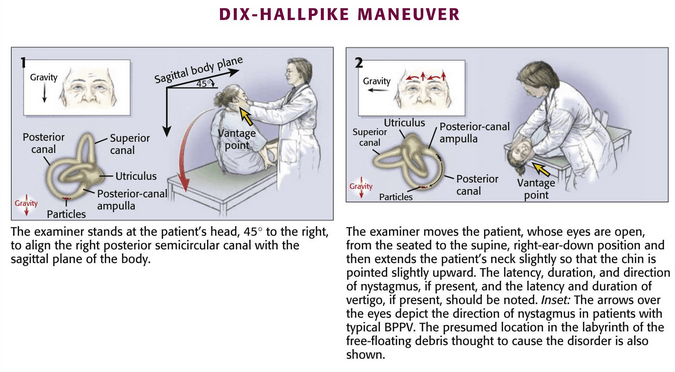
  1. Make the patient sit on examination table, such that the shoulders would level on the edge of table when lying down
  2. Always start the examination with the ear that is least suspected
  3. Turn the patient’s head to 45° towards the test ear, by holding the both sides of the patient’s head with your hands
  4. Instruct the patient to fix his/her eyes on a point directly in front of him/her and keep the eyes open throughout the test
  5. Supports the patient’s head as the patient lies back quickly from a sitting to supine position, ending with the head hanging 30 degrees off the end of the examination table
  6. Observe* the patient in this position for 30 seconds
  7. Then the patient returns to the upright position and is observed* for 30 seconds.
  8. Repeat the entire maneuver with the head turned 45 degrees toward the opposite side.

Observe*

  1. Nystagmus
  2. Vertiginous symptoms

Interpretation:

When the head is turned to the affected right ear, the nystagmus occurs as follows:

1. When the head is lowered 30 degree below the bed, the fast phase of the nystagmus is upward , rotating toward the affected ear
2. When the patient is brought back to the sitting position, the fast phase of the nystagmus is downward , rotating toward the affected ear
69 shares
  • Facebook69
  • Twitter
Clinical Skills and Approaches Clinical examinationInternal medicineOtorhinolaryngology

Post navigation

Previous post
Next post

Related Posts

Clinical Skills and Approaches

C-spine X-ray : Mnemonic Approach

Oct 27, 2020Sep 22, 2022

Mnemonic: ABCDEF For images of the particular Cervical spine (C-spine) X-ray findings and views mentioned below, please refer to the links at the end of the article or use web-search. Adequacy Skull base, C1-C7 and upper T1 must be visible 3 views: True lateral, AP, Odontoid (Open mouth) +/- Swimmer’s…

Read More
Clinical Skills and Approaches

Management of Diabetes – GLUCOSE BAD mnemonic

Jul 25, 2020Jul 25, 2020

Glycemic control HbA1c 3 monthly or Bianually (if treatment goal acheived and glycemic control considered stable) – Target: Non-pregnant adult patients: <7% Minor cardiovascular disease, minor hypoglycemic episodes, short diagnosis time with diabetes, and long life expectancy: <6.5% Significant co-morbidities, progressive micro- and macrovascular complications, or short life expectancy: <8%…

Read More
Clinical Skills and Approaches knee ligament examination

Tests for Knee Ligaments

Oct 29, 2017Sep 3, 2020

Anterior Cruciate Ligament (ACL) Lacchman’s test It is performed with the patient supine and the knee flexed 20–30°. The examiner grasps the distal femur (from lateral side) with one hand and the proximal tibia with the other hand (from medial side). The lower leg is given a brisk forward tug…

Read More

Leave a Reply Cancel reply

Your email address will not be published. Required fields are marked *

This site uses Akismet to reduce spam. Learn how your comment data is processed.

Pre-clinical (Basic Sciences)

Anatomy

Biochemistry

Community medicine (PSM)

Embryology

Microbiology

Pathology

Pharmacology

Physiology

Clinical Sciences

Anesthesia

Dermatology

Emergency medicine

Forensic

Internal medicine

Gynecology & Obstetrics

Oncology

Ophthalmology

Orthopedics

Otorhinolaryngology (ENT)

Pediatrics

Psychiatry

Radiology

Surgery

RSS Ask Epomedicine

  • What to study for Clinical examination in Orthopedics?
  • What is the mechanism of AVNRT?

Epomedicine weekly

  • About Epomedicine
  • Contact Us
  • Author Guidelines
  • Submit Article
  • Editorial Board
  • USMLE
  • MRCS
  • Thesis
©2026 Epomedicine | WordPress Theme by SuperbThemes