Skip to content
Epomedicine

Mnemonics, Simplified Concepts & Thoughts

Epomedicine

Mnemonics, Simplified Concepts & Thoughts

Subacromial Injection

Epomedicine, Feb 11, 2023Feb 11, 2023

Indications: Diagnostic and therapeutic purposes of –

  1. Shoulder impingement
  2. Supraspinatus tendinitis
  3. Subacromial bursitis

Syringe preparation:

  1. Size: 5-10 ml
  2. Needle: 21 G
  3. Steroid: 0.5-1 ml Methylprednisolone (Depomedrol) 40 mg/ml
  4. Local anesthesia: 5-10 ml Lignocaine 1% or Bupivacaine 0.5%
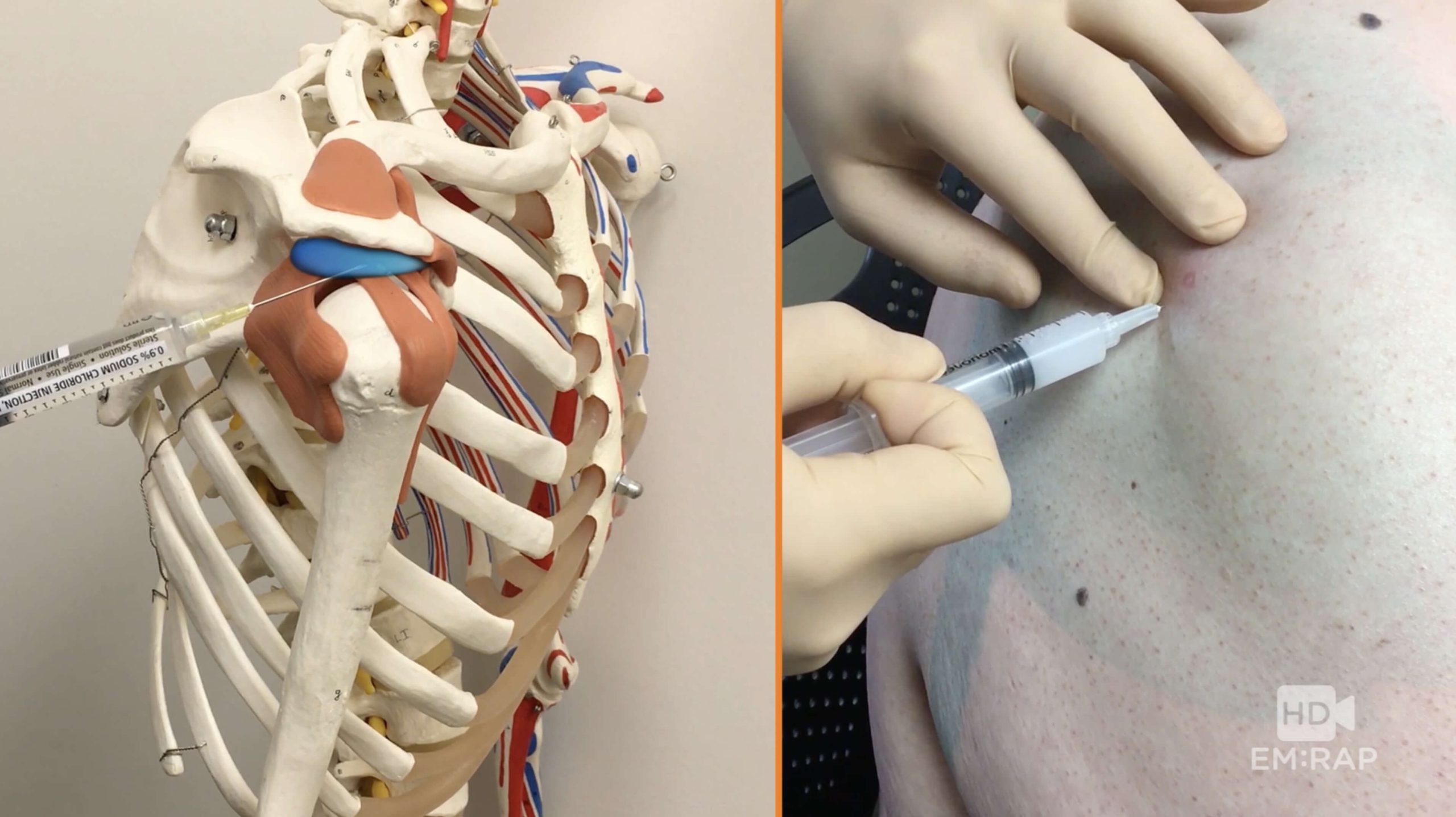
subacromial injection technique

Position:

Comfortably seated with the arm at the side and the hands resting on the lap.

Posterior approach:

  1. Identify posterolateral corner of the acromion.
  2. The needle should be inserted just inferior and lateral to the posterolateral corner of the acromion aiming slightly up and medial, toward the acromioclavicular joint.
  3. The needle should be felt to pass just beneath the acromion, and when placed within the bursa, it should be possible to gently sweep medial and lateral with little resistance.
  4. Aspirate prior to injection
  5. Fluid should flow freely into the bursal space when injecting, if not the needle is withdraw slightly to remove its tip from soft tissue while injecting.

Lateral approach:

  1. Identify and mark inferolateral margin of acronion.
  2. The needle should be inserted 1-1.5 inches below the middle of the acromion aiming slightly upwards. If the humeral head is contacted, withdraw and reinsert in a more superior direction.
  3. Direct the needle perpendicularly until the bone is reached and withdraw the needle 1-2 mm. At approximately 1 inch deep, needle should be in the subacromial bursa. To aim around supraspinatus tendon, position the needle over the anterior edge of the acromion.
  4. As in posterior approach, confirm the position of needle by aspirating and feeling of no resistance while injecting.
  • Facebook
  • Twitter
Clinical Skills and Approaches Musculoskeletal systemOrthopedicsProcedures

Post navigation

Previous post
Next post

Related Posts

Clinical Skills and Approaches eschar

Eschar

Sep 24, 2016

Synonyms Tache noire Definition of Eschar An eschar is a local skin lesions coated by a thick coagulated crust or slough that usually results from burn or infection. Causes of Eschar Tick bite fever Scrub typhus Anthrax Tularaemia Spider bites Disseminated fungal infection Post-burn Diagnostic Clues Cigarette-burn Sign In scrub…

Read More
Clinical Skills and Approaches

Drug Eruptions – When the Solution becomes Problem

Jun 18, 2020Jun 18, 2020

Before we start to develop our understanding of the drug eruptions. Let’s first lay down the foundation by clearing some basic concepts. What is an Allergy? What is meant by an adverse drug reaction? What is the diversity of allergic reactions due to drugs? Allergy This is a hypersensitivity disorder…

Read More
Clinical Skills and Approaches

New Ballard Score: How to use it correctly?

Sep 18, 2019Jan 11, 2022

Assessment of gestational age can be made postnatally by either Dubowitz Score or New Ballard Scoring system. In sick infants, examination of Anterior lens canpsule vascularity with a +20D lens can be useful in assessing gestation and it needs to be carried out within 24 hours of birth. Dr Jeanne…

Read More

Leave a Reply Cancel reply

Your email address will not be published. Required fields are marked *

This site uses Akismet to reduce spam. Learn how your comment data is processed.

Epomedicine. Subacromial Injection [Internet]. Epomedicine; 2023 Feb 11 [cited 2026 Jan 2]. Available from: https://epomedicine.com/clinical-medicine/subacromial-injection/.

Pre-clinical (Basic Sciences)

Anatomy

Biochemistry

Community medicine (PSM)

Embryology

Microbiology

Pathology

Pharmacology

Physiology

Clinical Sciences

Anesthesia

Dermatology

Emergency medicine

Forensic

Internal medicine

Gynecology & Obstetrics

Oncology

Ophthalmology

Orthopedics

Otorhinolaryngology (ENT)

Pediatrics

Psychiatry

Radiology

Surgery

RSS Ask Epomedicine

  • What to study for Clinical examination in Orthopedics?
  • What is the mechanism of AVNRT?

Epomedicine weekly

  • About Epomedicine
  • Contact Us
  • Author Guidelines
  • Submit Article
  • Editorial Board
  • USMLE
  • MRCS
  • Thesis
©2026 Epomedicine . All rights reserved.