Skip to content
Epomedicine

Mnemonics, Simplified Concepts & Thoughts

Epomedicine

Mnemonics, Simplified Concepts & Thoughts

Injection technique for De Quervain’s Tenosynovitis

Epomedicine, Feb 9, 2023Aug 4, 2024

Syringe Preparation:

  1. Size: 1 ml
  2. Needle: 25 G 16 mm
  3. Steroid: 0.5 ml 20 mg triamcinolone or methylprednisolone
  4. Local anesthesia: 0.5 ml 1% lidocaine
  5. Volume: 1 ml

Position:

Comfortably seated with neutral forearm rotation with radial styloid facing upwards – position the wrist in slight ulnar deviation.
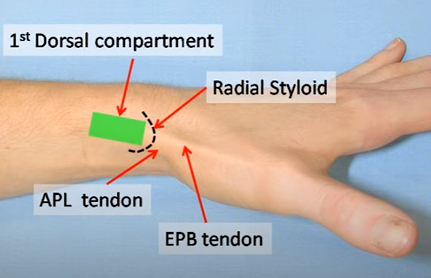
DQ tenosynovitis
Source: WikiMSK (CC BY-SA 4.0)

Technique:

  1. Identify tendons: Thumb extension and abduction makes tendon readily visible
  2. Relax the tendons for injection
  3. Site of injection: Between 5-10mm proximal to the tip of the radial styloid, between the two tendons, through the retinaculum, within the sheath.
  4. Angle: 15-20 degrees
  5. If the needle is withdrawn while injecting very gently, then a point should be reached where fluid between 5-10mm proximal to the tip of the radial styloid, between the two tendons, through the retinaculum, within the sheath flows freely, indicating that the needle tip has left the tendon and is within the sheath.
  • Facebook
  • Twitter
Clinical Skills and Approaches Musculoskeletal systemOrthopedics

Post navigation

Previous post
Next post

Related Posts

Clinical Skills and Approaches Dix hallpike maneuver

Vestibular examination : Dix-Hallpike Maneuver for BPPV

May 26, 2014Aug 27, 2014

Benign Paroxysmal Positional Vertigo (BPPV) is the commonest cause of episodic vertigo and is characterized by acute attacks of transient vertigo initiated by certain head positions, lasting seconds to minutes, accompanied by nystagmus that fatigues on repeated testing. Important terminologies linked with pathogenesis of BPPV: Otoconia: Calcium carbonate crystals released…

Read More
Clinical Skills and Approaches

Schirmer’s test

Jun 26, 2020Jun 26, 2020

Schirmer’s test is a measurement of tear production, devised by the German ophthalmologist Otto W.A. Schirmer. Originally, Schirmer used blotting paper to collect tears elicited by one of the 3 methods of stimulating lacrimation: Inserting the strip of paper itself Irritating the nasal mucosa after the cornea had been anesthetized…

Read More
Clinical Skills and Approaches cheilitis and glossitis

Hematological Signs – Angular Stomatitis and Atrophic Glossitis

Jun 14, 2015

ANGULAR STOMATITIS/CHEILITIS Definition: Maculopapular and vesicular lesions grouped on the skin at the corners (or ‘angles’) of the mouth and the mucocutaneous junction. It is made worse by licking the lips. Causes:  1. Oral candidiasis 2. Poorly fitting dentures 3. Bacterial infection 4. Less common Nutritional deficiencies (especially riboflavin, iron and pyridoxine) Iron…

Read More

Leave a Reply Cancel reply

Your email address will not be published. Required fields are marked *

This site uses Akismet to reduce spam. Learn how your comment data is processed.

Pre-clinical (Basic Sciences)

Anatomy

Biochemistry

Community medicine (PSM)

Embryology

Microbiology

Pathology

Pharmacology

Physiology

Clinical Sciences

Anesthesia

Dermatology

Emergency medicine

Forensic

Internal medicine

Gynecology & Obstetrics

Oncology

Ophthalmology

Orthopedics

Otorhinolaryngology (ENT)

Pediatrics

Psychiatry

Radiology

Surgery

RSS Ask Epomedicine

  • What to study for Clinical examination in Orthopedics?
  • What is the mechanism of AVNRT?

Epomedicine weekly

  • About Epomedicine
  • Contact Us
  • Author Guidelines
  • Submit Article
  • Editorial Board
  • USMLE
  • MRCS
  • Thesis
©2026 Epomedicine | WordPress Theme by SuperbThemes