Skip to content
Epomedicine

Mnemonics, Simplified Concepts & Thoughts

Epomedicine

Mnemonics, Simplified Concepts & Thoughts

nutritional history

Nutritional History Made Easy

Epomedicine, Sep 5, 2015

Energy Requirement

1. For a child with normal body weight:

  • 100 Kcal/kg for 1st 10 kg
  • Add 50 Kcal/kg for next 10 kg
  • Add 20 Kcal/kg for body weight additional to 20 kgs

2. By age:

  • For ≤ 1 year: 100 Kcal/kg/day
  • Every additional years till puberty: Add 100 Kcal/year

Adequacy of feeding:

1. Breastfeeding:

  • Child gaining weight
  • Sleeps adequately between feeds with minimum interval of 2-3 hours between feeds
  • Passes urine 6-8 times per day

2. Complementary feeds:

  • 6-12 months: 3 times per day if breast-fed and 5 times per day if not breastfed
  • 12 months-2 years: 5 times per day
  • >2 years: Family food as 3 meals/day and 2 times.day nutritious snacks between meals

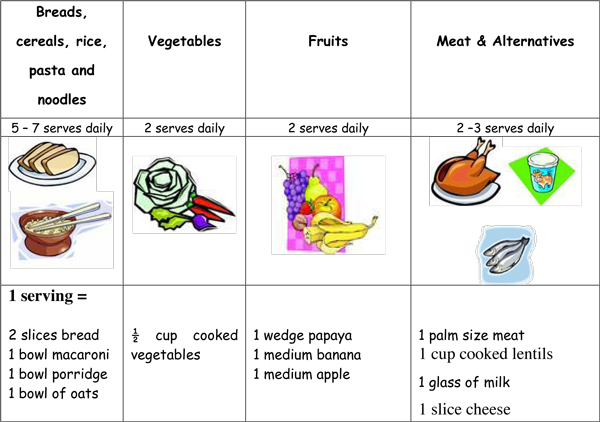
Calories provided by common foods:

Following servings of each food provides approximately 100 Kcal:

  Amount Cooked measure
Cereals 30 gm 1 katori or 2 chapatis
Pulses 30 gm 1 katori
Vegetables    
Leafy 200 gm 1.5 katori
Roots 100 gm ¾ katori
Others 300 gm 2 katori
Nuts 15 gm  
Fruits (Pulpy fruits) 125 gm 1 medium size (raw)
Cow’s milk 150 ml ¾-1 cup
Egg 1 ¼ 1 ¼
Meat 80 gm 2 big pieces
Sugar 25 gm 5 tsp
Butter 15 gm 3 tsp
Oil 10 gm 2 tsp
Sago seeds (Sabudana) 30 gm 1 medium katori (cooked)

Assessment of Nutrition:

nutritional history

The 24-hour recall is the most commonly used method of obtaining information about a child’s intake and is useful as a screening tool. Parents/caregivers are asked to describe the types and amounts of food eaten by the child in the previous 24 hour period. This may not represent a typical day’s intake, and thus, the recall may not accurately describe a child’s nutrient intake.

  • Facebook
  • Twitter
Clinical Skills and Approaches Pediatrics

Post navigation

Previous post
Next post

Related Posts

Clinical Skills and Approaches fever patterns

Fever : Definition, Mechanism and Types

Nov 9, 2017

Definition of Fever Studies have found that the maximum normal oral temperature is 37.2ºC (98.9ºF) at 6 A.M. and 37.7ºC (99.9ºF) at 4 P.M.; these values define the 99th percentile for healthy individuals. Hence, an A.M. temperature of >37.2ºC (>98.9ºF ) or a P.M. temperature of >37.7ºC (>99.9ºF) would define…

Read More
Clinical Skills and Approaches

Ten Diagnostic Dilemmas in Neonatal Meningitis

Jun 28, 2020Jun 28, 2020

Incidence the global incidence of neonatal sepsis at 5–6 per 1000 live births and that of meningitis at 0.7–1 (2.4–16 in South and South-East Asia, 6–21 in sub-Saharan Africa, and 1.8–12 in the Middle East and North Africa) Causative Agents : Group B streptococci  Escherichia coli  Klebsiella pneumoniae  Streptococcus pneumoniae …

Read More
Clinical Skills and Approaches

Constructing Differential Diagnoses : Mnemonic

Aug 20, 2020Feb 27, 2021

Think of VITAMINS ABCDEK V: Vascular (bleed or blocked), or anything related to hematology I: Infective or Post-infective T: Trauma or mechanical factors such as obstructions or pressure. A: Autoimmune-related or Allergy M: Metabolic I: Idiopathic or Iatrogenic N: Neoplasia S: Social reasons – child abuse and social deprivation A:…

Read More

Leave a Reply Cancel reply

Your email address will not be published. Required fields are marked *

This site uses Akismet to reduce spam. Learn how your comment data is processed.

Epomedicine. Nutritional History Made Easy [Internet]. Epomedicine; 2015 Sep 5 [cited 2026 Jan 22]. Available from: https://epomedicine.com/clinical-medicine/nutritional-history-made-easy/.

Pre-clinical (Basic Sciences)

Anatomy

Biochemistry

Community medicine (PSM)

Embryology

Microbiology

Pathology

Pharmacology

Physiology

Clinical Sciences

Anesthesia

Dermatology

Emergency medicine

Forensic

Internal medicine

Gynecology & Obstetrics

Oncology

Ophthalmology

Orthopedics

Otorhinolaryngology (ENT)

Pediatrics

Psychiatry

Radiology

Surgery

RSS Ask Epomedicine

  • What to study for Clinical examination in Orthopedics?
  • What is the mechanism of AVNRT?

Epomedicine weekly

  • About Epomedicine
  • Contact Us
  • Author Guidelines
  • Submit Article
  • Editorial Board
  • USMLE
  • MRCS
  • Thesis
©2026 Epomedicine . All rights reserved.