Definition of Fever
Studies have found that the maximum normal oral temperature is 37.2ºC (98.9ºF) at 6 A.M. and 37.7ºC (99.9ºF) at 4 P.M.; these values define the 99th percentile for healthy individuals. Hence, an A.M. temperature of >37.2ºC (>98.9ºF ) or a P.M. temperature of >37.7ºC (>99.9ºF) would define a fever. The normal daily temperature variation is typically 0.5ºC (0.9ºF).
In women who menstruate, the A.M. temperature is generally lower in the 2 weeks before ovulation; it then rises by about 0.6ºC ( 1ºF) with ovulation and remains at that level until menses occur.
Fever is an elevation of body temperature that exceeds the normal daily variation and occurs in conjunction with an increase in the hypothalamic set point. When the hypothalamic setpoint is raised, the body is perceived to be cooler than the new set point. Shivering is initiated to generate heat. Blood is shunted from the periphery to the core to conserve heat and sweating is diminished. The generated heat will raise the body temperature to match the elevated set point. When the hypothalamic set point is lowered, either as part of the normal diurnal fluctuations that occur during an infection or in response to antipyretic agents, heat is lost by evaporation (sweating) and radiation (cutaneous vasodilation).
A fever of >41.5ºC (>106.7ºF) is called hyperpyrexia. This extraordinarily high fever can develop in patients with severe infections but most commonly occurs in patients with central nervous system (CNS) hemorrhages.
The conversion formula is:
- TºF = 9/5 (TºC) + 32
- TºC = 5/9 (TºF) – 32
For axillary, oral and rectal temperature, there is an approximately 0.8ºF or 0.4ºC difference between each site and the next higher one. For convenience, it is rounded up to 1ºF or 0.5ºC.
Mechanism of Fever
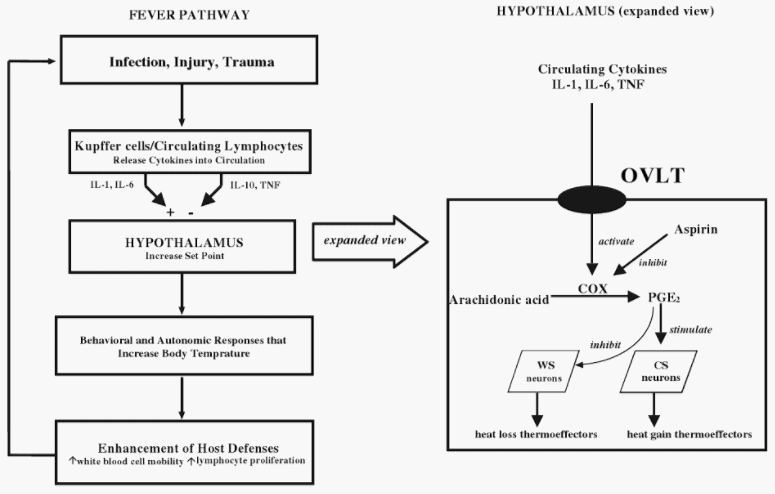
Types of Fever
A) Based on Duration of Fever:
- Acute fevers (<7 days): infectious diseases such as malaria and viral-related upper respiratory tract infection
- Sub-acute fevers (usually not more than 2 weeks in duration): typhoid fever and intra-abdominal abscess
- Chronic or persistent fevers (>2 weeks duration): chronic bacterial infections such as tuberculosis, viral infections like HIV, cancers and connective tissue diseases. However, any cause of acute fever can become persistent or chronic if untreated.
B) Based on Height of Fever:
Normal and febrile body temperature ranges (rectal temperatures).
| Body temperature | °C | °F |
|---|---|---|
| Normal | 37–38 | 98.6–100.4 |
| Mild/low grade fever | 38.1–39 | 100.5–102.2 |
| Moderate grade fever | 39.1–40 | 102.2–104.0 |
| High grade fever | 40.1–41.1 | 104.1–106.0 |
| Hyperpyrexiaa | >41.1 | >106.0 |
- a: Hyperpyrexia in severe malaria is defined as rectal temperature above 40 °C. C, centigrade; F, Fahrenheit.
C) Based on Pattern of Fever:
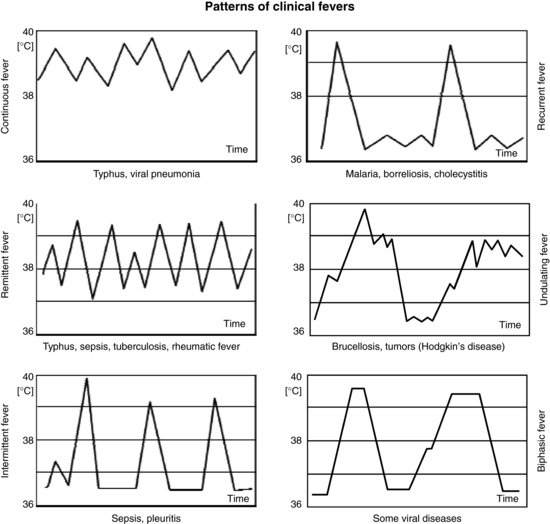
1. Sustained or Continuous Fever: Fever that oscillates less than 1 ºC or ~1.5 ºF daily; doesn’t touch normal
- Typhoid fever
- Drug fever
- Typhus
- Neoplasms
2. Remittent Fever: Fever that oscillates more than 1 ºC or ~1.5 ºF ; doesn’t touch normal
- Pattern of most fevers
3. Intermittent Fever: Fever that falls to normal each day.
- Quotidian (24 hour periodicity): P. falciparum
- Double quotidian (12 hour periodicity): Kala-azar, Gonococcal arthritis, Juvenile RA, Some drug fevers (carbamazepine)
4. Hectic or Septic Fever: When remittent or intermittent fever shows large variation between the peak and nadir
- Kawasaki disease
- Pyogenic infections
5. Periodic or Cyclic Fever: Episodes of fever recurring at regular intervals
- Tertian (48 hour periodicity): P. vivax, P. ovale
- Quartan (72 hour periodicity): P. malariae
- Pel-Ebstein Fever: bouts of fever lasting 3 to 10 days followed by asymptomatic periods of the same length (Hodgkin’s disease)
- Relpasing fever (every 10-14 days): Borrelia recurrentis
- Undulant fever (gradual increase in temperature that remains high for a few days, and then gradually decreases to normal): Brucellosis
6. Recurrent Fever: Illness involving the same organ (e.g. urinary tract) or multiple organ systems in which fever recurs at irregular interval
- Familial Mediterranean Fever
Defervescence
In differentiating malaria from typhoid fever, effective anti-malarial therapy leads to fever defervescence by crisis (within hours) whereas in typhoid fevers resolution occurs by lysis (gradually over days) following effective antibiotics.
It has been suggested that fevers due to cancers can be distinguished from those due infectious diseases using the Naprosyn test. When Naprosyn (Naproxen 375 mg twice daily), or other NSAIDS, is given for 3 days, fevers due to cancers display a rapid and sustained decline while little or no change is observed in fevers due to infectious diseases. However, Naprosyn test is unhelpful in differentiating neoplastic from noninfectious disorders such as connective tissue diseases.
Excellent.