Skip to content
Epomedicine

Mnemonics, Simplified Concepts & Thoughts

Epomedicine

Mnemonics, Simplified Concepts & Thoughts

Common mistakes in Per Abdominal examination

Dr. Pedchrome, Jul 31, 2020Jul 31, 2020

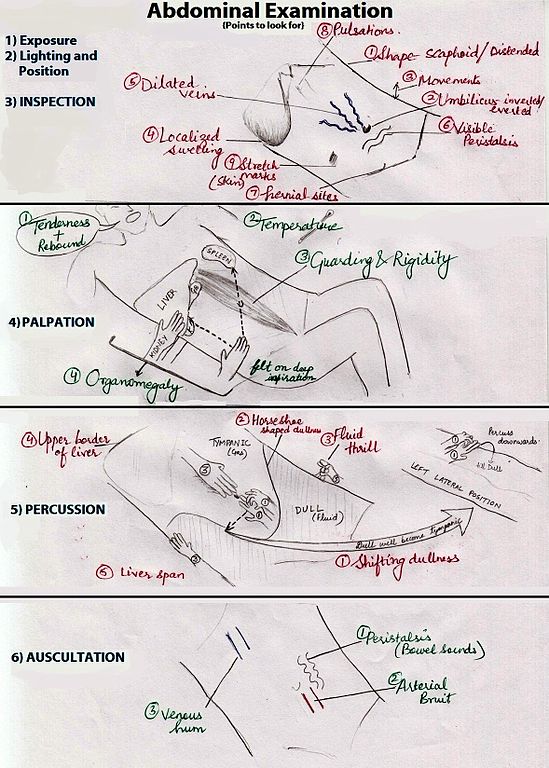
1. Forgetting to Expose abdomen adequately:

Before examination, patient should ideally be exposed from the nipples to mid thigh. Failure to do so may lead to missed findings during examination e.g. Hernia

Abdominal examination
Armanjain011 / CC BY-SA

2. Abdominal symmetry and movement:

Abdominal symmetry and movement should be examined tangentially and from leg end. Comment should be made on movement of all quadrants with respiration.

3. Forgetting to relax abdomen before palpation:

Flex the legs at knees and arms should be by side of body. Head should be rested on a pillow. Only after abdomen is in the relaxed position, palpation should be proceeded.

4. Missing points on palpation:

a. Remember to ask for pain in any site before palpating. The part with pain should be skipped and palpated at the end.

b. Look for rigidity and guarding besides tenderness.

c. Tenderness should be assessed by looking at facial expression +/- guarding

d. Remember to palpate urinary bladder.

e. Hernial orifices should be palpated and is commonly missed point.

f. Make the patient sit and check for renal angle fullness and tenderness.

5. Remember: Shifting dullness is done in percussion and fluid thrill is done in palpation, in a patient with abdominal distension.

6. Auscultation: 

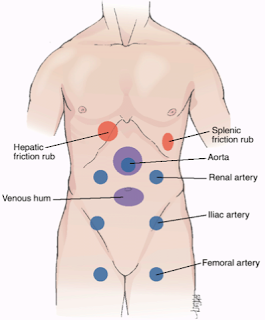
Look for Renal bruit, Hepatic bruit. etc. in indicated cases. Bowel sound should be listened to. When bowel sounds are not present, one should listen for a full 3 minutes before determining that bowel sounds are, in fact, absent.

Recommended reading
https://meded.ucsd.edu/clinicalmed/abdomen.htm
http://www.ncbi.nlm.nih.gov/books/NBK420/

Pediatric doctor
Dr. Pedchrome

MD Pediatrics and Fellowship Neonatology, he chooses to stay anonymous. He often writes his views online as well as share few important topics for medical students, doctors and specially parents. He does research in pediatrics.
  • Facebook
  • Twitter
Clinical Skills and Approaches Clinical examinationGastrointestinal systemGeneral SurgeryInternal medicinePediatrics

Post navigation

Previous post
Next post

Related Posts

Clinical Skills and Approaches lhermittes sign

Lhermitte’s Sign

Jul 11, 2016Jul 11, 2016

Synonym: Lhermitte’s phenomenon, Barber chair phenomenon Definition of Lhermitte’s Sign Lhermitte’s sign (pronounced Ler-meets) is an electric shock-like sensations, spreading along the spine in a cervico-caudal direction and into the arms and legs felt upon active or passive flexion of the neck. Reverse Lhermitte’s Sign is defined when symptoms are…

Read More
Clinical Skills and Approaches Pitting-edema-demonstration

Edema – Physical Examination

Dec 6, 2013May 27, 2019

Synonyms: Oedema, Swelling Definition of Edema Accumulation of excessive amount of fluid in the extravascular interstitial space of the body. Interstitial space is the extravascular compartment of the extracellular fluid and surrounds the cells of a given tissue. Anasarca is a severe and generalized edema with profound subcutaneous tissue swelling. Further…

Read More
Clinical Skills and Approaches stethoscope murmur

Murmurs Made Easy

Jun 5, 2019May 20, 2023

Mnemonic: SSSS Stenotic lesion of Semilunar valve and Septal defect cause Systolic murmur. From this, you should also be able to remember that regurgitant lesions of semilunar valve causes Diastolic murmur. The stenotic lesions of atrio-ventricular valve causes diastolic murmur and regurgitant lesions cause systolic murmur. Causes of systolic murmur:…

Read More

Comment

  1. Pallavi Rana says:
    Jan 26, 2021 at 9:08 pm

    But steps are in wrong order

    Reply

Leave a Reply to Pallavi Rana Cancel reply

Your email address will not be published. Required fields are marked *

This site uses Akismet to reduce spam. Learn how your comment data is processed.

Pre-clinical (Basic Sciences)

Anatomy

Biochemistry

Community medicine (PSM)

Embryology

Microbiology

Pathology

Pharmacology

Physiology

Clinical Sciences

Anesthesia

Dermatology

Emergency medicine

Forensic

Internal medicine

Gynecology & Obstetrics

Oncology

Ophthalmology

Orthopedics

Otorhinolaryngology (ENT)

Pediatrics

Psychiatry

Radiology

Surgery

RSS Ask Epomedicine

  • What to study for Clinical examination in Orthopedics?
  • What is the mechanism of AVNRT?

Epomedicine weekly

  • About Epomedicine
  • Contact Us
  • Author Guidelines
  • Submit Article
  • Editorial Board
  • USMLE
  • MRCS
  • Thesis
©2026 Epomedicine | WordPress Theme by SuperbThemes