Skip to content
Epomedicine

Mnemonics, Simplified Concepts & Thoughts

Epomedicine

Mnemonics, Simplified Concepts & Thoughts

Bryant's triangle

Bryant’s triangle (Examination of Hip)

Epomedicine, Jun 4, 2014Sep 5, 2022

Synonyms: Iliofemoral triangle

Position: The patient lies supine with the pelvis square, and the limbs in identical position.

Points of the Bryant’s triangle:

The Bryant’s triangle is a right angled formed by:

  1. Anterior Superior Iliac Spine (ASIS)
  2. Tip of Greater trochanter
  3. Junction of perpendiculars from the 2 points above (1st draw a perpendicular from ASIS to bed and another perpendicular from greater trochanter to meet the 1st perpendicular)

Use: Quantitative measurement of supra-trochanteric shortening of hip
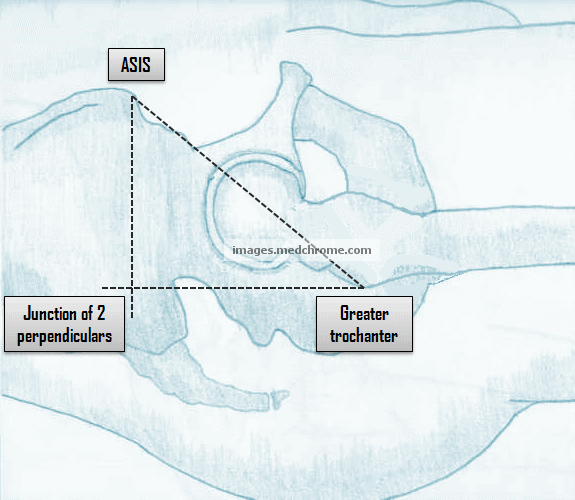
Bryant's triangle
From images.medchrome.com

Examination:
The triangle should be marked on both the sides and each side of the triangle is compared with its counterpart on the normal side. The distance between the tip of greater trochanter and the junction of 2 perpendiculars i.e. base of the triangle measures supra-trochanteric shortening. This may occur due to shortening in neck or head of femur, hip joint or dislocation of joint:

  1. Dislocation of hip
  2. Central fracture – dislocation of hip
  3. Destruction of head or acetabulum or both
  4. Fracture of the neck of femur
  5. Coxa-vara deformity of the hip
  6. Malunited intra-trochanteric fracture

Bryant’s triangle is on no value in:

Mnemonic: ABC

  1. ASIS absent
  2. Bilateral disease
  3. Chopped hip (hip disarticulated)

Reversed Bryant’s triangle:

When the proximal migration of the tip of greater trochanter is beyond the ASIS, then reversed Bryant’s triangle is drawn. Total supratrochanteric shortening will be the summation of base of triangle on normal side and the base of triangle in abnormal side.

14 shares
  • Facebook14
  • Twitter
Clinical Skills and Approaches Clinical examinationOrthopedics

Post navigation

Previous post
Next post

Related Posts

Clinical Skills and Approaches

Ely’s test

Jan 17, 2022Jan 17, 2022

Rectus femoris is the only Quadriceps muscle that cross the hip joint and act as a hip flexor and knee extensor. When the rectus femoris is shortened/tightened, it tends to pull the pelvis forward into anterior pelvic tilt and also forces the knee into hyperextension. Ely’s test: Patient is positioned…

Read More
Clinical Skills and Approaches chop diabetic ketosis pathway

Diabetic Ketosis without Acidosis

Oct 31, 2017Dec 19, 2017

Ketosis and Ketonuria Ketosis and Ketonuria may occur whenever increased amounts of fat are metabolized, carbohydrate intake is restricted, or the diet rich in fats (either “hidden” or obvious). This state can occur in the following situations: a. Metabolic conditions: Diabetes mellitus Renal glycosuria Glycogen storage disease (von Gierke’s disease)…

Read More
Clinical Skills and Approaches BPH symptoms

Mnemonic based approach to grading and planning treatment for BPH

Feb 26, 2016Jun 18, 2016

MNEMONIC: FUNWISE During the last 1 month, how often/many times you had to – 1. Frequency: Urinate again <2 hours after you finished urinating ? 2. Urgency: Difficulty in postponing the urine ? 3. Nocturia: Get up to urinate from bedtime to wakeup ? 4. Weak stream: Weak urinary stream…

Read More

Leave a Reply Cancel reply

Your email address will not be published. Required fields are marked *

This site uses Akismet to reduce spam. Learn how your comment data is processed.

Pre-clinical (Basic Sciences)

Anatomy

Biochemistry

Community medicine (PSM)

Embryology

Microbiology

Pathology

Pharmacology

Physiology

Clinical Sciences

Anesthesia

Dermatology

Emergency medicine

Forensic

Internal medicine

Gynecology & Obstetrics

Oncology

Ophthalmology

Orthopedics

Otorhinolaryngology (ENT)

Pediatrics

Psychiatry

Radiology

Surgery

RSS Ask Epomedicine

  • What to study for Clinical examination in Orthopedics?
  • What is the mechanism of AVNRT?

Epomedicine weekly

  • About Epomedicine
  • Contact Us
  • Author Guidelines
  • Submit Article
  • Editorial Board
  • USMLE
  • MRCS
  • Thesis
©2026 Epomedicine | WordPress Theme by SuperbThemes