Skip to content
Epomedicine

Mnemonics, Simplified Concepts & Thoughts

Epomedicine

Mnemonics, Simplified Concepts & Thoughts

ABG Sampling (Radial Artery)

Epomedicine, May 22, 2024May 22, 2024

Start with WIPERS

WIPERS mnemonic for starting patient examination

Then ABG

1. Allen’s test (modified):

  • Exsanguination: Ask the patient to make tight fist for about 30 seconds
  • Occlusion: Occlude the radial and ulnar artery simultaneously with fingers
  • Release:
    • Fist: Hand must stay blanched, else occlusion pressure is not enough (restart the test)
    • Ulnar artery:
      • Reperfusion within 5-15 seconds: Negative Allen’s test (Good blood flow)
      • No reperfusion within 5-15 seconds: Positive Allen’s test (Circulation of ulna artery is not sufficient)

In case of Positive Allen’s test: DO NOT puncture radial artery

2. Bad things:

  • Allergy to LA
  • Absolute contraindications: Cellulitis, Peripheral vascular disease, Arteriovenous fistula, For local anesthesia (Allergy to LA)
  • Relative contraindications: Coagulopathy (including Anticoagulant use)

3. Gather equipment needed

Then Procedure
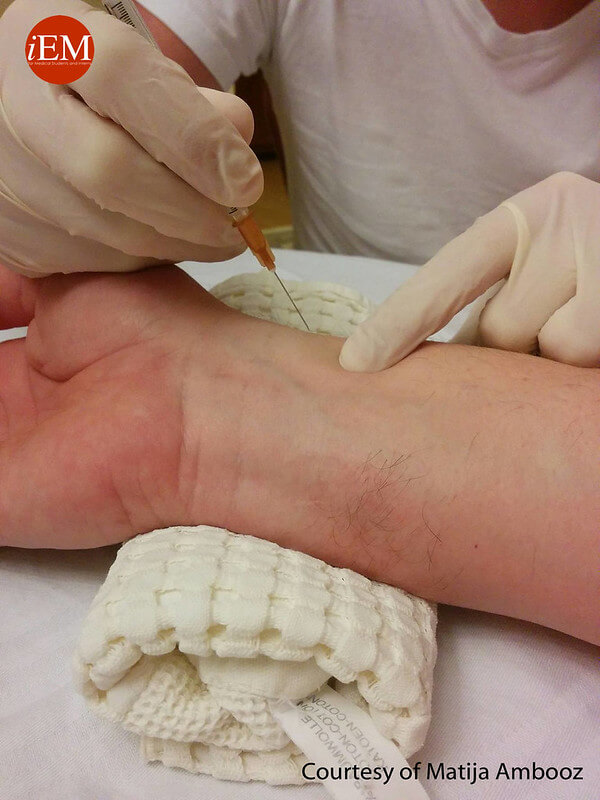
ABG sampling radial artery
“622.4 – Figure 4 – ABG sampling position – radial artery” by iem-student.org is licensed under CC BY-NC-SA 2.0.

1. Position:

  • Position the patient so that they are sitting or lying down comfortably, ideally with their wrist supported by a pillow.
  • Extend the wrist fully

2. Site preparation:

  • Don the non-sterile gloves
  • Identify site: Palpate the radial artery just proximal to the point of maximum pulsation with non-dominant hand
  • Sterilize the skin with an alcohol wipe and allow it to dry and do not re-palpate

3. Local anesthesia (skin): Offer the patient local anesthesia –

  • 25 G needle (orange) and 2 ml syringe
  • 1% lignocaine

4. ABG sampling:

  • Use 23 G needle (blue) and 2 ml syringe (heparinized with 0.1 ml 1:1000 heparin)
  • Hold the syringe like a pen with a dominant hand
  • Insert the needle at 45-60 degrees with the bevel facing upwards while palpating the artery with other hand
  • Advance the needle slowly until a flash of blood is seen in the needle hub
  • Collect 1-2 ml of arterial blood (bright red and fills quickly in pulsatile fashion)

5. Post sampling:

  • Discard the needle safely
  • Elevate the arm and apply firm pressure to puncture site for 5 minutes
  • Expel any air bubbles from syringe and seal it with a cap
  • Label the syringe (Patient details, FiO2, Body temperature)
  • Roll the syringe in the palms of your hands for 10 seconds (to ensure heparin mixing)
  • Send the sample within 15 minutes of collection for analysis
  • Facebook
  • Twitter
Clinical Skills and Approaches ProceduresRespiratory system

Post navigation

Previous post
Next post

Related Posts

Clinical Skills and Approaches renal angle tenderness

Costovertebral or Renal angle tenderness

Jul 26, 2019Jul 26, 2019

Synonyms: Murphy’s kidney punch, CVA tenderness (CVAT) Anatomy of Costovertebral angle or Renal angle: Costovertebral angle is formed by the junction of the 12th, or lowermost, rib with the paravertebral muscles, which run parallel to and on both sides of the vertebral column. Eliciting costovertebral angle tenderness: Position of patient:…

Read More
Clinical Skills and Approaches patellar clonus

Clonus : Clinical Examination and Mechanism

Jan 20, 2016Dec 7, 2022

Definition of clonus Clonus is a rhythmic sustained involuntary muscular contraction (generally 5-8 Hz) evoked by sudden passive stretch of the muscle and tendon. Eliciting Clonus Clonus is commonly elicited in gastrocnemius (ankle clonus). Other sites where clonus can be elicited are quadriceps (patellar clonus), finger flexors and jaw. 1….

Read More
Clinical Skills and Approaches relative bradycardia enteric fever

Relative Bradycardia

Nov 1, 2017

Synonyms: Faget sign, Sphygmo-thermic dissociation, Sphygmo-thermal dissociation Definition of Relative Bradycardia Physiologically, for each 1 °F rise in body temperature, there is a commensurate increase in the heart rate of 10 beats/min . When temperature elevations are not accompanied by a physiologic increase in the pulse, the patient is said…

Read More

Leave a Reply Cancel reply

Your email address will not be published. Required fields are marked *

This site uses Akismet to reduce spam. Learn how your comment data is processed.

Pre-clinical (Basic Sciences)

Anatomy

Biochemistry

Community medicine (PSM)

Embryology

Microbiology

Pathology

Pharmacology

Physiology

Clinical Sciences

Anesthesia

Dermatology

Emergency medicine

Forensic

Internal medicine

Gynecology & Obstetrics

Oncology

Ophthalmology

Orthopedics

Otorhinolaryngology (ENT)

Pediatrics

Psychiatry

Radiology

Surgery

RSS Ask Epomedicine

  • What to study for Clinical examination in Orthopedics?
  • What is the mechanism of AVNRT?

Epomedicine weekly

  • About Epomedicine
  • Contact Us
  • Author Guidelines
  • Submit Article
  • Editorial Board
  • USMLE
  • MRCS
  • Thesis
©2026 Epomedicine | WordPress Theme by SuperbThemes