Skip to content
Epomedicine

Mnemonics, Simplified Concepts & Thoughts

Epomedicine

Mnemonics, Simplified Concepts & Thoughts

Clinical Criteria for Diagnosis of Enteric Fever

Dr. Sulabh Kumar Shrestha, MS Orthopedics, Aug 5, 2019May 31, 2020

In the Absence of Microbiological Confirmation, these case defintions and criteria may be helpful.

Case definitions of Typhoid Fever

a. Confirmed enteric fever:

  • A patient with persistent fever (38 °C or more) lasting 3 or more days, with laboratory-confirmed S. typhi organisms (blood, bone marrow, bowel fluid)
  • A clinical compatible case that is laboratory confirmed

b. Probable enteric fever:

  • A patient with persistent fever (38 °C or more) lasting 3 or more days, with a positive sero-diagnosis or antigen detection test but no S. typhi isolation
  • A clinical compatible case that is epidemiologically linked to a confirmed case in an outbreak

c. Chronic carrier: An individual excreting S. typhi in the stool or urine for longer than one year after the onset of acute typhoid fever. 1 Background document: The diagnosis, treatment and prevention of typhoid fever. Communicable Disease Surveillance and Response Vaccines and Biologicals. World Health Organization [Internet] [cited 2019 August 5]. Available from: http://www.who. int/rpc/TFGuideWHO.pdf

Combined Clinical and Lab Findings in Enteric Fever
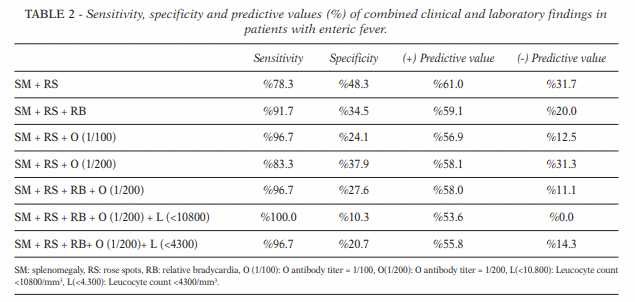
Enteric fever clinical and lab

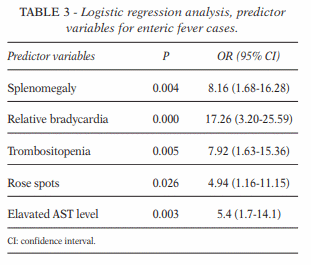
Independent predictors

enteric fever independent predictors

In this study, splenomegaly, rose spots, relative bradycardia and thrombocytopenia and elevated AST level were found to have a predictive value for enteric fever. Therefore, the diagnosis of enteric fever can be made prior to microbiological test results when these findings are present in the first 24 hours of hospitalization. In addition, splenomegaly, rose spots, relative bradycardia, a titer of O antibody 1/200, normal leukocyte count (<10800/mm3) or leucopenia (<4300/mm3) in patient with fever have a high sensitivity in the diagnosis of enteric fever. 2Kuvandik C, Karaoglan I, Namiduru M, Baydar I. Predictive value of clinical and laboratory findings in the diagnosis of the enteric fever. New Microbiol. 2009 Jan;32(1):25-30. PubMed PMID: 19382666.

Clinical criteria studied by Neopane et.al.

Requirement: 3 Major Criteria + 3 or more Minor Criteria

The study revealed that the sensitivity of criterion though only 72.2%, the specificity is 98.3% (CI: 89.8-99.9) which is very high. The results showed positive likelihood ratio of > 10 and negative likelihood ratio less than 0.4. 3Neopane A, Panta S. Validation of the proposed clinical diagnostic criteria of enteric fever. Kathmandu Univ Med J (KUMJ). 2012 Oct-Dec;10(40):8-11. PubMed PMID: 23575044.

Major Criteria:

  1. Fever
  2. Headache
  3. Relative bradycardia

Minor Criteria:

  1. Pain abdomen
  2. Splenomegaly
  3. Diarrhea
  4. Chills
  5. Vomiting
dr. sulabh kumar shrestha
Dr. Sulabh Kumar Shrestha, MS Orthopedics

He is the section editor of Orthopedics in Epomedicine. He searches for and share simpler ways to make complicated medical topics simple. He also loves writing poetry, listening and playing music. He is currently pursuing Fellowship in Hip, Pelvi-acetabulum and Arthroplasty at B&B Hospital.
  • Facebook
  • Twitter
PGMEE, MRCS, USMLE, MBBS, MD/MS Gastrointestinal systemInfectious diseaseInternal medicinePediatrics

Post navigation

Previous post
Next post

Related Posts

PGMEE, MRCS, USMLE, MBBS, MD/MS

Axillary Artery Mnemonics

Oct 16, 2017Oct 26, 2022

Origin of Axillary Artery: Continuation of Subclavian artery Extent of Axillary Artery: Outer border of 1st rib to Lower border of teres major (terminates as brachial artery) Relation to Axillary Vein: Lateral to Axillary Vein 3 Parts of Axillary Artery: In relation to Pectoralis Minor muscle 1st part: Proximal 2nd…

Read More
PGMEE, MRCS, USMLE, MBBS, MD/MS

Working formulation of NHL (Mnemonic)

Jan 16, 2019Feb 26, 2019

All follicular except large cell: Low grade All diffuse: Intermediate grade Blastic and non-cleaved: High grade

Read More
PGMEE, MRCS, USMLE, MBBS, MD/MS

Linea Aspera

Oct 26, 2022May 14, 2024

Linea aspera is a ridge of roughened surface on the posterior surface of the shaft of femur which serves as a site for attachment of muscles and intermuscular septum. The various structures attached to linea aspera can be remembered using few mnemonics: Mnemonic 1#: 1, 2, 3 It gives attachment…

Read More

Leave a Reply Cancel reply

Your email address will not be published. Required fields are marked *

This site uses Akismet to reduce spam. Learn how your comment data is processed.

Pre-clinical (Basic Sciences)

Anatomy

Biochemistry

Community medicine (PSM)

Embryology

Microbiology

Pathology

Pharmacology

Physiology

Clinical Sciences

Anesthesia

Dermatology

Emergency medicine

Forensic

Internal medicine

Gynecology & Obstetrics

Oncology

Ophthalmology

Orthopedics

Otorhinolaryngology (ENT)

Pediatrics

Psychiatry

Radiology

Surgery

RSS Ask Epomedicine

  • What to study for Clinical examination in Orthopedics?
  • What is the mechanism of AVNRT?

Epomedicine weekly

  • About Epomedicine
  • Contact Us
  • Author Guidelines
  • Submit Article
  • Editorial Board
  • USMLE
  • MRCS
  • Thesis
©2026 Epomedicine | WordPress Theme by SuperbThemes