Skip to content
Epomedicine

Mnemonics, Simplified Concepts & Thoughts

Epomedicine

Mnemonics, Simplified Concepts & Thoughts

A Classical case of Congenital Diaphragmatic Hernia

Dr. Pedchrome, Jun 1, 2020Jun 1, 2020

A Single/ Term Male Baby weighing 3.0 kg was delivered via emergency LSCS for fetal distress who was prenatally diagnosed to have congenital diaphragmatic hernia in utero. He was born with Apgar score 4/10, 6/10, was immediately intubated and transferred to NICU. After stabilization, he was kept under the ventilator and planned for surgery by the Pediatric surgery team.

Chest Xray – showed bilateral severe pulmonary hypoplasia with intestinal content in the left chest with displacement of the mediastinum to the right.
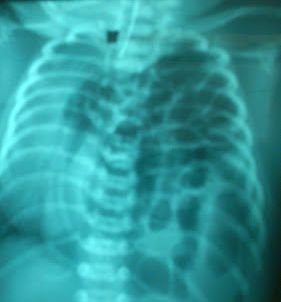
Congenital diaphragmatic hernia

Almost entire bowel loops were in the chest.


Initial Stabilization until intubation can be done with:

1. Oxygen by blow-by and insert 10 F Orogastric tube. Remove air manually by aspiration.

2. Attach the OG tube to an intermittent suction device set at 40 mmHg pressure or do frequent manual aspirations.

3. Get a Chest Xray and be sure gastric tube is in place. Locate the stomach.

4. Make sure of adequate oxygenation to prevent PPHN.

5. Evlauate for PPHN with preductal and post ductal saturation measurements.

6. Maintain adequate hydration and if needed – Inotropic support.

7. Watch closely for Pneumothorax.

8. Keep the infant calm with analgesia.

In such scenario:

1. Bag and Mask Ventilation is contraindicated as it inflates the gut, further compromising the lung functions.

2. Intubation and Bagging should be done and NG tube should be inserted. Intuabtion is preferred with a cuffed ET tube.

Pediatric doctor
Dr. Pedchrome

MD Pediatrics and Fellowship Neonatology, he chooses to stay anonymous. He often writes his views online as well as share few important topics for medical students, doctors and specially parents. He does research in pediatrics.
  • Facebook
  • Twitter
Case Reports PediatricsRespiratory system

Post navigation

Previous post
Next post

Related Posts

Case Reports

A Child with Fever, Diarrhea, AKI, Hematuria, Altered senosrium and Anemia

Jun 7, 2020Jun 7, 2020

Case Scenario A 3 year boy form Western region presented at Emergency Room in a state of altered sensorium. The child was well 5 days back, but since then he is been having fever and loose stool. The episode of illness started with fever, measured upto 102 F, was on…

Read More
Case Reports adh release

Craniopharyngioma – Case Discussion

Jan 20, 2016Jun 12, 2016

Case Summary A 38 year old female came with: Headache for 6 months Diminution of peripheral vision bilatetrally Irregular menstrual cycle for the last 1 year Now, polydypsia and excessive urination Her prolactin level was 115.6 ng/ml (increased), FSH was 1.3 mIU/ml (decreased) and LH was 0.242 mIU/ml (decreased). CT…

Read More
Case Reports

Nine Interesting cases in Neonates

Dec 5, 2022Dec 5, 2022

1. Sepsis presenting with Diabetic ketoacidosis like feature in Preterm neonate A thriving preterm neonate had new onset sepsis with off color skin and poor feed tolerance. A workup for sepsis was sent and antibiotics were upgraded to 2nd line agents. Inotrope was added for tachycardia with poor perfusion. By…

Read More

Leave a Reply Cancel reply

Your email address will not be published. Required fields are marked *

This site uses Akismet to reduce spam. Learn how your comment data is processed.

Pre-clinical (Basic Sciences)

Anatomy

Biochemistry

Community medicine (PSM)

Embryology

Microbiology

Pathology

Pharmacology

Physiology

Clinical Sciences

Anesthesia

Dermatology

Emergency medicine

Forensic

Internal medicine

Gynecology & Obstetrics

Oncology

Ophthalmology

Orthopedics

Otorhinolaryngology (ENT)

Pediatrics

Psychiatry

Radiology

Surgery

RSS Ask Epomedicine

  • What to study for Clinical examination in Orthopedics?
  • What is the mechanism of AVNRT?

Epomedicine weekly

  • About Epomedicine
  • Contact Us
  • Author Guidelines
  • Submit Article
  • Editorial Board
  • USMLE
  • MRCS
  • Thesis
©2026 Epomedicine | WordPress Theme by SuperbThemes