Skip to content
Epomedicine

Mnemonics, Simplified Concepts & Thoughts

Epomedicine

Mnemonics, Simplified Concepts & Thoughts

sleep eeg

Sleep Stages and EEG : Mnemonic

Epomedicine, Jul 2, 2018

Mnemonic: BATS Drink Blood – in sleep
sleep eeg

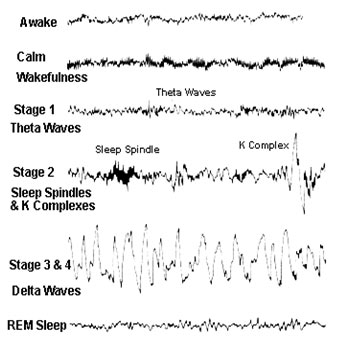
1. Awake with eyes open: Beta wave (highest frequency and lowest amplitude)

2. Awake with eyes closed: Alpha wave (synchronized brain activity)

3. NREM/Slow wave/Orthodox sleep (70-80%):

  • Stage 1 (light sleep): Theta waves
  • Stage 2 (intermediate): Sleep spindles and K-complex
  • Stage 3 and 4 (deep sleep): Delta waves (lowest frequency and highest amplitude)

4. REM/Paradoxical sleep (20-30%): Beta waves

Order in which frequency decreases and amplitude increases: BAT Drink

  1. Beta wave: >14 Hz, low amplitude
  2. Alpha wave: 8-13 Hz, high amplitude
  3. Theta wave: 4-7 Hz, high amplitude
  4. Delta wave: 3-5 Hz, maximum amplitude
3 shares
  • Facebook
  • Twitter
PGMEE, MRCS, USMLE, MBBS, MD/MS Nervous systemPhysiology

Post navigation

Previous post
Next post

Related Posts

PGMEE, MRCS, USMLE, MBBS, MD/MS gastric lymph node stations

Gastric Carcinoma : Quick Review

Feb 28, 2018

Etiology and Risk factors of Gastric Carcinoma Mnemonic: 14 “A”s Animal foods (smoked, cured or preserved – contains high nitroso- compounds) Anti-oxidant poor foods Acetaldehyde in Alcohol Acid peptic disease or Antigen i.e. H.pylori Atrophic gastritis and Achlorhydria Adenomatous polyps (precursor of intestinal type of gastric cancer) A type Blood group Asians…

Read More
PGMEE, MRCS, USMLE, MBBS, MD/MS gastric glands

Gastric Acid Secretion in Parietal cells: Mechanism

Jun 16, 2023Jun 16, 2023

Key player: H+/K+ ATPase or “proton pump” (in canalicular membrane of parietal cells) a. Hydrogen ions are generated within the parietal cell from dissociation of water. The hydroxyl ions formed in this process rapidly combine with carbon dioxide to form bicarbonate ion, a reaction catalyzed by carbonic anhydrase. b. Bicarbonate…

Read More
PGMEE, MRCS, USMLE, MBBS, MD/MS complement protective mechanism

Complement Pathway – Explained

Jun 5, 2016Dec 8, 2022

The complement system is composed of about 20 different proteins released into the blood after production in the liver. They interact in coordinated and regulated way to produce biologically active protein products. ACTIVATION OF COMPLEMENT CASCADE The complement cascade can be activated in 3 ways: C3 and C3 CONVERTASE All of…

Read More

Leave a Reply Cancel reply

Your email address will not be published. Required fields are marked *

This site uses Akismet to reduce spam. Learn how your comment data is processed.

Pre-clinical (Basic Sciences)

Anatomy

Biochemistry

Community medicine (PSM)

Embryology

Microbiology

Pathology

Pharmacology

Physiology

Clinical Sciences

Anesthesia

Dermatology

Emergency medicine

Forensic

Internal medicine

Gynecology & Obstetrics

Oncology

Ophthalmology

Orthopedics

Otorhinolaryngology (ENT)

Pediatrics

Psychiatry

Radiology

Surgery

RSS Ask Epomedicine

  • What to study for Clinical examination in Orthopedics?
  • What is the mechanism of AVNRT?

Epomedicine weekly

  • About Epomedicine
  • Contact Us
  • Author Guidelines
  • Submit Article
  • Editorial Board
  • USMLE
  • MRCS
  • Thesis
©2026 Epomedicine | WordPress Theme by SuperbThemes