Skip to content
Epomedicine

Mnemonics, Simplified Concepts & Thoughts

Epomedicine

Mnemonics, Simplified Concepts & Thoughts

kawasaki-disease

Kawasaki Disease – Diagnostic Criteria Mnemonic

Epomedicine, Oct 7, 2016Oct 7, 2016

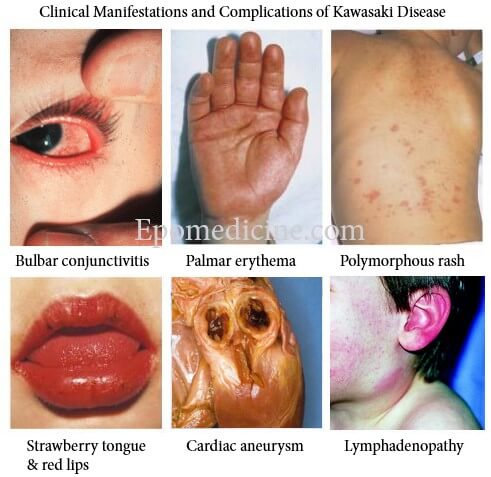
The diagnostic criteria of Kawasaki Disease can be remembered using a mnemonic – “FEBRILE“.
kawasaki-disease

Fever: >5 days plus ≥4 of the following

Enathem:

  • Lips: Erythema, fissuring or crusting
  • Oropharynx: Diffuse injection
  • Tongue: Strawberry tongue

Bulbar conjunctivitis: Bilateral, painless and non-exudative

Rash: Polymorphous rash

Internal organ involvement (not the part of criteria)

  • Cardiac artery aneurysm: commonest and most life-threatening complication
  • Urethritis with sterile pyuria
  • Aseptic meningitis
  • Hydrops of gallbladder
  • Sensorineural hearing loss
  • Uveitis
  • Hepatic dysfunction

Lymphadenopathy: >1.5 cm, non-suppurative

Extremity changes:

  • Erythema of palms or soles
  • Edema (non-pitting)
  • Desquamation (perigenital and perineal followed by periungual, starting at the tips of finger)

Clinical Phases of Kawasaki Disease
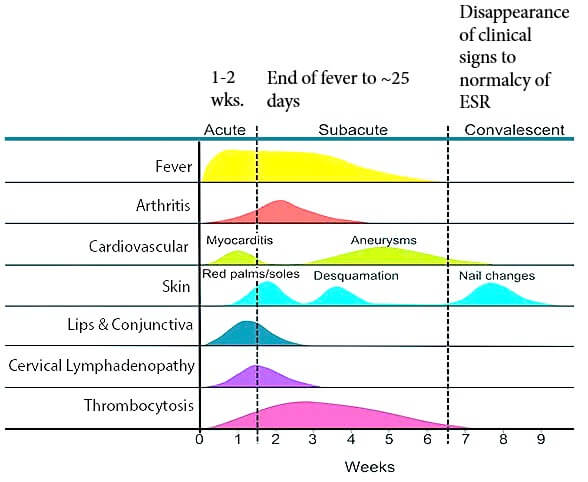
kawasaki-disease-clinical-phases


33 shares
  • Facebook33
  • Twitter
PGMEE, MRCS, USMLE, MBBS, MD/MS Cardiovascular systemPediatrics

Post navigation

Previous post
Next post

Related Posts

PGMEE, MRCS, USMLE, MBBS, MD/MS

Portal Vein : Tributaries and Portocaval Anastomoses

Sep 28, 2020Aug 7, 2023

Origin: Hepatic Portal Vein is formed by the union of Splenic vein and Superior mesenteric Vein behind the neck of pancreas at L1 vertebral level. Termination: The portal vein terminates by branching into right branch (entering right lobe of liver) and left branch entering (left lobe of liver). Parts: Tributaries: Points to…

Read More
PGMEE, MRCS, USMLE, MBBS, MD/MS

List of Textbook for Pediatric Residents

Mar 27, 2021Mar 27, 2021

Residency in any subject in medical field is not a piece of cake. There is no limit of knowledge you need to acquire and the tougher thing is you need to acquire knowledge and skills side by side. A mastery in only one field can leave you deficient. As a…

Read More
PGMEE, MRCS, USMLE, MBBS, MD/MS schatzker classification

Schatzker classification for Tibial plateau fracture : Mnemonic

Apr 15, 2020Aug 18, 2021

Schatzker system is widely accepted and used to classify tibial plateau fractures. It is based on a 2D representation of the fracture. As a general rule, it can be divided into low-energy and lateral tibial plateau variants (types I-III) and high energy variants (type IV-VI). However, it does not include…

Read More

Leave a Reply Cancel reply

Your email address will not be published. Required fields are marked *

This site uses Akismet to reduce spam. Learn how your comment data is processed.

Epomedicine. Kawasaki Disease – Diagnostic Criteria Mnemonic [Internet]. Epomedicine; 2016 Oct 7 [cited 2025 Dec 18]. Available from: https://epomedicine.com/medical-students/kawasaki-disease-diagnostic-criteria-mnemonic/.

Pre-clinical (Basic Sciences)

Anatomy

Biochemistry

Community medicine (PSM)

Embryology

Microbiology

Pathology

Pharmacology

Physiology

Clinical Sciences

Anesthesia

Dermatology

Emergency medicine

Forensic

Internal medicine

Gynecology & Obstetrics

Oncology

Ophthalmology

Orthopedics

Otorhinolaryngology (ENT)

Pediatrics

Psychiatry

Radiology

Surgery

RSS Ask Epomedicine

  • What to study for Clinical examination in Orthopedics?
  • What is the mechanism of AVNRT?

Epomedicine weekly

  • About Epomedicine
  • Contact Us
  • Author Guidelines
  • Submit Article
  • Editorial Board
  • USMLE
  • MRCS
  • Thesis
©2025 Epomedicine . All rights reserved.