Skip to content
Epomedicine

Mnemonics, Simplified Concepts & Thoughts

Epomedicine

Mnemonics, Simplified Concepts & Thoughts

antigenic shift and drift

Antigenic Shift and Drift

Epomedicine, Apr 5, 2017

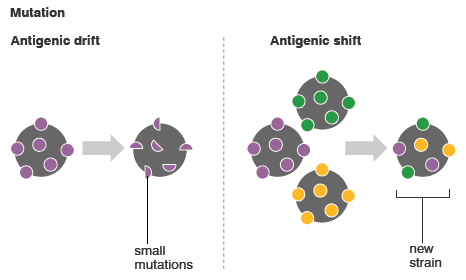
Antigenic Drift

Nature of antigenic variation: Minor

Mechanism:

  1. Gradual accumulation of amino acid substitutions due to point mutation in the hemagglutinin (H) and neuraminidase (N) genes.
  2. As mutations accumulate, antibodies generated by exposure to previous strains do not neutralize current strains to the same extent, resulting in only limited or partial immunity to the new strains.

Gives rise to: Epidemics

Shown by: Influenza A and B viruses
antigenic shift and drift

Antigenic Shift

Nature of antigenic variation: Major

Mechanism: Expression of a new allele of hemagglutin or neuraminidase through the following mechanism –

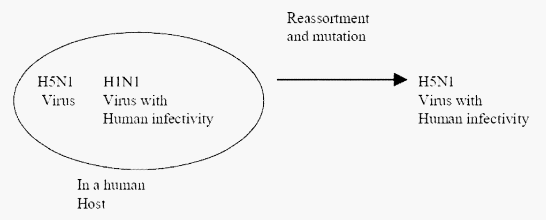
  1. Genetic reassortment: Non-human influenza is selective in its tropism, and cannot easily replicate in humans. However, avian influenza viruses may replicate in non-avian, non-human reservoirs (like swine). A pig that was co-infected with both avian and human strains of influenza might result in a genetic reassortment that produces a novel virus capable of replication in and transmission between humans.
  2. Mutation: Mutations may occur directly in a non-human virus, such as an avian virus, that allow the virus to readily spread from person to person.
reassortment

Gives rise to: Pandemics and Epidemics

Shown by: Influenza A virus
17 shares
  • Facebook17
  • Twitter
PGMEE, MRCS, USMLE, MBBS, MD/MS MicrobiologyRespiratory system

Post navigation

Previous post
Next post

Related Posts

PGMEE, MRCS, USMLE, MBBS, MD/MS ORS acute diarrhea

Acute Diarrhea – Approach

Sep 4, 2015Sep 4, 2015

There is no standard definition of diarrhea. Diarrhea may be defined with one or combination of the following criterion: Change in consistency of stool: Increased water-content Increase in freqency of stool: >3 times per day Increase in weight of stool: >200 grams per day or >10 grams/kg/day Among all these,…

Read More
PGMEE, MRCS, USMLE, MBBS, MD/MS

Sarcomere Structure : Mnemonic

Feb 2, 2019Feb 27, 2026

Remember the sequence: Zahir Is A Hungry Man Z is the final alphabet: Z lines represents the end of sarcomere M for middle: M line represents the midline of sarcomere I is a thin letter: I band has only thin filaments H is a thick letter: H zone has only…

Read More
PGMEE, MRCS, USMLE, MBBS, MD/MS superficial vein forearm

Superficial Veins of Forearm : Mnemonic

Jun 22, 2018

Origin: Dorsal venous network The 1st 2 letters of the word “biceps” that being the muscle with which the vein is in relation, will give a mnemonic aid to retain the relative position of the basilic and cephalic veins. (B.I., Basilic Internal) Basilic vein courses medially Cephalic vein course laterally…

Read More

Leave a Reply Cancel reply

Your email address will not be published. Required fields are marked *

This site uses Akismet to reduce spam. Learn how your comment data is processed.

Pre-clinical (Basic Sciences)

Anatomy

Biochemistry

Community medicine (PSM)

Embryology

Microbiology

Pathology

Pharmacology

Physiology

Clinical Sciences

Anesthesia

Dermatology

Emergency medicine

Forensic

Internal medicine

Gynecology & Obstetrics

Oncology

Ophthalmology

Orthopedics

Otorhinolaryngology (ENT)

Pediatrics

Psychiatry

Radiology

Surgery

RSS Ask Epomedicine

  • What to study for Clinical examination in Orthopedics?
  • What is the mechanism of AVNRT?

Epomedicine weekly

  • About Epomedicine
  • Contact Us
  • Author Guidelines
  • Submit Article
  • Editorial Board
  • USMLE
  • MRCS
  • Thesis
©2026 Epomedicine | WordPress Theme by SuperbThemes