Skip to content
Epomedicine

Mnemonics, Simplified Concepts & Thoughts

Epomedicine

Mnemonics, Simplified Concepts & Thoughts

Superficial-pathological-reflexes

Pathological reflexes – Variations of Babinski

Epomedicine, Jun 18, 2015Dec 7, 2022
pathological reflexes

Normally, the pathological reflexes are not evident because they are suppressed by cerebrum at brainstem or spinal cord level by 6 months of age.

Importance:

  1. If present bilaterally: indicates upper motor neuron lesion
  2. If present unilaterally: indicates lower motor neuron lesion

Up-going (dorsiflexion) toe can be elicited at various sites and all indicated Upper Motor Neuron (UMN) lesion. Use a blunt-pointed object like fingernail or tip of a key or a reflex hammer to stroke the skin. The complete response is extension of big toe and fanning of 4 small toes. These are normal in newborn upto  6 months of age after which they are suppresed by the cerebrum. Babinski sign is the commonest method used to elicit this.

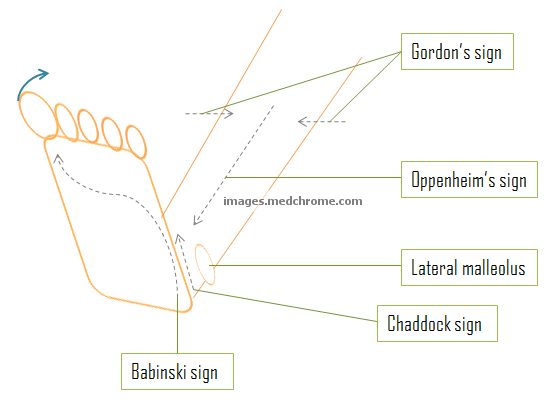
1. Babinski sign (phénomène des orteils): Stroking the lateral aspect of the sole of the foot in the direction as shown in the picture

2. Chaddock sign: Stroking the skin beneath the lateral (external) malleolus

3. Oppenheim’s sign (Oppenheimer sign): Stroking the antero-medial tibial surface

4. Gordon’s sign: Squeezing of the lower calf muscles firmly

Clinical Pearl:

How do you elicit pathological reflex in a patient with both feet amputated?

Answer: The Hoffman reflex
Flicking of terminal phalanx of index, middle or ring finger leads to reflex  flexion of distal phalanx of thumb and of distal phalanx of index or middle finger (whichever was flicked). It indicates tetany or upper motor neuron lesion.
35 shares
  • Facebook35
  • Twitter
Clinical Skills and Approaches Clinical examinationInternal medicineNervous systemOrthopedicsPediatrics

Post navigation

Previous post
Next post

Related Posts

X-ray Soft Tissue Neck

Jan 4, 2014

Anatomy: Retropharyngeal space: Extends from the base of the skull down to the level of the carina, and is located between the buccopharyngeal mucosa and the prevertebral fascia. Prevertebral space: A potential space that is located between the anterior aspect of the vertebral body and the prevertebral fascia. It is located directly posterior to…

Read More
Clinical Skills and Approaches eschar

Eschar

Sep 24, 2016

Synonyms Tache noire Definition of Eschar An eschar is a local skin lesions coated by a thick coagulated crust or slough that usually results from burn or infection. Causes of Eschar Tick bite fever Scrub typhus Anthrax Tularaemia Spider bites Disseminated fungal infection Post-burn Diagnostic Clues Cigarette-burn Sign In scrub…

Read More
Clinical Skills and Approaches

Approach to Thoracic and Lumbar Spine X-ray

Jun 22, 2021Jun 22, 2021

Views Standard: Supine AP and Latero-lateral (LL) views – thoracic or lumbar Thoracic: Lateral (Fulcrum) bending views: to determine the flexibility of curves in scoliosis Lumbar: De Seze view (Lumbopelvic view): Standing AP and LL – shows T11 to head of femur Dynamic lateral (flexion-extension) views: for instability Oblique views…

Read More

Leave a Reply Cancel reply

Your email address will not be published. Required fields are marked *

This site uses Akismet to reduce spam. Learn how your comment data is processed.

Pre-clinical (Basic Sciences)

Anatomy

Biochemistry

Community medicine (PSM)

Embryology

Microbiology

Pathology

Pharmacology

Physiology

Clinical Sciences

Anesthesia

Dermatology

Emergency medicine

Forensic

Internal medicine

Gynecology & Obstetrics

Oncology

Ophthalmology

Orthopedics

Otorhinolaryngology (ENT)

Pediatrics

Psychiatry

Radiology

Surgery

RSS Ask Epomedicine

  • What to study for Clinical examination in Orthopedics?
  • What is the mechanism of AVNRT?

Epomedicine weekly

  • About Epomedicine
  • Contact Us
  • Author Guidelines
  • Submit Article
  • Editorial Board
  • USMLE
  • MRCS
  • Thesis
©2026 Epomedicine | WordPress Theme by SuperbThemes