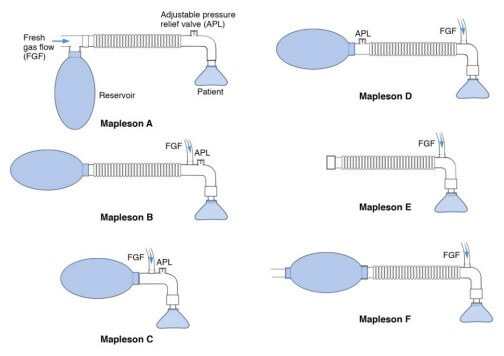
Anatomy of Mapleson Breathing Circuit Basically, a mapleson breathing circuit consists of following parts: 1. Face mask (towards patient end) 2. Reservoir bag (towards operator end) Accommodates fresh gas flow during expiration acting as a reservoir available for the following inspiration. Acts as a monitor of patient’s ventilatory pattern during…
Tag: Anesthesia
Emergency Medicine
Early vs Delayed Norepinephrine Use in Septic Shock
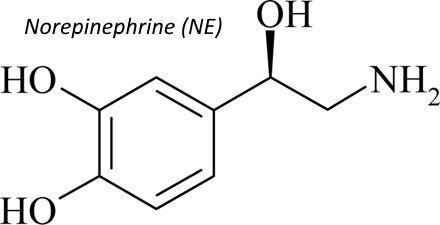
Norepinephrine has numerous effects in sepsis including veno-constriction (increasing preload), arterial constriction (increasing systemic vascular resistance), positive inotropy, improved cardiac output, and improved renal perfusion. This addresses all the major derangements observed in cases of septic shock. It is important to realize that MAP doesn’t necessarily equate perfusion. Increasing the…
Emergency Medicine
Septic Shock Fluid Resuscitation
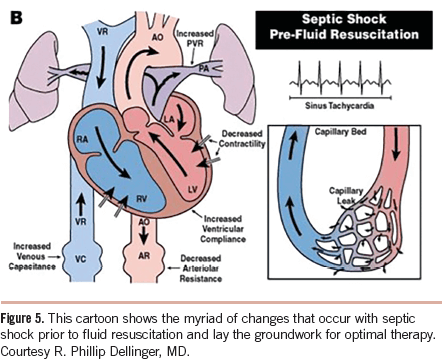
Endpoints of resuscitation MAP: > or = 65 mmHg Urine output: > 0.5 ml/kg/hr; despite ↓RBF (Renal Blood Flow) it can be normal due to – Atrial natriuretic factor are elevated in sepsis Hypoproteinemia in sepsis – low plasma colloid osmotic pressure is less able to facilitate oncotic reabsorption. CVP:…
Emergency Medicine
Is there no role of Early Goal Directed Therapy (EGDT) in Sepsis and Septic shock?
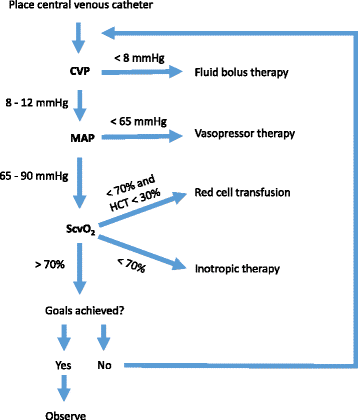
International Surviving Sepsis Campaign has recommended Early Goal Directed Therapy for the management of severe sepsis and septic shock. Recently, three large multicenter studies – the ProCESS (Protocolized Care for Early Septic Shock), ARISE (Australasian Resuscitation In Sepsis Evaluation), and ProMISe (Protocolized Management In Sepsis) demonstrated no difference in the…
Clinical Skills and Approaches
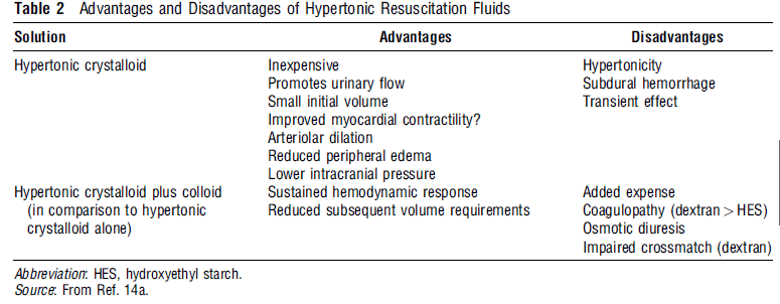
Head trauma fluid resuscitation
Peculiarities of cerebral circulation: 1. Brain and spinal cord is isolated from endothelium by BBB composed of continuous capillaries that limits movement of proteins and electrolytes 2. Fluid movement is primarily determined by osmolar gradient (in contrast to peripheral tissues – transcapillary gradient of large macromolecules) 3. Hence, administration of…
Clinical Skills and Approaches
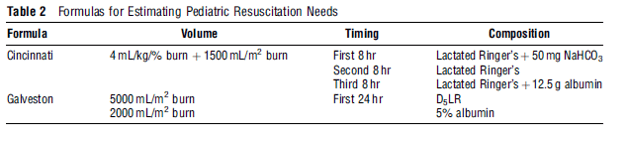
Burn Fluid Resuscitation
A) Clinical endpoints suggesting adequacy of burn fluid resuscitation: B) Pathophysiology of Burn:
Clinical Skills and Approaches
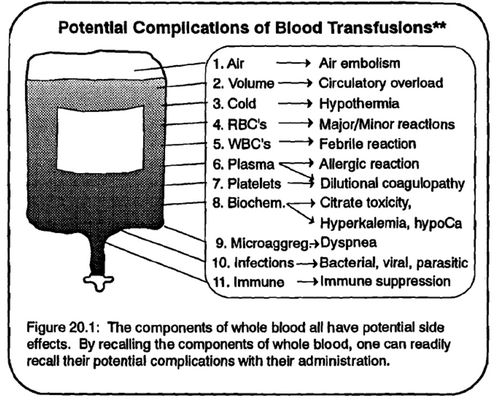
Perioperative Fluid Management
Author: Sulabh Kumar Shrestha, KISTMCTH A) RELEVANT ANATOMY AND PHYSIOLOGY Details of the body fluid compartments are described here Microvessels for fluid exchange: The Exchange Vessels – capillaries and most proximal part of the venules Sinusoidal capillaries (liver, spleen, bone marrow): freely permeable to all solutes Fenestrated capillaries (glands, glomeruli, GIT):…
PGMEE, MRCS, USMLE, MBBS, MD/MS

Aspirin and Clopidegrol : Perioperative Guidelines
The average lifespan of platelets is 7 to 10 days. Aspirin and Clopidegrol inhibits platelets for around 21 days. Hence, when these agents are stopped 7 days before the surgery, it allows 33% regeneration of platelets. Stents and coronary lesions act as unstable plaque until they are completely covered by…