Skip to content
Epomedicine

Mnemonics, Simplified Concepts & Thoughts

Epomedicine

Mnemonics, Simplified Concepts & Thoughts

Bilateral V-Y (Kutler) flap for finger stump closure

Epomedicine, Feb 12, 2023Feb 12, 2023

Indications

Classically, this flap is indicated in patients with transverse or volar oblique amputations.

In actuality, the patient in whom this flap is useful generally will have an amputation where there is more tissue on the radial and ulnar margins of an amputation and exposed distal phalanx.

Limitations

Generally, the flap does not allow for advancement of more than 3 to 4 mm, and there is a sagittal scar placed on the tip of the finger.
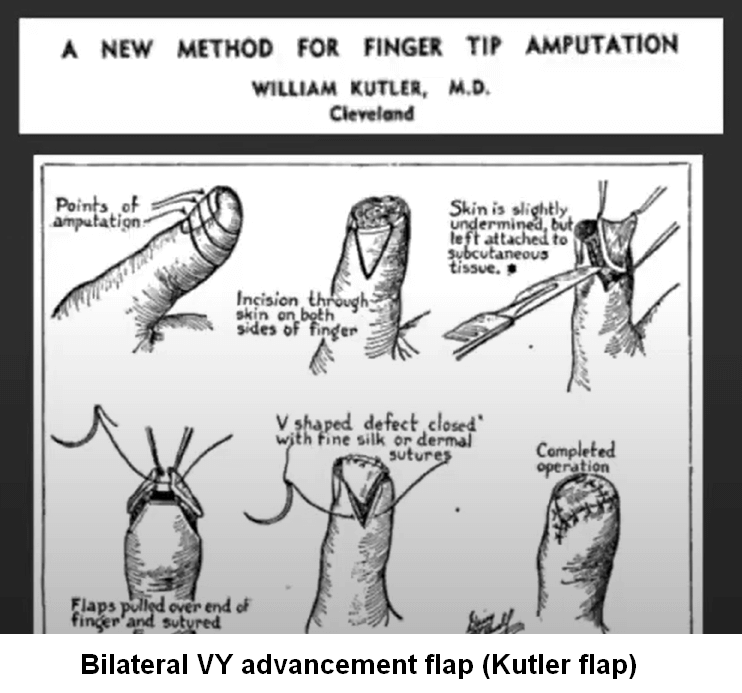
kutler flap

Technique

1. The injured area is debrided and bone spikes trimmed.

2. V-shaped incisions are made on each side of the fingertip and carried down through the subcutaneous tissue.

  • Dorsal edges of the 2 flaps begin 1-2 mm volar to the edge of the fingernail and extend volarly 7-8 mm.
  • Apex of the “V” flap sits just distal to the DIP crease.

3. Base of the triangular flap produced is held by a fine skin hook, and with sharp-pointed scissors the fibrous strands holding the skin to the bone are palpated and divided, so retaining a soft pedicle containing the neurovascular supply.

4. Flaps are sutured together over the fingertip and remaining defects are closed as a V-Y repair. However, it is not necessary to close the skin centrally over the fingertip as long as there is good soft tissue closure over the exposed distal phalanx.

Refereces:

  1. Gaber M. Kutler repair for the amputated fingertip. Ann R Coll Surg Engl. 1979 Jul;61(4):298-300. PMID: 475275; PMCID: PMC2492195.
  2. Chao, J. D., Huang, J. M., & Wiedrich, T. A. (2001). Local hand flaps. Journal of the American Society for Surgery of the Hand, 1(1), 25–44. doi:10.1053/jssh.2001.21783
  3. https://youtu.be/ZwrbhW_1mnU
  • Facebook
  • Twitter
Surgical Skills OrthopedicsPlastic surgerySurgical skills

Post navigation

Previous post
Next post

Related Posts

Surgical Skills

Aberdeen Knot

Feb 10, 2023Feb 10, 2023

To end continuous suture, either a square knot, surgeon’s knot or an Aberdeen knot is required. The Aberdeen knot has been shown to be superior to a surgeon’s knot. Recommendations on number of throws: Technique/Steps:

Read More
Surgical Skills

Zancolli-Lasso Procedure

May 6, 2021May 6, 2021

Based on the preoperative clinical examination, the decision on which donor superficialis (FDS) tendon to use is made (commonly FDS middle finger is used). Transverse incision is made at the level of the distal palmer crease. Care should be taken to avoid the neurovascular bundles and the flexor tendons must…

Read More
Surgical Skills

Biomechanics in MIPO (Minimally Invasive Plate Osteosynthesis)

Jan 17, 2024Jan 20, 2024

1. Provides optimal environment for fracture healing: 2. Relative stability of fracture: 3. Acts as internal fixator: 4. Plate length and Number of screws in Bridge plate function: 5. Plate working length: References: Dr. Sulabh Kumar Shrestha, MS Orthopedics He is the section editor of Orthopedics in Epomedicine. He searches…

Read More

Leave a Reply Cancel reply

Your email address will not be published. Required fields are marked *

This site uses Akismet to reduce spam. Learn how your comment data is processed.

Pre-clinical (Basic Sciences)

Anatomy

Biochemistry

Community medicine (PSM)

Embryology

Microbiology

Pathology

Pharmacology

Physiology

Clinical Sciences

Anesthesia

Dermatology

Emergency medicine

Forensic

Internal medicine

Gynecology & Obstetrics

Oncology

Ophthalmology

Orthopedics

Otorhinolaryngology (ENT)

Pediatrics

Psychiatry

Radiology

Surgery

RSS Ask Epomedicine

  • What to study for Clinical examination in Orthopedics?
  • What is the mechanism of AVNRT?

Epomedicine weekly

  • About Epomedicine
  • Contact Us
  • Author Guidelines
  • Submit Article
  • Editorial Board
  • USMLE
  • MRCS
  • Thesis
©2026 Epomedicine | WordPress Theme by SuperbThemes