Skip to content
Epomedicine

Mnemonics, Simplified Concepts & Thoughts

Epomedicine

Mnemonics, Simplified Concepts & Thoughts

Zero Position of Saha

Epomedicine, Jul 18, 2024Jul 18, 2024

Zero Position

Zero position is the position during elevation in coronal or sagittal plane or in any plane where:

  1. There is no further rotation, active gliding of joint surfaces and circumduction
  2. The mechanical axis corresponds to the anatomical axis of the shaft
  3. Gliding, rotation and “breast-stroke” movements become identical

Zero position of shoulder

The humerus is elevated to about 165° with individual variations and is in the newly acquired scapular plane (around 45° anterior to the coronal plane).

The humeral shaft axis roughly is in alignment with the scapular spine in this position.

This is the relative position of scapula and humerus which is seen in fast-moving quadrupeds to give stability to the joint.
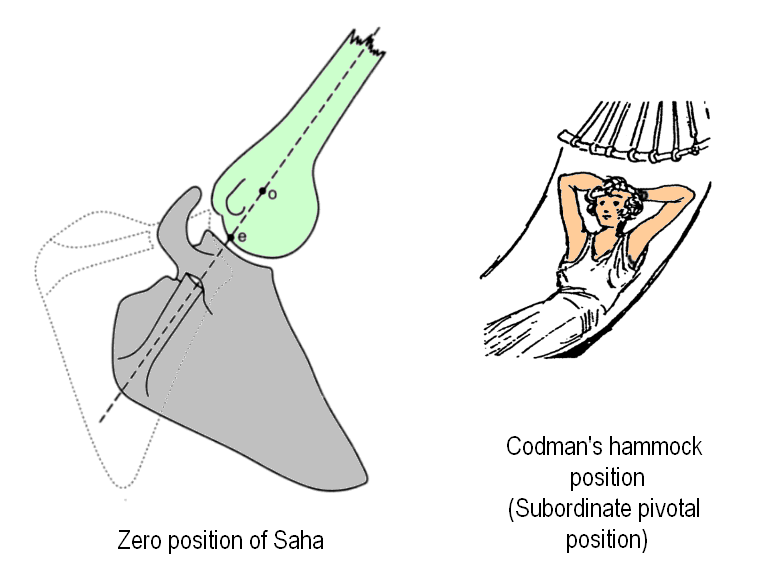
Zero position of shoulder

Codman’s subordinate pivotal position

Codman’s hammock position and Saha’s zero position concept are not different.

Codman pointed out a position when lying on a hammock with hands clasped behind the head. In this position, the arm is elevated and externally rotated with the clavicle slightly elevated and the shoulder close to maximum elevation.

The deltoid, supraspinatus and infraspinatus all are relaxed, and the humerus aligns with the scapular spine.

In this position, the joint is locked posteriorly as far as dorsal motion is concerned, but lateral motion is still possible if the humerus is rotated.

Clinical uses of Zero position

  1. Treatment of dislocations
  2. Treatment of unimpacted abduction fractures of the surgical neck
  3. Treatment of epiphyseal separations
  4. Treatment of upper fourth shaft fractures

References:

  1. SAHA AK. [Zero position of the glenohumeral joint: its recognition and clinical importance]. Ann R Coll Surg Engl. 1958 Apr;22(4):223-6. PMID: 13534237; PMCID: PMC2413634.
  2. The Shoulder – Function and Clinical Aspects (Katsuya Nobuhara)
  • Facebook
  • Twitter
PGMEE, MRCS, USMLE, MBBS, MD/MS AnatomyMusculoskeletal systemOrthopedics

Post navigation

Previous post
Next post

Related Posts

PGMEE, MRCS, USMLE, MBBS, MD/MS

Straight Leg Raising Test (SLRT) – Pathophysiology

Apr 20, 2020Jun 3, 2020

Epineurium of sciatic nerve (like all other nerves) is continuous with the duramater withing the spinal canal which is firmly attached to the foramen magnum above and the filum terminale below. In the elastic neuromeningeal pathway, tension applied at one point will spread through out the length of spine until…

Read More
PGMEE, MRCS, USMLE, MBBS, MD/MS lungs lymph nodes

TNM and Staging of Lung Cancer Simplified

Aug 15, 2016

The current staging system is recommended for the classification of both non–small cell and small cell lung carcinomas and for carcinoid tumors of the lung . TNM Staging of Lung Cancer Primary Tumor (T) The “T” staging of bronchogenic carcinoma is a bit complex compared to others. Five things must…

Read More
PGMEE, MRCS, USMLE, MBBS, MD/MS

Femoral Hernia : Mnemonic

Aug 27, 2023Aug 27, 2023

Mnemonic: FEMORAL Females (4 times more common) Elderly McEvedey operation (incision above inguinal ligament – preferred in emergency intervention due to easy access to compromised bowel for any resection if required) Obstruction/incarceration/strangulation risk is higher (rigid walls of femoral ring) Richter’s hernia – most common location Above inguinal ligament –…

Read More

Leave a Reply Cancel reply

Your email address will not be published. Required fields are marked *

This site uses Akismet to reduce spam. Learn how your comment data is processed.

Epomedicine. Zero Position of Saha [Internet]. Epomedicine; 2024 Jul 18 [cited 2026 Jan 21]. Available from: https://epomedicine.com/medical-students/zero-position-of-saha/.

Pre-clinical (Basic Sciences)

Anatomy

Biochemistry

Community medicine (PSM)

Embryology

Microbiology

Pathology

Pharmacology

Physiology

Clinical Sciences

Anesthesia

Dermatology

Emergency medicine

Forensic

Internal medicine

Gynecology & Obstetrics

Oncology

Ophthalmology

Orthopedics

Otorhinolaryngology (ENT)

Pediatrics

Psychiatry

Radiology

Surgery

RSS Ask Epomedicine

  • What to study for Clinical examination in Orthopedics?
  • What is the mechanism of AVNRT?

Epomedicine weekly

  • About Epomedicine
  • Contact Us
  • Author Guidelines
  • Submit Article
  • Editorial Board
  • USMLE
  • MRCS
  • Thesis
©2026 Epomedicine . All rights reserved.