Skip to content
Epomedicine

Mnemonics, Simplified Concepts & Thoughts

Epomedicine

Mnemonics, Simplified Concepts & Thoughts

Z-effect and Reverse Z-effect in PFN

Epomedicine, Apr 27, 2023Jan 20, 2024

‘Z-effect’ and ‘Reverse Z-effect’ are complications relating to differential migration of screws that arise from fixation of unstable proximal femoral fractures with Proximal Femoral Nail (PFN) having 2 interlocking head screws. The 4 patterns of unstable intertrochanteric fracture hip are:

  1. Disrupted calcar femorale/posteromedial cortex
  2. Reverse oblique: angulated proximal medial to distal lateral
  3. Transverse trochanteric or transtrochanteric (fracture exits lateral cortex)
  4. Subtrochanteric extension

Z-effect: The Z-effect involves the lateral migration of the lag screw, varus collapse and perforation of the femoral head by the superior derotation screw.

Reverse Z-effect: The reverse Z-effect involves the lateral migration of the superior derotation screw accompanied by the medial migration of the lag screw.
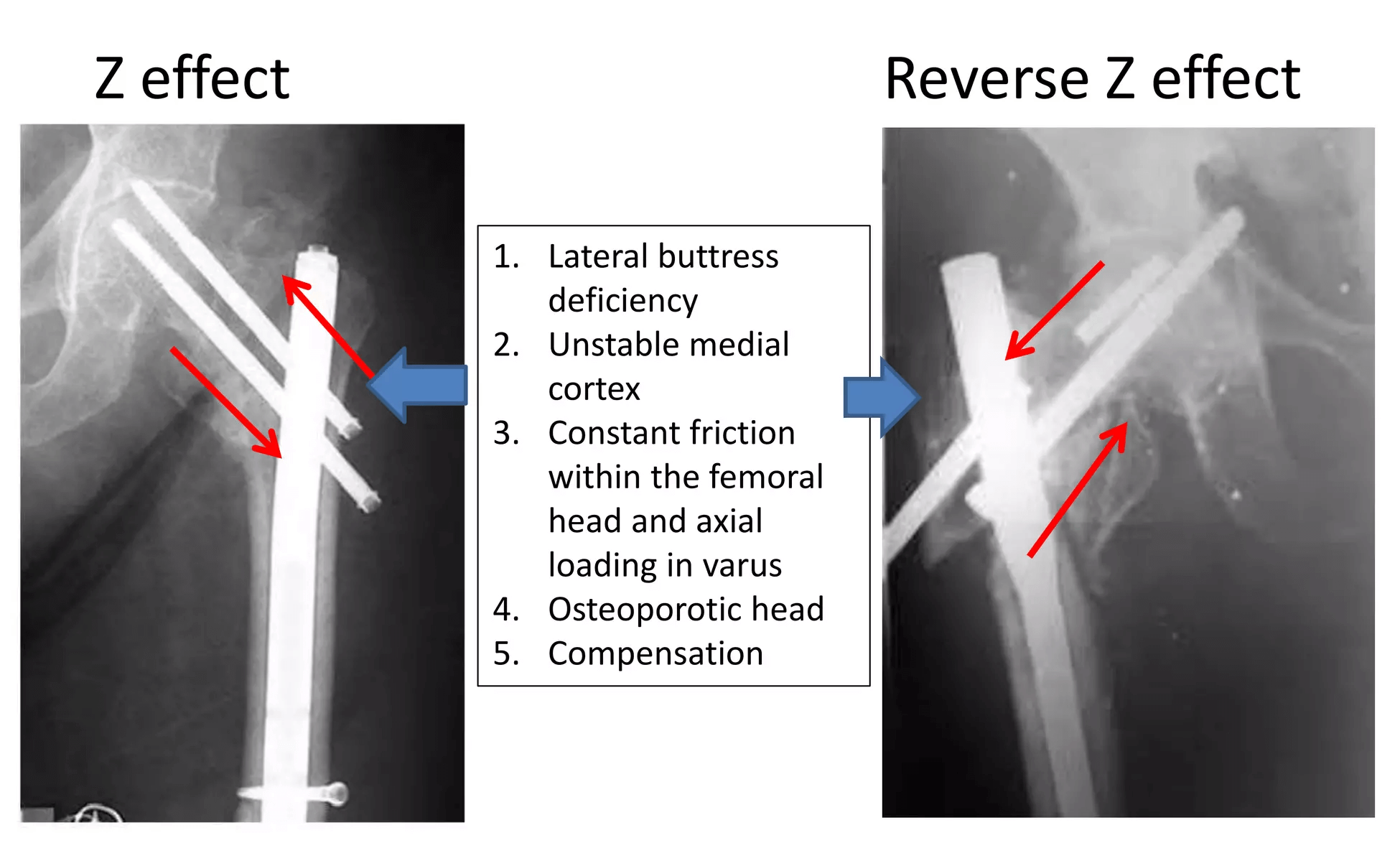
pfn z-effect

In practice, sometimes only one screw actually migrates, and the fracture undergoes an accommodation process that may lead to the perforation of the femoral head by the screw that remains in the normal position.

Possible causes:

1. Strauss EJ, et.al.: Significant medial cortex comminution that are prone to varus collapse (mismatch between the compressive strengths of femoral head and femoral neck)

2. Weil YA, et.al.: Deficient lateral buttress and unstable calcar pattern

3. Poor bone quality

Reference: Siddiqui, Y.S., Khan, A.Q., Asif, N., & Sherwani, M.A. (2019). Modes of failure of proximal femoral nail (PFN) in unstable trochanteric fractures. MOJ Orthopedics & Rheumatology.
  • Facebook
  • Twitter
PGMEE, MRCS, USMLE, MBBS, MD/MS BiomechanicsOrthopedics

Post navigation

Previous post
Next post

Related Posts

PGMEE, MRCS, USMLE, MBBS, MD/MS ulnar nerve course

Ulnar nerve Anatomy – Course and Innervation

Jun 7, 2018Jun 1, 2024

Origin: C(7), C8, T1 (medial cord of Brachial plexus) Course: Motor innervation: 1. Forearm: Flexor carpi ulnaris (weakness of ulnar deviation and flexion of wrist), Medial half of flexor digitorum profundus (branches near the elbow) 2. Hand: branches near wrist Sensory innervation: Palmar branch at forearm and Digital branch at wrist…

Read More
PGMEE, MRCS, USMLE, MBBS, MD/MS

Osteopetrosis : Mnemonic

Jul 20, 2022Jul 20, 2022

Synonyms: Marble bone disease Albers-Schonberg disease (Autosomal dominant form) Mnemonic: OSTEOPETROSIS Osteoclast dysfunction (Carbonic anhydrase II gene mutation or chloride channel dysfunction) Symmetric skeletal sclerosis Thickened cortex with loss of medullary canal diameter (bone in bone appearance) Extramedullary hematopoiesis (aplastic anemia and hepatosplenomegaly) Overgrowth of skull foramina (cranial nerve palsies)…

Read More
PGMEE, MRCS, USMLE, MBBS, MD/MS hemolysis causes

Hemolytic Anemia – Quick review

Feb 4, 2017Feb 5, 2017

Although, we classify as intravascular and extravascular hemolysis, “diseases” don’t read the book. These disorders may be described as causing extravascular hemolysis, but your case may be the uncommon exception with intravascular hemolysis that was not mentioned. Diseases may cause anemia by both intravascular and extravascular hemolysis. Extravascular hemolysis typically…

Read More

Leave a Reply Cancel reply

Your email address will not be published. Required fields are marked *

This site uses Akismet to reduce spam. Learn how your comment data is processed.

Epomedicine. Z-effect and Reverse Z-effect in PFN [Internet]. Epomedicine; 2023 Apr 27 [cited 2025 Dec 6]. Available from: https://epomedicine.com/medical-students/z-effect-and-reverse-z-effect-in-pfn/.

Pre-clinical (Basic Sciences)

Anatomy

Biochemistry

Community medicine (PSM)

Embryology

Microbiology

Pathology

Pharmacology

Physiology

Clinical Sciences

Anesthesia

Dermatology

Emergency medicine

Forensic

Internal medicine

Gynecology & Obstetrics

Oncology

Ophthalmology

Orthopedics

Otorhinolaryngology (ENT)

Pediatrics

Psychiatry

Radiology

Surgery

RSS Ask Epomedicine

  • What to study for Clinical examination in Orthopedics?
  • What is the mechanism of AVNRT?

Epomedicine weekly

  • About Epomedicine
  • Contact Us
  • Author Guidelines
  • Submit Article
  • Editorial Board
  • USMLE
  • MRCS
  • Thesis
©2025 Epomedicine . All rights reserved.