Skip to content
Epomedicine

Mnemonics, Simplified Concepts & Thoughts

Epomedicine

Mnemonics, Simplified Concepts & Thoughts

Wrist Extensor Compartments

Epomedicine, Jun 20, 2020Oct 15, 2020

The Extensor Zone VII (wrist) contains 6 extensor compartments comprising of 6 synovial sheath lined tunnels separated from each other by fibrous sheath. These compartments contain tendons of muscles that pass from forearm to hand.
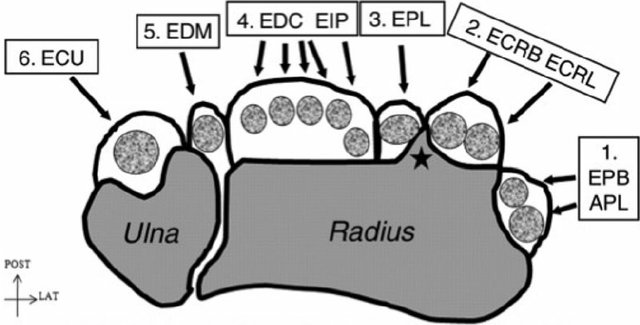
dorsal wrist compartments
Patel KR, Tadisina KK, Gonzalez MH. De Quervain’s Disease. Eplasty. 2013 Jul 16;13:ic52. PMID: 23943679; PMCID: PMC3723064. / CC BY 2.0

The number of tendons passinf thorugh the compartments (radial to ulnar) can be remembered using the mnemonic: 2-2-1-2-1-1.

Compartment 1: APL (Abductor Pollicis Longus; radial; frequently has multiple slips) and EPB (Extensor Pollicis Brevis; ulnar)

  • Remember: These form the lateral border of Anatomical Snuff box
  • DeQuervain’s tenosynovitis (modified Eichoff’s test or Finkelstein’s test) – most common extensor compartment tenosynovitis

Compartment 2: ECRL (Extensor Carpi Radialis Longus) and ECRB (Extensor Carpi Radilis Brevis)

  • Intersection syndrome: the intersection (at an angle of around 60°) of the musculotendinous junctions of the first and second extensor compartment tendons leading to tenosynovitis of 2nd compartment due to friction from the overlying 1st compartment.

Lister’s tubercle separates Compartment 2 from Compartment 3.

Compartment 3: EPL (Extensor Pollicis Longus)

  • Remember: This forms the medial border of Anatomical Snuff box
  • Drummer’s wrist: Drummers, Rheumatoid Arthritis, Distal radius fractures
Applied anatomy of Anatomical Snuff Box

Compartment 4: EDC (Extensor Digitorum Profundus; radial) and EIP (Extensor Indicis Proprius; ulnar) + Posterior interosseous nerve (PIN)

  • Tenosynovitis (more diffuse) may be confused with Ganglion cyst (more compact)
Finger Extensor Apparatus – Simplified

Compartment 5: EDM (Extensor Digiti Minimi)

  • 1st tendon to rupture in Vaughan-Jackson syndrome (commonly seen in Rheumatoid Arthritis – sequential atraumatic rupture of extensor tendons in hand starting from ulnar side and progressing radially)

Compartment 6: ECU (Extensor Carpi Ulnaris)

  • Snapping ECU: ECU tendon subluxates producing painful “snap” during extension and supination and reduces with pronation.

ECU subsheath is a part of TFCC.

The PIN (Posterior interosseous nerve from Radial nerve) innervates the EDC, EDM, and ECU muscles from the superficial wrist extensor compartment. It then innervates the APL, EPB, EPL, and EIP muscles.
31 shares
  • Facebook22
  • Twitter
PGMEE, MRCS, USMLE, MBBS, MD/MS AnatomyMusculoskeletal systemOrthopedics

Post navigation

Previous post
Next post

Related Posts

PGMEE, MRCS, USMLE, MBBS, MD/MS

Aortic arch derivatives : Mnemonic

May 28, 2023May 28, 2023

The aortic arches or pharyngeal arch arteries are formed sequentially with the pharyngeal arches. Aortic arch Derivatives Mnemonic 1st Maxillary artery (part) 1st arch is maximal 2nd Stapedial arteryHyoid artery Second = Stapedial 3rd Common carotid arteryProximal part of internal carotid artery C = 3rd letter of alphabet 4th Left: Aortic archRight: Subclavian…

Read More
PGMEE, MRCS, USMLE, MBBS, MD/MS cardiac impulse spread

Physiology of Conducting System of Heart

Jul 12, 2018Aug 10, 2023

Origin and Spread of Cardiac Impulse Mnemonic: SAIL MRS. SAVE APPS 1. SA node (generates impulse at highest rate, i.e. 70-80/min) 3 Internodal pathways: 2. AV node Bundle of His 3. Interventricular septum – Left 4. Midportion Right Septal activation Purkinje System 5. Septum (upper to lower) – purkinje system…

Read More

Anatomy and Physiology of Sebaceous glands

Nov 11, 2013

Definition: Sebaceous glands are numerous microscopic glands in the dermis that usually open into the hair follicles and secrete sebum. They are holocrine glands, i.e., the sebum consists of the entire secreting cells. Location: Found everywhere on the skin apart from the palms and soles Types of Sebaceous glands: 1….

Read More

Comments (3)

  1. Musa Garba says:
    Oct 17, 2022 at 9:01 am

    Interesting and simplified with clinicals immediately followed

    Reply
  2. Dr.Sathyamoorhty. says:
    Apr 20, 2023 at 9:32 pm

    Excellent description. Wonderful explanation of all the detail’s.

    Reply
  3. Alyssa Rosesmith says:
    Sep 27, 2024 at 5:24 pm

    There is a typo in this “The number of tendons passinf thorugh the compartments (radial to ulnar) can be remembered using the mnemonic: 2-2-1-2-1-1.” following the picture! Great work just wanted to let you know!

    Reply

Leave a Reply to Musa Garba Cancel reply

Your email address will not be published. Required fields are marked *

This site uses Akismet to reduce spam. Learn how your comment data is processed.

Pre-clinical (Basic Sciences)

Anatomy

Biochemistry

Community medicine (PSM)

Embryology

Microbiology

Pathology

Pharmacology

Physiology

Clinical Sciences

Anesthesia

Dermatology

Emergency medicine

Forensic

Internal medicine

Gynecology & Obstetrics

Oncology

Ophthalmology

Orthopedics

Otorhinolaryngology (ENT)

Pediatrics

Psychiatry

Radiology

Surgery

RSS Ask Epomedicine

  • What to study for Clinical examination in Orthopedics?
  • What is the mechanism of AVNRT?

Epomedicine weekly

  • About Epomedicine
  • Contact Us
  • Author Guidelines
  • Submit Article
  • Editorial Board
  • USMLE
  • MRCS
  • Thesis
©2026 Epomedicine | WordPress Theme by SuperbThemes