Skip to content
Epomedicine

Mnemonics, Simplified Concepts & Thoughts

Epomedicine

Mnemonics, Simplified Concepts & Thoughts

Venous Drainage of Heart : Mnemonic

Epomedicine, Jun 12, 2023Jun 12, 2023

Mnemonic: CAT

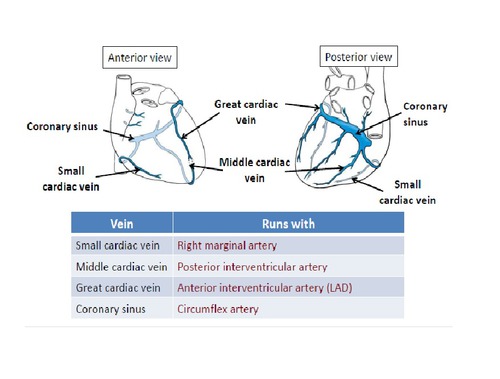
1. Coronary sinus (50%): Drains blood from left side of heart → Thebesian valve → Right Atrium

  • Location: Posterior coronary (atrio-ventricular) sulcus
  • Tributaries:
    • Left marginal vein → Great cardiac vein (anterior interventricular sulcus) → Coronary sinus
    • Right marginal vein → Small cardiac vein (right posterior coronary sulcus) → Coronary sinus
    • Middle cardiac vein (posterior interventricular sulcus) → Coronary sinus
    • Oblique vein of left atrium (oblique vein of Marshall)
    • Posterior vein of left ventricle
venous drainage of heart

2. Anterior cardiac veins (20%): Drain blood from right side of heart → Right Atrium

  • Location: Right anterior coronary sulcus

3. Thebesian veins/Venae cordis minimi (30%): Drain deoxygenated blood from endocardium and myocardium → Respective chamber of heart
  • Facebook
  • Twitter
PGMEE, MRCS, USMLE, MBBS, MD/MS AnatomyCardiovascular system

Post navigation

Previous post
Next post

Related Posts

PGMEE, MRCS, USMLE, MBBS, MD/MS protein-c-s mnemonic

Protein C and S pathway – Mnemonic

May 23, 2019May 23, 2019

Factor Va and VIIIa are different in coagulation cascade. They are the co-factors for factor Xa and IXa respectively. Another mnemonic: protein C Cuts Coagulation by Cutting Cofactors (Va and VIIIa) Protein S is cofactor for protein S. Protein C and S pathway using the mnemonic: Time To: Thrombin (factor…

Read More
PGMEE, MRCS, USMLE, MBBS, MD/MS

Fibromyalgia : Mnemonic Approach

Mar 5, 2022Jun 20, 2025

Clinical Features Mnemonic: FIBRO 1. Fatigue: 80-90% 2. Fibrofog: Dyscognition or Cognitive impairment e.g. trouble concentrating, forgetfulness, and disorganized or slow thinking 3. Insomnia: 90% 4. Blues: Depression and anxiety 5. Rigidity: Prolonged early morning stiffness not relieved by exercise and absence of synovitis 6. Ow!: Pain (the predominant symptom)…

Read More
PGMEE, MRCS, USMLE, MBBS, MD/MS

How Hyperchloremia Impairs Renal Function

Jul 7, 2025Jul 7, 2025

While historically, NS and RL have been thought to be generally equivalent for resuscitation, there has been an associated risk of hyperchloremic metabolic acidosis with large-volume resuscitation using normal saline. Hyperchoremic metabolic acidosis has been found to increase the risk of acute kidney injury. This is thought to be due to the…

Read More

Leave a Reply Cancel reply

Your email address will not be published. Required fields are marked *

This site uses Akismet to reduce spam. Learn how your comment data is processed.

Pre-clinical (Basic Sciences)

Anatomy

Biochemistry

Community medicine (PSM)

Embryology

Microbiology

Pathology

Pharmacology

Physiology

Clinical Sciences

Anesthesia

Dermatology

Emergency medicine

Forensic

Internal medicine

Gynecology & Obstetrics

Oncology

Ophthalmology

Orthopedics

Otorhinolaryngology (ENT)

Pediatrics

Psychiatry

Radiology

Surgery

RSS Ask Epomedicine

  • What to study for Clinical examination in Orthopedics?
  • What is the mechanism of AVNRT?

Epomedicine weekly

  • About Epomedicine
  • Contact Us
  • Author Guidelines
  • Submit Article
  • Editorial Board
  • USMLE
  • MRCS
  • Thesis
©2026 Epomedicine | WordPress Theme by SuperbThemes