Skip to content
Epomedicine

Mnemonics, Simplified Concepts & Thoughts

Epomedicine

Mnemonics, Simplified Concepts & Thoughts

Unhappy Triad of O’Donoghue : Mnemonic

Epomedicine, Oct 19, 2024Oct 19, 2024

O’Donoghue unhappy triad is occurrence of 3 different soft tissue injuries of knee simultaneously. It includes:

Mnemonic: MAM

  1. Medial collateral ligament injury
  2. Anterior cruciate ligament injury
  3. Medial meniscus injury (associated with lateral compartment bone bruise)
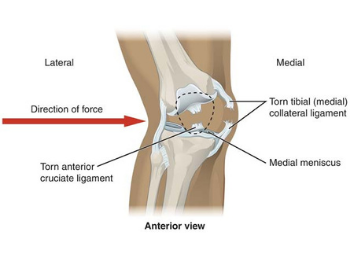
unhappy triad knee

Mechanism: valgus stress with rotation of the knee

Later on, more studies emerged showing that injuries in the lateral meniscus were more prevalent than injuries in the medial meniscus. The unhappy triad changed since its description by O’Donoghue. Being first described as a rupture in the ACL, MCL and medial meniscus, the latter was replaced by the lateral meniscus as a more frequent presence in this triad. Studies are now showing that due to the association of the triad with lesions of the anterolateral complex this is now a tetrad.

  • Facebook
  • Twitter
PGMEE, MRCS, USMLE, MBBS, MD/MS Musculoskeletal systemOrthopedicsRadiology

Post navigation

Previous post
Next post

Related Posts

PGMEE, MRCS, USMLE, MBBS, MD/MS

Muscles of Back – Simplified

Oct 18, 2020Oct 18, 2020

A. Superficial Group (Appendicular group) Arise from vertebral column and attach to shoulder (assist in movement of limbs) a. Most superficial: Trapezius (From external occipital protuberance, ligamentum nuchae and spinous process C7-T12) Latissimus dorsi (From spinous process T7-T12, thoracolumbar fascia and iliac crest) b. Covered by trapezius: Levator scapulae (From…

Read More
PGMEE, MRCS, USMLE, MBBS, MD/MS Anterior and posterior epistaxis

Epistaxis Basics : Anatomy, Physiology and Pathology

May 3, 2014

Synonyms: Nosebleed, Nasal bleeding Definition: Epistaxis is defined as bleeding from the nasal cavity. It ranges from minor blood-tinged mucus when blowing the nose to life-threatening hemorrhage. Epidemiology: Age: Bimodal distribution – common in <10 years and >60 years Season: Winter Anatomy and Physiology: Why is the nose prone to…

Read More
PGMEE, MRCS, USMLE, MBBS, MD/MS retinal layers

Retinal Layers Simplified

Jul 28, 2016Oct 29, 2017

The ten layers of retina – this microscopic anatomy is frequently asked in examinations and also important from the physiological viewpoint. There are plenty of mnemonics around the web, but we will proceed in a different approach to remember the 10 retinal layers easily. A. Retina is 3 neuron system…

Read More

Leave a Reply Cancel reply

Your email address will not be published. Required fields are marked *

This site uses Akismet to reduce spam. Learn how your comment data is processed.

Pre-clinical (Basic Sciences)

Anatomy

Biochemistry

Community medicine (PSM)

Embryology

Microbiology

Pathology

Pharmacology

Physiology

Clinical Sciences

Anesthesia

Dermatology

Emergency medicine

Forensic

Internal medicine

Gynecology & Obstetrics

Oncology

Ophthalmology

Orthopedics

Otorhinolaryngology (ENT)

Pediatrics

Psychiatry

Radiology

Surgery

RSS Ask Epomedicine

  • What to study for Clinical examination in Orthopedics?
  • What is the mechanism of AVNRT?

Epomedicine weekly

  • About Epomedicine
  • Contact Us
  • Author Guidelines
  • Submit Article
  • Editorial Board
  • USMLE
  • MRCS
  • Thesis
©2026 Epomedicine | WordPress Theme by SuperbThemes