Skip to content
Epomedicine

Mnemonics, Simplified Concepts & Thoughts

Epomedicine

Mnemonics, Simplified Concepts & Thoughts

glass prescription slip

Understanding Eye Glass Prescription Slip

Epomedicine, Aug 12, 2015Aug 17, 2015

A phoropter/refractor is an instrument commonly used by eye care professionals during an eye examination, containing different lenses used for refraction of the eye during sight testing, to measure an individual’s refractive error and determine his or her eyeglass prescription. Retinoscopy is done instead in children who are unable to communicate.

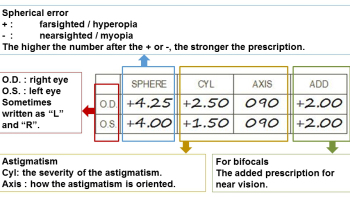
Below is an example of a glass prescription slip with a bird’s eye view interpretation for each components. As a doctor, understanding the glass prescription slip helps in making the diagnosis and proper counselling and as a patient one understands about his/her disease.
glass prescription slip
An example of glass prescription slip with interpretations.

Relevant terms to understand glass prescription slip:

1. OD (Oculus dexter): Right Eye

2. OS (Oculus sinister): Left Eye

3. OU (oculus uterque): Both Eyes

4. SPH (Sphere): Amount of lens power in dioptres required to correct near-sightedness (myopia) or far-sightedness (hypermetropia)

  • Correction is equal in all meridians of eye
  • If number has minus (-) sign: it is Myopia
  • If number has plus (+) sign: it is Hypermetropia

5. CYL (Cylinder): Amount of lens power for astigmatism

  • Correction in meridian specified by the prescribed axis
  • One meridian has no added curvature, and the meridian perpendicular to this “no added power” meridian contains the maximum power and lens curvature to correct astigmatism.
  • If number has minus (-) sign: it is Myopic astigmatism
  • If number has plus (+) sign: it is Hypermetropic astigmatism

6. Axis: The lens meridian that is 90 degrees away from the meridian that contains the cylinder power.

  • 90 indicates “with-the-rule” astigmatism
  • 180 indicates “against-the-rule” astigmatism

7. Near Add: Added magnifying power to the bottom of the multifocal lens to correct presbyopia

  • Always + even when not specified

Large difference in the power between two eyes (anisometropia) may lead to amblyopia in children. Hence, this is concerning.
  • Facebook
  • Twitter
PGMEE, MRCS, USMLE, MBBS, MD/MS OphthalmologyPatient

Post navigation

Previous post
Next post

Related Posts

PGMEE, MRCS, USMLE, MBBS, MD/MS chemokines

Chemokines Mnemonics

Jan 18, 2017Jan 18, 2017

Difference between cytokines and chemokines Cytokines are small proteins released by cells, the function of which is “cell-signaling“. Chemokines are small cytokines, which functions as a “chemo-attractant“. Types of Chemokines When you go through the structural classification of chemokines, you come accross various arrangements of letter: C: denotes cysteine X:…

Read More
PGMEE, MRCS, USMLE, MBBS, MD/MS immunization schedule nepal

National Immunization Schedule of Nepal (2024)

May 20, 2019Oct 5, 2024

There should be at least 7 contacts of children (At birth, 6,10,14 weeks, 9, 12, 15 months) to health center to fully immunize as per national immunization programme of Nepal. Previously, 11 antigens were provided through national immunization program. Recently, rotavirus vaccine and fIPV (fractional IPV) has been added. Nepal is polio…

Read More
PGMEE, MRCS, USMLE, MBBS, MD/MS

Paget’s Disease of bone : Mnemonic

Jul 20, 2022Jul 20, 2022

Synonyms: Osteitis deformans Collage of matrix madness Mnemonic: Sixteen “P”s 1. Paramyxovirus infection and inclusions in osteocalsts 2. Pain (most common symptom – localized fractures or nerve compressions) 3. Pelvis (most common site) 4. Polyostotic (more common; 85%) 5. Phases: Active (lytic, mixed, sclerotic) and Inactive 6. Plasma volume expansion…

Read More

Comment

  1. Maksuda Mehmud Maniyar says:
    Jul 20, 2020 at 4:24 am

    I am medical student
    And your Content really help me in studies. Thank u very much…

    Reply

Leave a Reply to Maksuda Mehmud Maniyar Cancel reply

Your email address will not be published. Required fields are marked *

This site uses Akismet to reduce spam. Learn how your comment data is processed.

Pre-clinical (Basic Sciences)

Anatomy

Biochemistry

Community medicine (PSM)

Embryology

Microbiology

Pathology

Pharmacology

Physiology

Clinical Sciences

Anesthesia

Dermatology

Emergency medicine

Forensic

Internal medicine

Gynecology & Obstetrics

Oncology

Ophthalmology

Orthopedics

Otorhinolaryngology (ENT)

Pediatrics

Psychiatry

Radiology

Surgery

RSS Ask Epomedicine

  • What to study for Clinical examination in Orthopedics?
  • What is the mechanism of AVNRT?

Epomedicine weekly

  • About Epomedicine
  • Contact Us
  • Author Guidelines
  • Submit Article
  • Editorial Board
  • USMLE
  • MRCS
  • Thesis
©2026 Epomedicine | WordPress Theme by SuperbThemes