Skip to content
Epomedicine

Mnemonics, Simplified Concepts & Thoughts

Epomedicine

Mnemonics, Simplified Concepts & Thoughts

Congenital Pseudoarthrosis of Tibia (CPT)

Epomedicine, Mar 24, 2023Jul 31, 2024

Origin of Pathology

Periosteum

  • The periosteum could create a fibrous band causing an increase in local pressure around the bone resulting in reduced vascularization as well as bone atrophy

Clinical features

Mnemonic: ABCDeF

  1. Age of onset:
    • Early (<4 years old) – majority present with bowing in 1st year of life
    • Late (>4 years old)
  2. Bowing: Antero-lateral (junction of middle 1/3 and distal 1/3)
  3. Cafe-au-lait spots and Neurofibromatosis type 1 (in 55% cases)
  4. Deformity
  5. Fractures; Fibrous dysplasia (in 15% cases)

Boyd Classification

Mnemonic: B-2C-2D-E
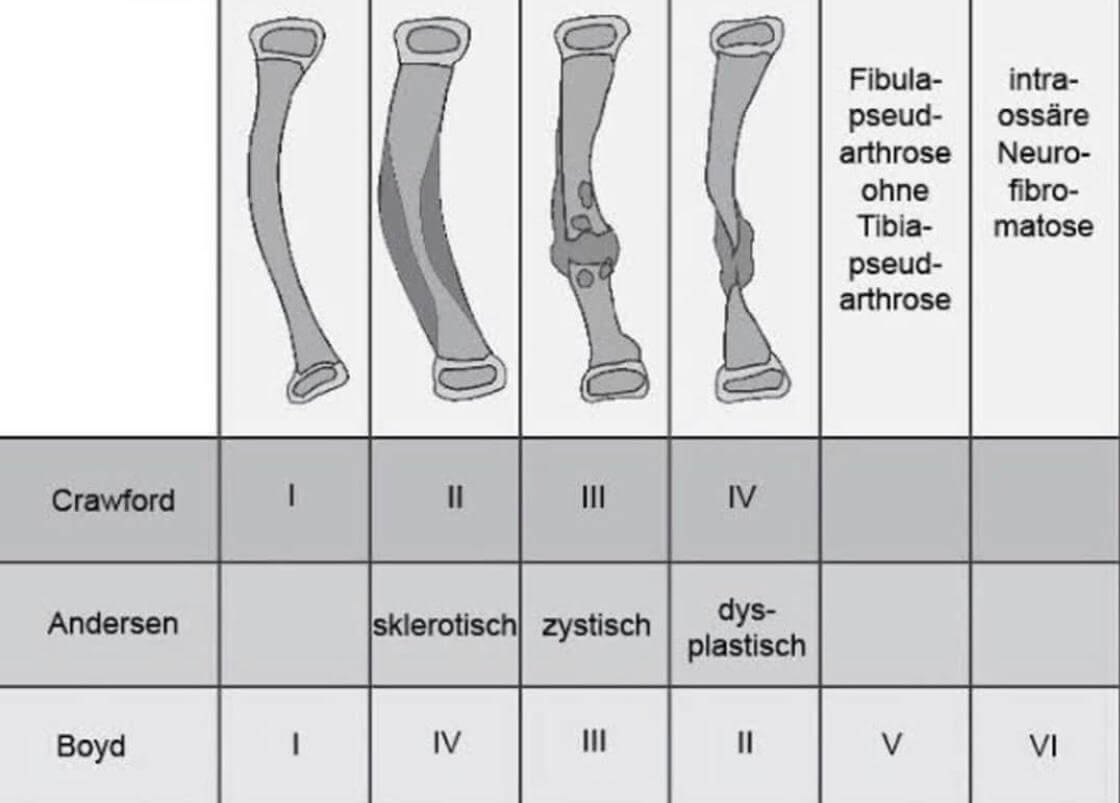
CPT classification

I – Bowing

II – Constriction (hourlgass)

  • Most common type
  • Poorest prognosis
  • More often associated with NF1

III – Cyst

IV – Dense (Sclerotic)

V – Dysplastic fibula

VI – “Endosseous” (Intraosseous) neurofibroma or schwannoma

Paley Classification

TypeBone endsPseudoarthrosis mobilityPrevious surgical intervention
1AtrophicMobileAbsent
2AtrophicMobilePresent
3HypertrophicStiffAbsent/Present

Treatment

cpt treatment

Differential Diagnoses

1. Osteofibrous dysplasia of long bones

2. Congenital angulation of tubular bones

3. Monostotic fibrous dysplasia

Poor Prognostic Factors

  1. Markedly progressed disease
  2. Early fractures
  3. Inferior metaphyseal location of pseudoarthrosis
  4. Atrophy of bone
  5. Extensive sclerotic lesions with a smaller diameter bone
  6. Significant shortening
  7. Associated fibular involvement
  • Facebook
  • Twitter
PGMEE, MRCS, USMLE, MBBS, MD/MS Musculoskeletal systemOrthopedics

Post navigation

Previous post
Next post

Related Posts

PGMEE, MRCS, USMLE, MBBS, MD/MS

THA dislocation : WHAT mnemonic

May 28, 2021Oct 30, 2022

The incidence of THA dislocation is: Primary THA: 1-2% Revision THA: 5-7% Mnemonic: WHAT caused the total hip arthroplasty dislocation? Wear Types: Volumetric wear: proportional to r2 (diameter of head) Linear wear (related to penetration of femoral head into liner): smaller heads have higher linear wear Adhesive wear (most important):…

Read More
PGMEE, MRCS, USMLE, MBBS, MD/MS

Shoulder Muscles Anatomy – Simplified

Nov 2, 2019Nov 2, 2019

Proximal humerus Insertion of Rotato Cuffs Mnemonic: SIT-S a. Greater tubercle: Supraspinatus, Infraspinatus, Teres minor b. Lesser tubercle: Subscapularis Attachment of Other muscles Anteriorly and posteriorly the muscles attach on each side of the depressions (groove and sulcus). a. Anteriorly: Insertion of 3 muscles Mnemonic: Lady between 2 Majors Crest…

Read More
PGMEE, MRCS, USMLE, MBBS, MD/MS

Atropine Induced Paradoxical Bradycardia

Jan 5, 2022Jan 5, 2022

Atropine induced paradoxical bradycardia is the sinus bradyarrhythmia following low-dose atropine resulting from the paradoxical slowing in the sinoatrial (SA) node discharge rate. Mechanism of Atropine Induced Paradoxical Bradycardia Central vagotonic effect (blocking M1 acetylcholine receptors in parasympathetic ganglion controlling SA node) of atropine which, at higher doses, is masked…

Read More

Leave a Reply Cancel reply

Your email address will not be published. Required fields are marked *

This site uses Akismet to reduce spam. Learn how your comment data is processed.

Epomedicine. Congenital Pseudoarthrosis of Tibia (CPT) [Internet]. Epomedicine; 2023 Mar 24 [cited 2026 Jan 17]. Available from: https://epomedicine.com/medical-students/boyd-classification-for-congenital-pseudoarthrosis-of-tibia/.

Pre-clinical (Basic Sciences)

Anatomy

Biochemistry

Community medicine (PSM)

Embryology

Microbiology

Pathology

Pharmacology

Physiology

Clinical Sciences

Anesthesia

Dermatology

Emergency medicine

Forensic

Internal medicine

Gynecology & Obstetrics

Oncology

Ophthalmology

Orthopedics

Otorhinolaryngology (ENT)

Pediatrics

Psychiatry

Radiology

Surgery

RSS Ask Epomedicine

  • What to study for Clinical examination in Orthopedics?
  • What is the mechanism of AVNRT?

Epomedicine weekly

  • About Epomedicine
  • Contact Us
  • Author Guidelines
  • Submit Article
  • Editorial Board
  • USMLE
  • MRCS
  • Thesis
©2026 Epomedicine . All rights reserved.