Skip to content
Epomedicine

Mnemonics, Simplified Concepts & Thoughts

Epomedicine

Mnemonics, Simplified Concepts & Thoughts

urinary bladder cancer tnm

TNM and staging of Urinary Bladder Cancer Simplified

Epomedicine, Aug 14, 2016

As discussed earlier in – TNM Classification and Cancer Staging Simplified, Urinary bladder is a hollow organ whose “T” classification resembles that of the gastrointestinal tract. Since, the regional lymph nodes of the urinary bladder also lie beyond the serosa like in colon and rectum, positive regional nodes are usually seen only with advanced tumors, i.e. T4=N1.  The regional lymph nodes are below the bifurcation of the common iliac arteries and above the inguinal ligament

TNM Classification
urinary bladder cancer tnm

Primary Tumor (T)

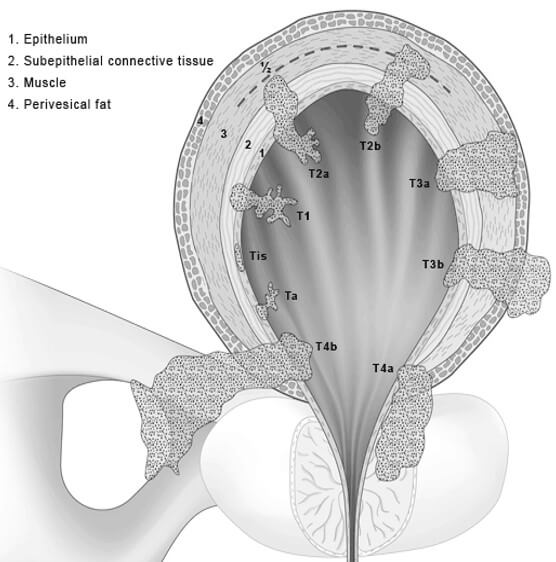
Progressive involvement of the layers of wall and beyond.

  • T1: Submucosa (Lamina propria or Subepithelial tissue)
  • T2: Muscularis propria
    • a: superficial (inner half)
    • b: deep (outer half)
  • T3: Perivesical fat or tissue
    • a: microscopically
    • b: macroscopically
  • T4: Invasion of adjacent structures
    • a: prostatic stroma, uterus, vagina
    • b: pelvic wall, abdominal wall

Regional Lymph Node (N)

  • N1: Single positive node in primary drainage regions (in true pelvis)
  • N2: Multiple positive nodes in primary drainage regions (in true pelvis)
  • N3: Common iliac nodes

AJCC staging for Bladder Cancer
urinary bladder cancer staging matrix

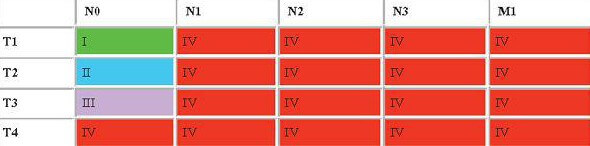
T4b or N1-3 or M1 = Stage IV (~5% five year survival)

Stage I-III is N0M0 and corresponds to “T” classification:

  • T1N0M0 = Stage I (~88% five year survival)
  • T2N0M0 = Stage II (~63% five year survival)
  • T3 or 4a NoMo = Stage III (~46% five year survival)

General Principle of Management

  • Stage I: Conservatively resected transurethrally
  • Stage II: Partial cystectomies
  • Stage III: Total cystectomy and urethral diversion
  • Stage IV: No longer completely resectable.

25 shares
  • Facebook25
  • Twitter
PGMEE, MRCS, USMLE, MBBS, MD/MS General SurgeryOncologyRenal and Electroloyte

Post navigation

Previous post
Next post

Related Posts

PGMEE, MRCS, USMLE, MBBS, MD/MS

Friedreich’s Ataxia : Mnemonic

Oct 21, 2022Oct 21, 2022

Friedreich’s ataxia is a hereditary spinocerebellar degenerative disorder named after German neurologist, Professor Nicholaus Friedreich. Mnemonic: FRIEDREICH’S Ataxia 1. Foot deformity (progressive cavo-varus), Frataxin expression reduced 2. Recessive (autosomal), Repeat of trinucleotide GAA (chromosome 9) 3. Iron accumulation in mitochondria 4. Extensor plantar response 5. Dysarthria (within 5 years of…

Read More
PGMEE, MRCS, USMLE, MBBS, MD/MS

Anterior Cranial Fossa : Mnemonic

Apr 29, 2024Apr 29, 2024

Boundaries Contents Mnemonic: Remember 6 ‘C’ 1. Frontal Crest: Site of attachment of falx cerebri 2. Foramen Cecum (Between frontal crest and crista galli): Site of communication between the draining veins of nasal cavity and the superior sagittal sinus 3. Crista galli: Site of attachment for falx cerebri 4. Cribiform…

Read More
PGMEE, MRCS, USMLE, MBBS, MD/MS hodgkin staging

Hodgkin’s Lymphoma – Staging and Prognostic Factors

Aug 13, 2016Aug 13, 2016

Costwold Modified Ann-Arbor Staging I: 1 Lymph Node (LN) region (I) or 1 Extralymphatic site (IE) II: On the same side of diaphragm – ≥2 LN region (II) or Localized Extralymphatic extension + ≥1 LN region (IIE) III: On both the sides of diaphragm – LN regions (III) ± Spleen involvement (IIIS) ± Localized…

Read More

Leave a Reply Cancel reply

Your email address will not be published. Required fields are marked *

This site uses Akismet to reduce spam. Learn how your comment data is processed.

Pre-clinical (Basic Sciences)

Anatomy

Biochemistry

Community medicine (PSM)

Embryology

Microbiology

Pathology

Pharmacology

Physiology

Clinical Sciences

Anesthesia

Dermatology

Emergency medicine

Forensic

Internal medicine

Gynecology & Obstetrics

Oncology

Ophthalmology

Orthopedics

Otorhinolaryngology (ENT)

Pediatrics

Psychiatry

Radiology

Surgery

RSS Ask Epomedicine

  • What to study for Clinical examination in Orthopedics?
  • What is the mechanism of AVNRT?

Epomedicine weekly

  • About Epomedicine
  • Contact Us
  • Author Guidelines
  • Submit Article
  • Editorial Board
  • USMLE
  • MRCS
  • Thesis
©2026 Epomedicine | WordPress Theme by SuperbThemes