Skip to content
Epomedicine

Mnemonics, Simplified Concepts & Thoughts

Epomedicine

Mnemonics, Simplified Concepts & Thoughts

Talus Anatomy : Mnemonic

Epomedicine, Jan 3, 2023Jan 4, 2023

Mnemonic: 0, 1, 2, 3, 4, 5

0 : Attachments of muscles and tendons

1 : Sinus and Canal

  • sinus tarsi – a space bordered by the neck of the talus and anterosuperior aspect of the calcaneus; contains –
    • Artery of sinus tarsi
    • Talocalcaneal interosseous ligament
    • Cervical ligament
  • tarsal canal – medial opening to sinus tarsi; contains –
    • Artery of tarsal canal
    • Talocalcaneal interosseous ligament

2 : Processes and Tubercles

  • Lateral process: 2 attachments –
    • lateral talocalcaenal ligament
    • ATFL (anterior talo-fibular ligament)
    • Fracture = “snowboarder’s” fracture
  • Posterior process: FHL tendon runs between the 2 tubercles
    • Medial tubercle
    • Lateral tubercle:
      • Stieda process: elongated anatomical variant
      • Os trigonum: non-fusion of ossification center

3 : Parts

  • Head
  • Neck
  • Body

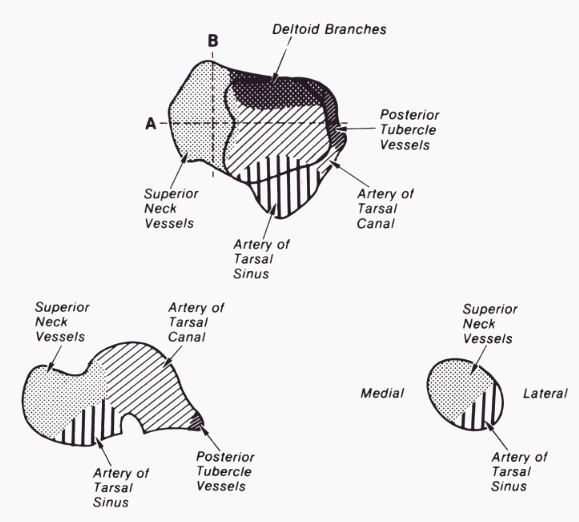
4 : Blood vessels:

  • Posterior tibial artery:
    • Artery of tarsal canal (most important): supplies most talar body
    • Calcaneal branches: supplies posterior talus
  • Anterior tibial artery: supplies head and neck
  • Perforating peroneal arteries
    • Artery of tarsal sinus: supplies head and neck
  • Deltoid artery: supplies body (important in talar neck fracture)
Blood Supply of Talus

5 : Articulating surfaces

  • 2 on head:
    • with navicular
    • with calcaneus (anterior facet)
  • 2 on body:
    • with calcaneus (middle facet)
    • with calcaneus (posterior facet)
  • 1 on lateral process:
    • with lateral malleolus
  • Facebook
  • Twitter
PGMEE, MRCS, USMLE, MBBS, MD/MS AnatomyMusculoskeletal systemOrthopedics

Post navigation

Previous post
Next post

Related Posts

PGMEE, MRCS, USMLE, MBBS, MD/MS pulmonary embolism xray

Perioperative Management of Venous thromboembolism (VTE)

Nov 3, 2021Nov 3, 2021

Recommended duration of anticoagulant prophylaxis The recommendations are as follows: 1. Provoked DVT (with reversible surgical or nonsurgical provoking factor): 3 months 2. Unprovoked isolated distal DVT (has low risk of recurrence): 3 months 3. Unprovoked proximal DVT or PE: Indefinite therapy if D-dimer positive after 1 month after 3 months of therapy or second VTE…

Read More
PGMEE, MRCS, USMLE, MBBS, MD/MS

SCFE : Mnemonic Approach

Jan 5, 2023Jan 5, 2023

Approach to a limping child General points Classification Management depends on 4 factors which can be remembered using the mnemonic SCFE. Stability and Severity a. Loder classification: b. Severity: Severity Southwick angle on frog-leg lateral view (Difference of head-shaft angle from normal side) Wilson slip % on AP or frog-leg…

Read More

Anatomy and Physiology of Sebaceous glands

Nov 11, 2013

Definition: Sebaceous glands are numerous microscopic glands in the dermis that usually open into the hair follicles and secrete sebum. They are holocrine glands, i.e., the sebum consists of the entire secreting cells. Location: Found everywhere on the skin apart from the palms and soles Types of Sebaceous glands: 1….

Read More

Leave a Reply Cancel reply

Your email address will not be published. Required fields are marked *

This site uses Akismet to reduce spam. Learn how your comment data is processed.

Pre-clinical (Basic Sciences)

Anatomy

Biochemistry

Community medicine (PSM)

Embryology

Microbiology

Pathology

Pharmacology

Physiology

Clinical Sciences

Anesthesia

Dermatology

Emergency medicine

Forensic

Internal medicine

Gynecology & Obstetrics

Oncology

Ophthalmology

Orthopedics

Otorhinolaryngology (ENT)

Pediatrics

Psychiatry

Radiology

Surgery

RSS Ask Epomedicine

  • What to study for Clinical examination in Orthopedics?
  • What is the mechanism of AVNRT?

Epomedicine weekly

  • About Epomedicine
  • Contact Us
  • Author Guidelines
  • Submit Article
  • Editorial Board
  • USMLE
  • MRCS
  • Thesis
©2026 Epomedicine | WordPress Theme by SuperbThemes