Skip to content
Epomedicine

Mnemonics, Simplified Concepts & Thoughts

Epomedicine

Mnemonics, Simplified Concepts & Thoughts

Talus Anatomy : Mnemonic

Epomedicine, Jan 3, 2023Jan 4, 2023

Mnemonic: 0, 1, 2, 3, 4, 5

0 : Attachments of muscles and tendons

1 : Sinus and Canal

  • sinus tarsi – a space bordered by the neck of the talus and anterosuperior aspect of the calcaneus; contains –
    • Artery of sinus tarsi
    • Talocalcaneal interosseous ligament
    • Cervical ligament
  • tarsal canal – medial opening to sinus tarsi; contains –
    • Artery of tarsal canal
    • Talocalcaneal interosseous ligament

2 : Processes and Tubercles

  • Lateral process: 2 attachments –
    • lateral talocalcaenal ligament
    • ATFL (anterior talo-fibular ligament)
    • Fracture = “snowboarder’s” fracture
  • Posterior process: FHL tendon runs between the 2 tubercles
    • Medial tubercle
    • Lateral tubercle:
      • Stieda process: elongated anatomical variant
      • Os trigonum: non-fusion of ossification center

3 : Parts

  • Head
  • Neck
  • Body

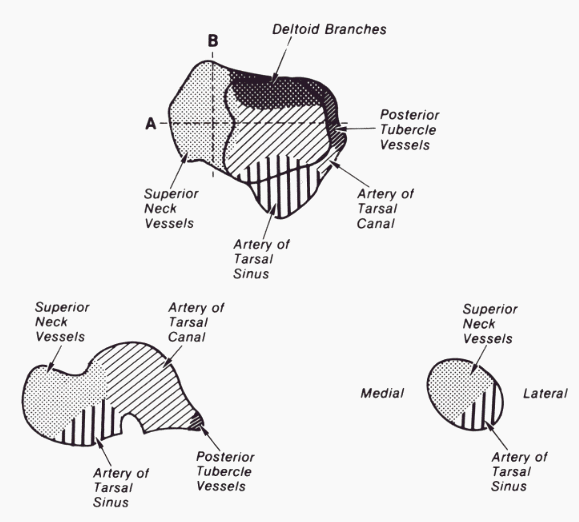
4 : Blood vessels:

  • Posterior tibial artery:
    • Artery of tarsal canal (most important): supplies most talar body
    • Calcaneal branches: supplies posterior talus
  • Anterior tibial artery: supplies head and neck
  • Perforating peroneal arteries
    • Artery of tarsal sinus: supplies head and neck
  • Deltoid artery: supplies body (important in talar neck fracture)
Blood Supply of Talus

5 : Articulating surfaces

  • 2 on head:
    • with navicular
    • with calcaneus (anterior facet)
  • 2 on body:
    • with calcaneus (middle facet)
    • with calcaneus (posterior facet)
  • 1 on lateral process:
    • with lateral malleolus
  • Facebook
  • Twitter
PGMEE, MRCS, USMLE, MBBS, MD/MS AnatomyMusculoskeletal systemOrthopedics

Post navigation

Previous post
Next post

Related Posts

PGMEE, MRCS, USMLE, MBBS, MD/MS

Chronic Wounds : Mnemonic Approach

Jan 18, 2021Jan 18, 2021

Chronic wounds are wounds that have failed to proceed through an orderly and timely reparative process to produce anatomic and functional integrity over a period of 3 months. Factors that Adversely Affect Wound Healing Mnemonic: DIDN’T HEAL Diabetes (Diminished sensation, peripheral perfusion and impaired polymorphonuclear phagocytosis) Infection Drugs (Steroids and…

Read More
PGMEE, MRCS, USMLE, MBBS, MD/MS

Management of Skeletal Tuberculosis – Principles

Dec 20, 2022Dec 20, 2022

Classification Stage/Type Pott’s spine (Kumar’s) Pott’s paraplegia (Tuli) Hip and Knee Hip (Shanmugasundaram) I Predestructive (Straightening, spasm, hyperemia) Negligible (Objective plantar extensor response or ankle clonus) Synovitis (ROM 75-100%/Haziness, rarefaction)– Hip: FAbER, Apparent lengthening Normal (C) II Early destructive (Diminished space, paradiscal erosion, K<10) Mild (Subjective neuro-deficit but walks with…

Read More
PGMEE, MRCS, USMLE, MBBS, MD/MS

Oxygen Hemoglobin Dissociation Curve : Mnemonic

Aug 28, 2021Aug 28, 2021

The oxygen hemoglobin dissociation curve is sigmoidal in shape because the binding of 1st oxygen molecule is difficult, however once bound, they facilitate the binding of subsequent molecules until the saturation is reached (plateau). This is called the allosteric interaction (cooperativity). Lets come to the mnemonics now. The curve can…

Read More

Leave a Reply Cancel reply

Your email address will not be published. Required fields are marked *

This site uses Akismet to reduce spam. Learn how your comment data is processed.

Epomedicine. Talus Anatomy : Mnemonic [Internet]. Epomedicine; 2023 Jan 3 [cited 2026 May 31]. Available from: https://epomedicine.com/medical-students/talus-anatomy-mnemonic/.

Pre-clinical (Basic Sciences)

Anatomy

Biochemistry

Community medicine (PSM)

Embryology

Microbiology

Pathology

Pharmacology

Physiology

Clinical Sciences

Anesthesia

Dermatology

Emergency medicine

Forensic

Internal medicine

Gynecology & Obstetrics

Oncology

Ophthalmology

Orthopedics

Otorhinolaryngology (ENT)

Pediatrics

Psychiatry

Radiology

Surgery

RSS Ask Epomedicine

  • What to study for Clinical examination in Orthopedics?
  • What is the mechanism of AVNRT?

Epomedicine weekly

  • About Epomedicine
  • Contact Us
  • Author Guidelines
  • Submit Article
  • Editorial Board
  • USMLE
  • MRCS
  • Thesis
©2026 Epomedicine | WordPress Theme by SuperbThemes