Skip to content
Epomedicine

Mnemonics, Simplified Concepts & Thoughts

Epomedicine

Mnemonics, Simplified Concepts & Thoughts

sleep eeg

Sleep Stages and EEG : Mnemonic

Epomedicine, Jul 2, 2018

Mnemonic: BATS Drink Blood – in sleep
sleep eeg

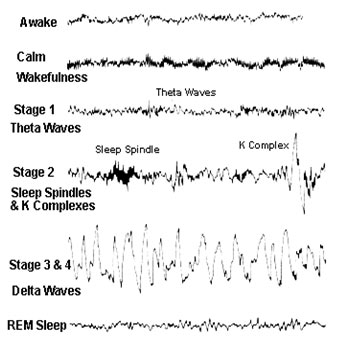
1. Awake with eyes open: Beta wave (highest frequency and lowest amplitude)

2. Awake with eyes closed: Alpha wave (synchronized brain activity)

3. NREM/Slow wave/Orthodox sleep (70-80%):

  • Stage 1 (light sleep): Theta waves
  • Stage 2 (intermediate): Sleep spindles and K-complex
  • Stage 3 and 4 (deep sleep): Delta waves (lowest frequency and highest amplitude)

4. REM/Paradoxical sleep (20-30%): Beta waves

Order in which frequency decreases and amplitude increases: BAT Drink

  1. Beta wave: >14 Hz, low amplitude
  2. Alpha wave: 8-13 Hz, high amplitude
  3. Theta wave: 4-7 Hz, high amplitude
  4. Delta wave: 3-5 Hz, maximum amplitude
3 shares
  • Facebook
  • Twitter
PGMEE, MRCS, USMLE, MBBS, MD/MS Nervous systemPhysiology

Post navigation

Previous post
Next post

Related Posts

PGMEE, MRCS, USMLE, MBBS, MD/MS

Wound Healing : Stages

Aug 5, 2020Aug 5, 2020

1. Haemostasis (immediate): In response to exposed collagen, platelets aggregate at the wound and degranulate, releasing inflammatory mediators. Clotting and complement cascades activated. Thrombus  formation and reactive vasospasm achieve haemostasis. 2. Inflammation (0-3 days): Vasodilatation and increased capillary permeability allow inflammatory cells to enter wound, and cause swelling. Neutrophils amplify inflammatory response by release…

Read More
PGMEE, MRCS, USMLE, MBBS, MD/MS myeloid differentiation aml

Concept of Acute Myeloid Leukemia (AML) FAB Classification

Aug 23, 2016Mar 10, 2018

There is no need of mnemonics to remember the FAB classification of Acute Myeloid Leukemia (AML); just remember the process myeloid differentiation. A simple schematic diagram with few intermediate processes and stimulating factors eliminated will meet our purpose here. The cells belonging to the myeloid lineage are: Granulocytes: Neutrophils, Eosinophils…

Read More
PGMEE, MRCS, USMLE, MBBS, MD/MS opioid receptors

Opioid Adverse Effects – Mnemonic

Apr 14, 2021Apr 14, 2021

Mnemonic: MORPHINES 1. Miosis Mechanism: Stimulation of Edinger-Westphal nucleus of Cranial nerve III 2. Orthostatic hypotension Mechanism: Vasodilation due to – Direct action decreasing tone of blood vessels Histamine release Depression of vasomotor center 3. Respiratory depression Mechanism: Inhibits respiratory center in a dose-dependent manner (neurogenic, hypercapneic and hypoxic drives…

Read More

Leave a Reply Cancel reply

Your email address will not be published. Required fields are marked *

This site uses Akismet to reduce spam. Learn how your comment data is processed.

Pre-clinical (Basic Sciences)

Anatomy

Biochemistry

Community medicine (PSM)

Embryology

Microbiology

Pathology

Pharmacology

Physiology

Clinical Sciences

Anesthesia

Dermatology

Emergency medicine

Forensic

Internal medicine

Gynecology & Obstetrics

Oncology

Ophthalmology

Orthopedics

Otorhinolaryngology (ENT)

Pediatrics

Psychiatry

Radiology

Surgery

RSS Ask Epomedicine

  • What to study for Clinical examination in Orthopedics?
  • What is the mechanism of AVNRT?

Epomedicine weekly

  • About Epomedicine
  • Contact Us
  • Author Guidelines
  • Submit Article
  • Editorial Board
  • USMLE
  • MRCS
  • Thesis
©2026 Epomedicine | WordPress Theme by SuperbThemes