Skip to content
Epomedicine

Mnemonics, Simplified Concepts & Thoughts

Epomedicine

Mnemonics, Simplified Concepts & Thoughts

Sciatic Nerve Variations around Piriformis Muscle

Epomedicine, Jul 15, 2025Jul 15, 2025

Variations involving the relationship between the sciatic nerve and the piriformis muscle are commonly classified based on Beaton and Anson’s classification.

Mnemonic: I Prefer Smart Anatomy For Perfect nerve-sparing
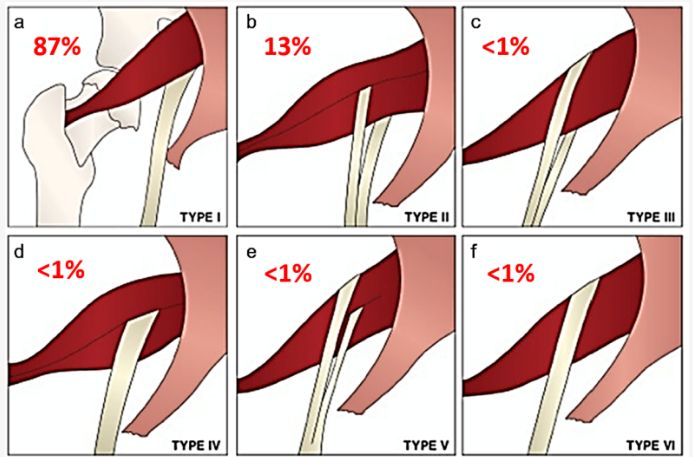
sciatic nerve variations
Bharadwaj UU, Varenika V, Carson W, Villanueva-Meyer J, Ammanuel S, Bucknor M, Robbins NM, Douglas V, Chin CT. Variant Sciatic Nerve Anatomy in Relation to the Piriformis Muscle on Magnetic Resonance Neurography: A Potential Etiology for Extraspinal Sciatica. Tomography. 2023; 9(2):475-484. https://doi.org/10.3390/tomography9020039 [CC BY 4.0]
TypeMnemonicMeaningDescriptionPrevalence
IIInferiorUndivided sciatic nerve passes below piriformis87%
IIPreferPiercingPeroneal pierces, tibial passes below13%
IIISmartSuperiorPeroneal above, tibial below<1%
IVAnatomyAll throughEntire sciatic pierces piriformis<1%
VForForked/Above and ThroughPeroneal above, tibial pierces piriformis<1%
VIPerfectPierced bothBoth divisions pierces piriformis<1%

Clinical Significance

  1. Piriformis Syndrome: Variations where nerve pierces or splits through the piriformis may predispose to entrapment neuropathy.
  2. Sciatic Nerve Block: Anomalies affect landmark-based regional anesthesia.
  3. Hip and Gluteal Surgery: Important for avoiding iatrogenic injury during posterior hip approaches.
  4. Imaging Interpretation: Variations may mimic masses or pathology on MRI/CT.
  • Facebook
  • Twitter
PGMEE, MRCS, USMLE, MBBS, MD/MS Musculoskeletal systemOrthopedics

Post navigation

Previous post
Next post

Related Posts

PGMEE, MRCS, USMLE, MBBS, MD/MS

Straight Leg Raising Test (SLRT) – Pathophysiology

Apr 20, 2020Jun 3, 2020

Epineurium of sciatic nerve (like all other nerves) is continuous with the duramater withing the spinal canal which is firmly attached to the foramen magnum above and the filum terminale below. In the elastic neuromeningeal pathway, tension applied at one point will spread through out the length of spine until…

Read More
PGMEE, MRCS, USMLE, MBBS, MD/MS

Z-effect and Reverse Z-effect in PFN

Apr 27, 2023Jan 20, 2024

‘Z-effect’ and ‘Reverse Z-effect’ are complications relating to differential migration of screws that arise from fixation of unstable proximal femoral fractures with Proximal Femoral Nail (PFN) having 2 interlocking head screws. The 4 patterns of unstable intertrochanteric fracture hip are: Z-effect: The Z-effect involves the lateral migration of the lag…

Read More
PGMEE, MRCS, USMLE, MBBS, MD/MS

Pressure Sores and Bed Sores

Oct 22, 2022Oct 22, 2022

A pressure injury is localized damage to the skin and underlying soft tissue usually over a bony prominence or related to a medical or other device. Normal capillary refill is 16-33 mmHg. Ischemia occurs with prolonged pressure >33 mmHg: Ischial tuberosity: >100 mmHg during sitting Sacral region: 40-60 mmHg in…

Read More

Leave a Reply Cancel reply

Your email address will not be published. Required fields are marked *

This site uses Akismet to reduce spam. Learn how your comment data is processed.

Pre-clinical (Basic Sciences)

Anatomy

Biochemistry

Community medicine (PSM)

Embryology

Microbiology

Pathology

Pharmacology

Physiology

Clinical Sciences

Anesthesia

Dermatology

Emergency medicine

Forensic

Internal medicine

Gynecology & Obstetrics

Oncology

Ophthalmology

Orthopedics

Otorhinolaryngology (ENT)

Pediatrics

Psychiatry

Radiology

Surgery

RSS Ask Epomedicine

  • What to study for Clinical examination in Orthopedics?
  • What is the mechanism of AVNRT?

Epomedicine weekly

  • About Epomedicine
  • Contact Us
  • Author Guidelines
  • Submit Article
  • Editorial Board
  • USMLE
  • MRCS
  • Thesis
©2026 Epomedicine | WordPress Theme by SuperbThemes