Skip to content
Epomedicine

Mnemonics, Simplified Concepts & Thoughts

Epomedicine

Mnemonics, Simplified Concepts & Thoughts

Pharmacology of Carbapenems : Mnemonics

Dr. Sulabh Kumar Shrestha, MS Orthopedics, Mar 30, 2021Mar 30, 2021

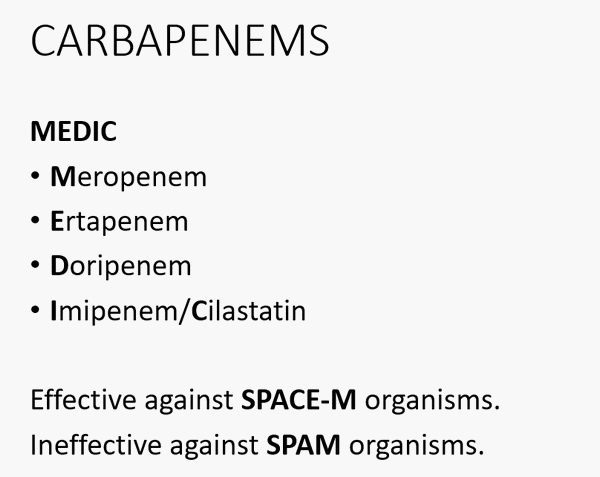
Commonly used Carbapenems

Mnemonic: MEDIC

  1. Meropenem
  2. Ertapenem
  3. Doripenem
  4. Imipenem/Cilastatin (renal dehydropeptidase I inhibitor)

Besides these, there are other drugs like tebipenem (1st oral carbapenem), panipenem, tomopenem (has MRSA activity), etc. which fall under carbapenems.
carbapenems mnemonic

Coverage

As the name suggests, they have carbapenems attached to beta-lactam ring which provides protection against most beta-lactamases. They have good gram positive, gram negative and anaerobe coverage.

These are effective against beta-lactamase producing organisms like SPACE-M (cephalosporins are often ineffective in these):

  1. Serratia
  2. Pseudomonas aeruginosa; Proteus vulgarus, Providencia
  3. Acinetobacter
  4. Citrobacter
  5. Enterobacter
  6. Morganella

Ertapenem lacks good coverage against: APE organisms (hence, referred as gorilla-cillin as well).

  1. Acinetobacter
  2. Pseudomonas aeruginosa
  3. Enterococcus

Some organisms are able to SPAM carbapenems and hence, do not work well with:

  1. Stenotrophomonas maltophilia
  2. Pseudomonas cepacia
  3. Atypicals (Legionella, Chlamydica, Mycoplasma)
  4. MRSA

These also do not effectively work against gram-negative bacteria that sometimes produce carbapenemase like Klebsiella pneumoniae, Pseudomonas aeruginosa, and Acinetobacter baumannii.

Mechanism of Action

These are beta-lactam antibiotics and work by interfering with bacterial cell wall synthesis, the details of which can be read in the post below. These are bactericidal antibiotic.

Antimicrobial Mechanism of Actions – Everything you need to know

Pharmacokinetics

  1. Renally excreted and require renal dosing
  2. Imipenem requires cilastatin to decrease inactivation of drugs in proximal renal tubules
  3. Half-life is ~1 hour except for Ertapenem which has a longer half-life of ~4 hrs (single dose per day may be sufficient)

Other points to be noted

  1. All these lower seizure threshold and may cause seizure especially in patients with renal dysfuction.
  2. Imipenem has the highest incidence of seizure.
  3. Meropenem has a lower risk of seizures and hence, useful in cases of Meningitis.

dr. sulabh kumar shrestha
Dr. Sulabh Kumar Shrestha, MS Orthopedics

He is the section editor of Orthopedics in Epomedicine. He searches for and share simpler ways to make complicated medical topics simple. He also loves writing poetry, listening and playing music. He is currently pursuing Fellowship in Hip, Pelvi-acetabulum and Arthroplasty at B&B Hospital.
5 shares
  • Facebook
  • Twitter
PGMEE, MRCS, USMLE, MBBS, MD/MS Infectious diseasePharmacology

Post navigation

Previous post
Next post

Related Posts

PGMEE, MRCS, USMLE, MBBS, MD/MS

Friedreich’s Ataxia : Mnemonic

Oct 21, 2022Oct 21, 2022

Friedreich’s ataxia is a hereditary spinocerebellar degenerative disorder named after German neurologist, Professor Nicholaus Friedreich. Mnemonic: FRIEDREICH’S Ataxia 1. Foot deformity (progressive cavo-varus), Frataxin expression reduced 2. Recessive (autosomal), Repeat of trinucleotide GAA (chromosome 9) 3. Iron accumulation in mitochondria 4. Extensor plantar response 5. Dysarthria (within 5 years of…

Read More
PGMEE, MRCS, USMLE, MBBS, MD/MS

Ivory Vertebra : Mnemonic

May 16, 2025May 16, 2025

Ivory vertebra refers to diffuse and homogenous increase in opacity of a vertebral body that retains size and contour with no change is size and opacity of adjacent intervertebral discs. Mnemonic: PH FILMS 1. Paget disease of bone 2. Hemangioma 3. Fluorosis 4. Infection (tubercular spondylitis) 5. Lymphoma (usually Hodgkin’s…

Read More
PGMEE, MRCS, USMLE, MBBS, MD/MS

Flow-Volume Loop : Mnemonics

Jun 19, 2024

The flow-volume loop is a plot of inspiratory and expiratory flow (on the Y-axis) against volume (on the X-axis) during the performance of maximally forced inspiratory and expiratory maneuvers. Condition Mnemonic Flow-volume loop Features Obstructive lung disease (small airways) Shift to leftConcave/Scooped out expiratory flow (↓FEV 25-75%) ↑TLC and RV↓FEV1…

Read More

Leave a Reply Cancel reply

Your email address will not be published. Required fields are marked *

This site uses Akismet to reduce spam. Learn how your comment data is processed.

Pre-clinical (Basic Sciences)

Anatomy

Biochemistry

Community medicine (PSM)

Embryology

Microbiology

Pathology

Pharmacology

Physiology

Clinical Sciences

Anesthesia

Dermatology

Emergency medicine

Forensic

Internal medicine

Gynecology & Obstetrics

Oncology

Ophthalmology

Orthopedics

Otorhinolaryngology (ENT)

Pediatrics

Psychiatry

Radiology

Surgery

RSS Ask Epomedicine

  • What to study for Clinical examination in Orthopedics?
  • What is the mechanism of AVNRT?

Epomedicine weekly

  • About Epomedicine
  • Contact Us
  • Author Guidelines
  • Submit Article
  • Editorial Board
  • USMLE
  • MRCS
  • Thesis
©2026 Epomedicine | WordPress Theme by SuperbThemes