Skip to content
Epomedicine

Mnemonics, Simplified Concepts & Thoughts

Epomedicine

Mnemonics, Simplified Concepts & Thoughts

pulmonary embolism xray

Perioperative Management of Venous thromboembolism (VTE)

Epomedicine, Nov 3, 2021Nov 3, 2021

Recommended duration of anticoagulant prophylaxis

The recommendations are as follows:

1. Provoked DVT (with reversible surgical or nonsurgical provoking factor): 3 months

2. Unprovoked isolated distal DVT (has low risk of recurrence): 3 months

3. Unprovoked proximal DVT or PE: Indefinite therapy if D-dimer positive after 1 month after 3 months of therapy or second VTE episode or based on patient preference if no bleeding risk

4. Cancer: Indefinite therapy or until cancer is active
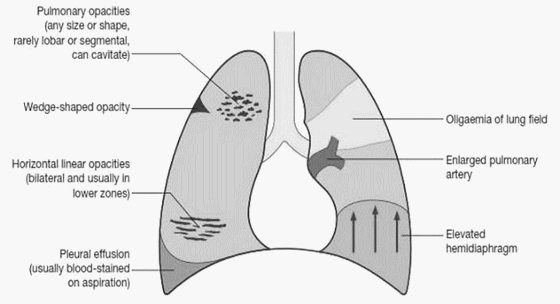
pulmonary embolism xray

Recommended delay of surgery in Acute VTE

It is advised to delay surgery until the patients receive atleast 1 month and preferably 3 months of anticoagulation whenever feasible.

However, where surgery needs to be performed:

  • Within 1 month of acute VTE: Intravenous UFH should be administered while the INR is less than 2.
  • Within 2 weeks of acute VTE: Intravenous heparin may be withheld 6 hours preoperatively and 12 hours postoperatively, if the surgery is short. 
  • If the acute event was within 2 weeks of major surgery and/or patients have a higher risk of postoperative bleeding, a vena caval filter should be inserted preoperatively or intraoperatively.
  • Warfarin should be withheld for only 4 doses if the most recent episode of VTE occurred 1-3 months before surgery. If the patient has been anticoagulated for 3 or more months, 5 doses of warfarin can be withheld before surgery. Preoperatively, subcutaneous UFH or LMWH is needed only for immobilized inpatients with an INR of less than 1.8.

References:

Kearon C, Akl EA. Duration of anticoagulant therapy for deep vein thrombosis and pulmonary embolism. Blood. 2014 Mar 20;123(12):1794-801. doi: 10.1182/blood-2013-12-512681. Epub 2014 Feb 4. PMID: 24497538.

https://www.medscape.com/answers/285265-94364/what-is-the-perioperative-anticoagulation-management-of-patients-with-venous-thromboembolism-vte
1 shares
  • Facebook
  • Twitter
PGMEE, MRCS, USMLE, MBBS, MD/MS AnesthesiaGeneral SurgeryInternal medicine

Post navigation

Previous post
Next post

Related Posts

PGMEE, MRCS, USMLE, MBBS, MD/MS

Adenoma-Carcinoma Sequence in Colorectal Cancer : Mnemonic

Jul 30, 2023Jul 30, 2023

Adenoma-carcinoma sequence is a stepwise development of normal epithelium to carcinoma due to accumulation of mutations over a number of years leading to activation of oncogenes and loss of tumor suppressor genes. One of the pathways follows adenoma–carcinoma sequence, that is, normal → adenoma → carcinoma. The other is pertaining…

Read More
PGMEE, MRCS, USMLE, MBBS, MD/MS Postaural wilde's incision

Approaches to Middle ear and Mastoid surgery

May 11, 2014

Endomeatal (Transcanal or Transmeatal) Approach: Not used commonly in children owing to relatively small ear canal This incision is used when the mesotympanum and hypotympanum are the surgical sites A posterior tympanomeatal flap is raised to enter into the middle ear. The flap includes skin over the medial two-thirds of the bony…

Read More
PGMEE, MRCS, USMLE, MBBS, MD/MS

Simplified Guide to Statin Therapy

Aug 15, 2019Aug 15, 2019

Statins Equivalent Dose Mnemonic: PRASLPF 2-5-10-20-40-40-80 Pituvastatin 2 mg Rosuvastatin 5 mg Atorvastatin 10 mg Simvastatin 20 mg Lovastatin 40 mg Pravastatin 40 mg Fluvastatin 80 mg Intensity of Statins a. High intensity (LDL lowering >/= 50%) Atorvastatin 40-80 mg Rosuvastatin 20-40 mg b. Moderate intenstity (LDL lowering 30-49%) Atorvastatin…

Read More

Leave a Reply Cancel reply

Your email address will not be published. Required fields are marked *

This site uses Akismet to reduce spam. Learn how your comment data is processed.

Pre-clinical (Basic Sciences)

Anatomy

Biochemistry

Community medicine (PSM)

Embryology

Microbiology

Pathology

Pharmacology

Physiology

Clinical Sciences

Anesthesia

Dermatology

Emergency medicine

Forensic

Internal medicine

Gynecology & Obstetrics

Oncology

Ophthalmology

Orthopedics

Otorhinolaryngology (ENT)

Pediatrics

Psychiatry

Radiology

Surgery

RSS Ask Epomedicine

  • What to study for Clinical examination in Orthopedics?
  • What is the mechanism of AVNRT?

Epomedicine weekly

  • About Epomedicine
  • Contact Us
  • Author Guidelines
  • Submit Article
  • Editorial Board
  • USMLE
  • MRCS
  • Thesis
©2026 Epomedicine | WordPress Theme by SuperbThemes