Skip to content
Epomedicine

Mnemonics, Simplified Concepts & Thoughts

Epomedicine

Mnemonics, Simplified Concepts & Thoughts

Paranasal sinus drainage in Nasal cavity : Mnemonic

Epomedicine, Aug 4, 2023Aug 4, 2023

Lateral wall of nasal cavity has:

  1. Conchae or turbinates: shelf like projections
  2. Meatus: air space inferior to each concha
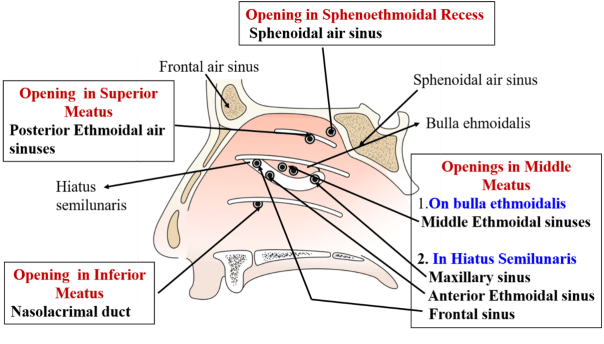
paranasal sinus drainage

Mnemonic: SPIN

1. Superior meatus: Posterior ethmoidal sinus

2. Inferior meatus: Nasolacrimal duct

The sphenoidal sinus drains into spheno-ethmoidal recess (superior to superior concha).

All others drain into middle meatus:

Mnemonic: AM/FM

  1. Anterior ethmoidal sinus
  2. Middle ethmoidal sinus
  3. Frontal sinus
  4. Maxillary sinus
  • Facebook
  • Twitter
PGMEE, MRCS, USMLE, MBBS, MD/MS AnatomyOtorhinolaryngology

Post navigation

Previous post
Next post

Related Posts

PGMEE, MRCS, USMLE, MBBS, MD/MS glass prescription slip

Understanding Eye Glass Prescription Slip

Aug 12, 2015Aug 17, 2015

A phoropter/refractor is an instrument commonly used by eye care professionals during an eye examination, containing different lenses used for refraction of the eye during sight testing, to measure an individual’s refractive error and determine his or her eyeglass prescription. Retinoscopy is done instead in children who are unable to…

Read More
PGMEE, MRCS, USMLE, MBBS, MD/MS cardiac-cycle-wiggers diagram

Cardiac Cycle – Summary and Wigger’s Diagram

Aug 30, 2016May 20, 2024

Cardiac Cycle Opening and closing of valves When the valve opens, different compartments act as a single chamber (atrio-ventricle or aorto-ventricle). For a blood to flow, pressure in “giver” must be higher then that in “receiver”. Pressure difference opens or closes the valve: Role of atrial contraction in Ventricular filling…

Read More
PGMEE, MRCS, USMLE, MBBS, MD/MS

Paget’s Disease of bone : Mnemonic

Jul 20, 2022Jul 20, 2022

Synonyms: Osteitis deformans Collage of matrix madness Mnemonic: Sixteen “P”s 1. Paramyxovirus infection and inclusions in osteocalsts 2. Pain (most common symptom – localized fractures or nerve compressions) 3. Pelvis (most common site) 4. Polyostotic (more common; 85%) 5. Phases: Active (lytic, mixed, sclerotic) and Inactive 6. Plasma volume expansion…

Read More

Leave a Reply Cancel reply

Your email address will not be published. Required fields are marked *

This site uses Akismet to reduce spam. Learn how your comment data is processed.

Pre-clinical (Basic Sciences)

Anatomy

Biochemistry

Community medicine (PSM)

Embryology

Microbiology

Pathology

Pharmacology

Physiology

Clinical Sciences

Anesthesia

Dermatology

Emergency medicine

Forensic

Internal medicine

Gynecology & Obstetrics

Oncology

Ophthalmology

Orthopedics

Otorhinolaryngology (ENT)

Pediatrics

Psychiatry

Radiology

Surgery

RSS Ask Epomedicine

  • What to study for Clinical examination in Orthopedics?
  • What is the mechanism of AVNRT?

Epomedicine weekly

  • About Epomedicine
  • Contact Us
  • Author Guidelines
  • Submit Article
  • Editorial Board
  • USMLE
  • MRCS
  • Thesis
©2026 Epomedicine | WordPress Theme by SuperbThemes