Skip to content
Epomedicine

Mnemonics, Simplified Concepts & Thoughts

Epomedicine

Mnemonics, Simplified Concepts & Thoughts

omental cake

Omental Cake

Epomedicine, Jul 11, 2016

Definition of Omental Caking

Thickening of the omentum resulting from localized or diffuse infiltration of omental fat by soft tissue density mass is referred as “omental caking”.

It is a radiological sign, which is often identified in CT scan.

Involved Anatomical Structure in Omental Caking

Greater Omentum – an extension of the anterior and posterior visceral peritoneum.
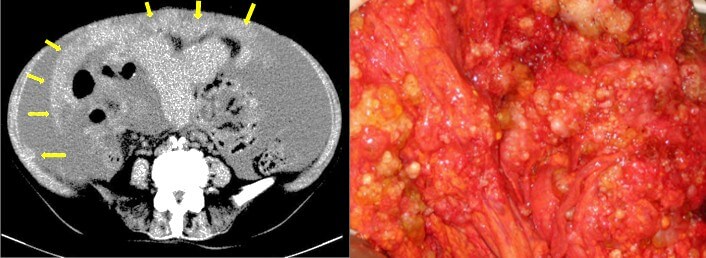
omental cake

Causes of Omental Caking

Metastatic involvement (Commonest)

  1. Ovarian carcinoma (commonest cause)
  2. Colonic carcinoma
  3. Gastric carcinoma
  4. Pancreatic carcinoma
  5. Others: Endometrial carcinoma, Bladder cancer, Renal cell carcinoma, Hepato-biliary malignancies, Melanoma, Lung cancer, Breast cancer

4 routes of spread to omentum:

  1. Direct extension
  2. Intraperitoneal seeding
  3. Hematogenous spread
  4. Lymphatic spread

Primary malignancies and benign tumors of omentum (Rare)

  1. Abdominal mesothelioma
  2. Haemangiopericytoma
  3. Leiomyoma
  4. Leiomyosarcoma
  5. Gastrointestinal stromal tumour (GIST)
  6. Lipoma
  7. Liposarcoma
  8. Neurofibroma
  9. Fibrosarcoma
  10. Small round cell tumours

Infections

  1. Tuberculous peritonitis
  2. Actinomycosis
  3. Coccidiodomycosis
  4. Non-tuberculous mycobacterial infection
  5. Histoplasmosis
  6. Omental paragonimiasis

Unusual Etiologies

  1. Myelofibrosis
  2. Sclerosing omentitis
  3. Amyloidosis

Further Investigation in Omental Caking

Percutaneous CT or US-guided biopsy for primary diagnosis and staging.

References

Mamlouk MD, vanSonnenberg E, Shankar S, Silverman SG. Omental cakes: unusual aetiologies and CT appearances. Insights into Imaging. 2011;2(4):399-408. doi:10.1007/s13244-011-0105-4.

11 shares
  • Facebook11
  • Twitter
PGMEE, MRCS, USMLE, MBBS, MD/MS Gastrointestinal systemRadiology

Post navigation

Previous post
Next post

Related Posts

PGMEE, MRCS, USMLE, MBBS, MD/MS

Tendon Transfer Principles : Mnemonic

Mar 2, 2021Nov 2, 2022

Tendon transfer is the use of the power of a functioning muscle unit to activate a non-functioning nerve/muscle/tendon unit. The transferred tendon remains attached to its parent muscle with an intact neurovascular pedicle. Mnemonic: SEACOAST-1 a. Synergistic: act together to produce a single composite movement (facilitate each other). e.g. b….

Read More
PGMEE, MRCS, USMLE, MBBS, MD/MS

Blood supply of femoral head

May 29, 2020Jan 11, 2024

Three sources of Blood supply Vascular arragement of Proximal Femur a. Extracapsular ring (At the base of femoral neck) These circumflex femoral arteries branch from: Trochanteric anastomosis (centered on trochanteric fossa): Descending branch of SGA + ascending branch of LFCA, MFCA and IGA Cruciate anastomosis (centered on lesser trochanter): Descending…

Read More
PGMEE, MRCS, USMLE, MBBS, MD/MS

Micturition reflex

Jun 13, 2020Sep 24, 2022

Micturition (Urination) is the ejection of urine from the urinary bladder through the urethra to the outside of the body. It is a type of reflex with voluntary control. The micturition cycle occurs in 2 phases: Urinary Storage Mnemonic: Storage = Sympathetic 1. Stimulus: Urine filling until tension in the…

Read More

Leave a Reply Cancel reply

Your email address will not be published. Required fields are marked *

This site uses Akismet to reduce spam. Learn how your comment data is processed.

Epomedicine. Omental Cake [Internet]. Epomedicine; 2016 Jul 11 [cited 2026 Jan 21]. Available from: https://epomedicine.com/medical-students/omental-caking/.

Pre-clinical (Basic Sciences)

Anatomy

Biochemistry

Community medicine (PSM)

Embryology

Microbiology

Pathology

Pharmacology

Physiology

Clinical Sciences

Anesthesia

Dermatology

Emergency medicine

Forensic

Internal medicine

Gynecology & Obstetrics

Oncology

Ophthalmology

Orthopedics

Otorhinolaryngology (ENT)

Pediatrics

Psychiatry

Radiology

Surgery

RSS Ask Epomedicine

  • What to study for Clinical examination in Orthopedics?
  • What is the mechanism of AVNRT?

Epomedicine weekly

  • About Epomedicine
  • Contact Us
  • Author Guidelines
  • Submit Article
  • Editorial Board
  • USMLE
  • MRCS
  • Thesis
©2026 Epomedicine . All rights reserved.