Skip to content
Epomedicine

Mnemonics, Simplified Concepts & Thoughts

Epomedicine

Mnemonics, Simplified Concepts & Thoughts

infective endocarditis

Modified Duke’s Criteria for Infective Endocarditis : Mnemonic

Epomedicine, Oct 22, 2017

Bacterial Endocarditis FIVE PM, i.e. BE FIVE PM

  1. Blood culture positive for IE
  2. Endocardial involvement
  3. Fever
  4. Immunologic phenomena
  5. Vascular phenomena
  6. Echocardioraphy minor criteria (eliminated)
  7. Predisposition
  8. Microbiologic evidence

Definite Diagnosis from Clinical Criteria:

  • 2 (major) + 0 (minor) or
  • 1 (major) + 3 (minor) or
  • 0 (major) + 5 (minor)

Look: when major criteria decreases, subsequently minor criteria increases by odd number.
infective endocarditis

A. Major Criteria

1. Blood culture positive

a. Typical micro-organisms consistent with IE from 2 separate blood cultures – S. aureus, S. viridans, S. bovis (gallolyticus), HACEK group, Community acquired enterococci, in the absence of primary foci OR

b. Persistently positive blood culture:

  • For organisms that are typical causes of IE: ≥2 positive blood cultures from blood samples drawn >12 hours apart
  • For organisms that are more commonly skin contaminants: 3 or a majority of ≥4 separate blood cultures (with first and last drawn atleast 1 hour apart)

c. Single positive blood culture for Coxiella burnetii or phase I IgG antibody titre >1:800

2. Evidence of Endocardial involvement

a. Positive echocardiogram (vegetation, abscess or valve dehiscence) or

b. New valvular regurgitation (increase or change in pre-existing murmur)

B. Minor criteria

  1. Fever > 38ºc
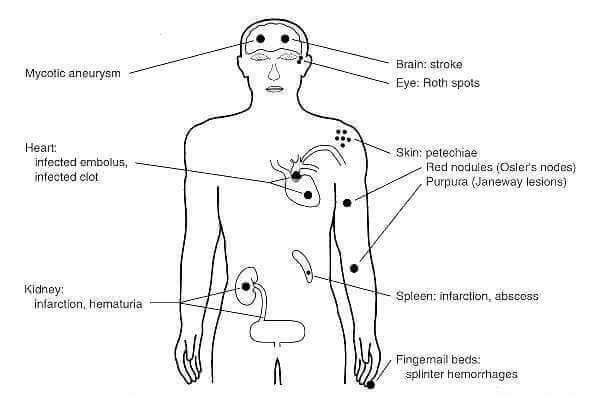
  2. Immunologic phenomena (glomerulonephritis, Osler’s nodes, Roth’s spots, Rheumatoid factor)
  3. Vascular phenomena (major arterial emboli, septic pulmonary infarcts, mycotic aneurysm, intracranial hemorrhage, conjuntival hemorrhage, Janeway lesions)
  4. (Echocardiography minor criteria eliminated)
  5. Predisposition (heart condition or IV drug user)
  6. Microbiologic evidence (Positive blood culture but not meeting major criteria or serologic evidence of active infection with organism consistet with IE)

Definitive Infective Endocarditis (IE)

Pathologic criteria:
  • Histologic evidence of active endocarditis – vegetation or intracardiac abscess OR
  • Microorganism demonstrated on culture or histology of vegetation or intracardiac abscess

Clinical criteria:

  • 2 Major OR
  • 1 Major + 3 Minor
  • 5 Minor

Possible Infective Endocarditis (IE)

1 Major + 1 Minor OR

3 Minor
100 shares
  • Facebook100
  • Twitter
PGMEE, MRCS, USMLE, MBBS, MD/MS Cardiovascular systemInternal medicinePediatrics

Post navigation

Previous post
Next post

Related Posts

PGMEE, MRCS, USMLE, MBBS, MD/MS intractable bladder hemorrhage management

Radiation cystitis : Diagnosis, prevention and management

Jan 7, 2016Jan 7, 2016

Cause of radiation cystitis: Bladder in the radiation field (treatment of pelvic malignancies like prostate, cervical, colorectal) Epidemiology of radiation cystitis: Incidence: 23% to 80% (variability due to variability in type and dosing of radiotherapy among different medical subspecialities) Incidence of severe hematuria: 5-8% Mean duration for developing radiation cystitis:…

Read More
PGMEE, MRCS, USMLE, MBBS, MD/MS

Fabry Disease : Mnemonic

Nov 1, 2024Nov 1, 2024

Mnemonic: FABRY CX 1. Febrile episodes, Foam cells 2. Angiokeratomas, Alpha galactosidase A deficiency 3. Burning pains in hands and feet 4. Renal failure 5. Youth death 6. Cardiovascular disease, Ceramide trihexoside accumulation 7. X-linked recessive inheritance Further reading:

Read More
PGMEE, MRCS, USMLE, MBBS, MD/MS pregnancy shaving

Heart Disease in pregnancy

Nov 20, 2022Nov 20, 2022

Mortality risk associated with pregnancy Group I – Mortality <1% Group II – Mortality 5-15% Group III – Mortality 25-50% Commonest in Pregnancy Valvular heart disease: Mitral stenosis Congenital heart disease: ASD Cyanotic congenital heart disease: Fallot’s tetralogy (TOF) Predictors of Cardiac Events during Pregnancy N – NYHA Class >II…

Read More

Leave a Reply Cancel reply

Your email address will not be published. Required fields are marked *

This site uses Akismet to reduce spam. Learn how your comment data is processed.

Pre-clinical (Basic Sciences)

Anatomy

Biochemistry

Community medicine (PSM)

Embryology

Microbiology

Pathology

Pharmacology

Physiology

Clinical Sciences

Anesthesia

Dermatology

Emergency medicine

Forensic

Internal medicine

Gynecology & Obstetrics

Oncology

Ophthalmology

Orthopedics

Otorhinolaryngology (ENT)

Pediatrics

Psychiatry

Radiology

Surgery

RSS Ask Epomedicine

  • What to study for Clinical examination in Orthopedics?
  • What is the mechanism of AVNRT?

Epomedicine weekly

  • About Epomedicine
  • Contact Us
  • Author Guidelines
  • Submit Article
  • Editorial Board
  • USMLE
  • MRCS
  • Thesis
©2026 Epomedicine | WordPress Theme by SuperbThemes