Some important terminologies
Gene: a functional part of the DNA molecule of a chromosome which directs the synthesis of a specific polypeptide chain.
Allele (allelomorph): alternative form of a gene found at the same locus on a pair of homologous chromosomes.
Homozygous: the presence of two identical alleles at a particular locus on a pair of homologous chromosomes.
Hybrid: individual having two different allele at a locus.
Dominant: a trait which is expressed in individual who are heterozygous for a particular allele.
Recessive: a trait which is expressed in individuals who are homozygous for a particular allele but not in those who are heterozygous.
Codominance: when both alleles are expressed in the heterozygote.
Genotype: the genetic constitution of an individual.
Phenotype: the appearance(physical,biochemical,physiological) of an individual which results from an interaction of the environment and the genotype.
Mutant: a gene which has undergone a change or mutation.
Mutation: a change in genetic material,either of a single gene,or in the number or structure of the chromosomes. A mutation which occurs in the gametes is inherited,a mutation which occurs in the somatic cells(somatic mutation) is not inherited.
Mosiac: an individual with two different cell lines derived from a single zygote.
Mendal’s first law: Law of uniformity
It refers to the fact that:
When two homozygotes with different alleles are crossed, all the offsprings of the F1 (first filial) generation are identical and heterogygous.
The characteristics do not blend and reappear in the later generation.
Eg. Pure bred tall(TT) X Pure bred short(tt) F1 Generation Tt Tt Tt Tt
Mendal’s second law: Law of segregation
- Refers to the observation that each individual possesses two genes for a particular characteristic,only one of which can be transmitted at any one time.
- Rare exceptions to this rule can occur when two allelic genes fail to separate because of chromosome nondisjunction at the first meiotic division.
- A hereditary disease or trait transmitted by a single gene is called Mendelian trait.
Features of Mendelian trait:
- A Mendelian trait is caused by a single gene.
- Mode of inheritance reveal whether a Mendelian trait is dominant or recessive and whether the gene that controls it is carried on an autosome or a sex chromosome.
- Mendelian trait or single gene disorder can be in herited in five ways : autosomal dominant, autosomal recessive, X linked dominant, X linked recessive and Y linked.
- Mendel’s second law which can predict the probability that a child will inherit a Mendelian trait,applies anew to each child.
Criteria (features) for an autosomal dominant:
- Both males and females can be affected. Can have male to male transmission.
- Male and female transmit the trait with equal frequency.
- Successive generations are affected.
- Transmission stops if a generation arises in which no one is affected.
- Can arise from fresh mutations.
- Autosomal dominant inheritance: when a parent is affected and the other is not,each offspring has a 50% probability of inheriting the mutant allele and the condition.
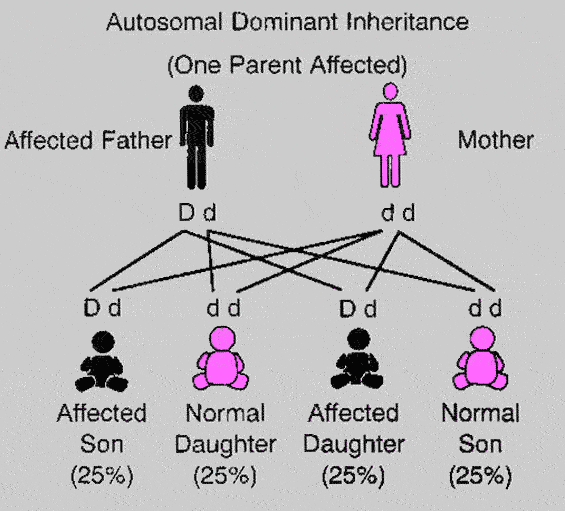
Some autosomal dominant disorders:
- Familial hypercholesterolemia.
- Huntington’s disease.
- Lactose intolerance.
- Marfan syndrome.
- Myotonic dystrophy.
- Polycystic kidney disease.
- Porphyria variegate.
Criteria for an autosomal recessive trait:
- Both males and females are affected.
- Affected males and females can transmit the trait, unless it causes death before reproductive age.
- The trait can skip generation.
- Parents of affected individual are heterozygous or also have the trait(carriers).
- Probability: normal(25%) and affected(25%) chance.
- Genotypic ratio: 1:2:1.
- Phenotypic ratio: 3:1.
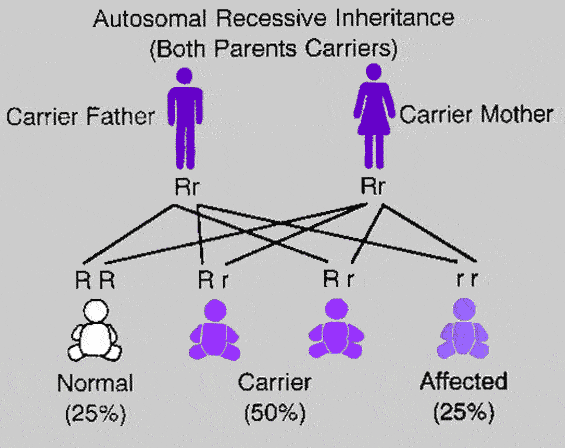
Some of the autosomal recessive disorders:
- Ataxia telangiectasia.
- Cystic fibrosis.
- Familial hypertrophic cardiomyopathy.
- Gaucher’s disease.
- Sickle cell disease.
- Tay-Sachs disease.
- Maple syrup urine disease.
Criteria for X-linked dominant trait:
- Males as well as females can be affected but often with an excess of females.
- Females are less severely affected than males.
- Affected males can transmit the disorder to their daughters but not to their sons.
- Some of the traits are:
- Vitamin D resistant rickets.
- Charcot –Marie tooth disease (hereditary sensory and motor neuropathy)
Criteria for X-linked recessive trait:
- Males are usually only affected.
- Transmitted through unaffected females.
- Males cannot transmit the disorder to their sons ie,no male to male transmission can occur.
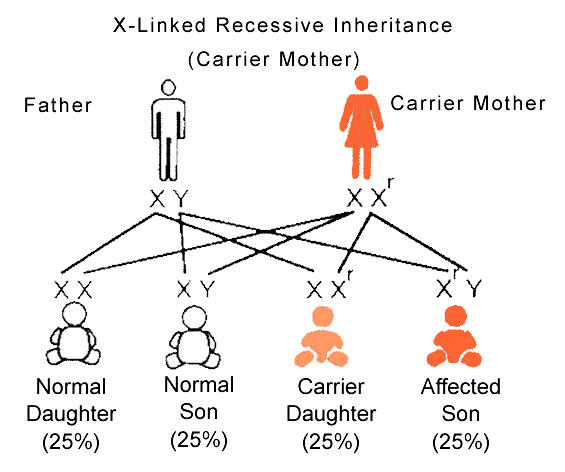
X linked recessive trait are:
- Partial color blindness.
- Duchenne’s muscular dystrophy.
- Glucose 6 phosphate dehydrogenase deficiency(G6PD) deficiency.
- Testicular feminization
- Hunter’s syndrome.
Y linked inheritance; also called Holandric inheritance:
- Males are only affected.
- Affected males must transmit it to their sons.
- Y linked inheritance (trait):
- Porcupine skin, hairy ears, webbed toes.
Mendal’s third law: Law of individual assortment:
- Refers to the fact that members of different gene pairs segregate to offspring independently of one another. However, genes that are close together on the same chromosome tend to be inherited together, i.e. they are linked.
Features:
- Genes are transmitted in different chromosomes.
- Transmission of one gene does not influence that of another.
- Meiotic events explain independent assortment.
- Example:
If a male having following features-
- Passing yellow urine (Bb)
- Colored eyelid (Hh) and
- Normal fingers (ee)
Mates with a female having following features:
- Passes red urine (bb)
- Normal eyelids (hh) and
- Short fingers (Ee);
Then the chances of a child having the following features- who passes red urine (bb) x colored eyelids (Hh) x short fingers (Ee) are ½ x ½ x ½ = 1/8.
Here’s a mnemonic to crack the genetic inheritance pattern of diseases.