Skip to content
Epomedicine

Mnemonics, Simplified Concepts & Thoughts

Epomedicine

Mnemonics, Simplified Concepts & Thoughts

Lung Cancer : Mnemonics

Epomedicine, Jun 20, 2024Jun 20, 2024

Types

Most common cancer: Metastases

Primary lung cancer:

TypeFrequencyLocationAssociationFeatures
Small (oat) cell carcinoma15%Sentral (central)Smoker Neuroendocrine differentiation (Kulchitsky cells)
Aggressive (disseminate early – lymphadenopathy)
Paraneoplastic syndrome (ACTH, ADH, Antibodies – Lambert eaton)
Inoperable
Chemosensitive
Adenocarcinoma40%PeripheralNon-smoker (most common)k-Ras, EGFR, ALK mutations
Nodule/mass
Hypertrophic osteoarthropathy (clubbing)
Bronchio-alveolar subtype (pneumonia-like): Excellent prognosis, apparent “thickening” of alveolar walls
Squamous cell carcinoma25%Sentral (central)Smoker (most common)Hilar mass
Obstruction
Cavitation
Calcium (PTHrP)
Keratin pearls and intracellular bridge
Large cell carcinoma10%PeripheralSmokerPoor prognosis
Pleomorphic giant cells
Carcinoid tumor2%CentralNon-smokerExcellent prognosis
Mass effect
Carcinoid sydrome (rare)
Chromogranin A +
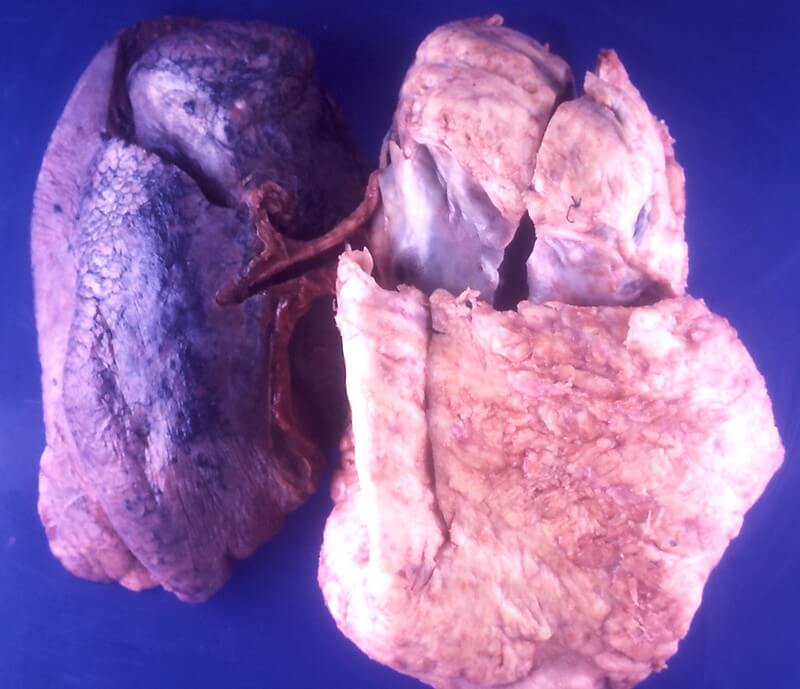
small cell cancer lung
“Small cell lung carcinoma simulating mesothelioma” by Pulmonary Pathology is licensed under CC BY-SA 2.0.

Growing rate (Doubling time)

Mnemonic: SmS LA

  1. Small cell carcinoma: 30 days
  2. Squamous cell carcinoma: 90 days
  3. Large cell carcinoma: 120 days
  4. Adenocarcinoma: 150-180 days
TNM and Staging of Lung Cancer Simplified

Management

1. Small cell lung cancer (SCLC): Chemotherapy +/- Radiotherapy

2. Non-small cell lung cancer (NSCLC):

  • Stage I, II, IIIA: Surgical resection +/- Chemo-radiotherapy
  • Stage IIIB, IV: Chemo-radiotherapy
    • >1 lobe involvement (ipsilateral or contralateral)
    • 2 sides local nodes involvement (contralateral mediastinal/hilar)
    • Mediastinal structure invasion
    • Distant lymph node metastases
    • Distant metastases

Contra-indications to lung surgery:

  1. SVC obstruction
  2. FEV1 <1.5
  3. Malignant pleural effusion
  4. Vocal cord paralysis
  • Facebook
  • Twitter
PGMEE, MRCS, USMLE, MBBS, MD/MS OncologyPathologyRespiratory system

Post navigation

Previous post
Next post

Related Posts

PGMEE, MRCS, USMLE, MBBS, MD/MS

Aortic arch derivatives : Mnemonic

May 28, 2023May 28, 2023

The aortic arches or pharyngeal arch arteries are formed sequentially with the pharyngeal arches. Aortic arch Derivatives Mnemonic 1st Maxillary artery (part) 1st arch is maximal 2nd Stapedial arteryHyoid artery Second = Stapedial 3rd Common carotid arteryProximal part of internal carotid artery C = 3rd letter of alphabet 4th Left: Aortic archRight: Subclavian…

Read More

Ophthalmology Spot Diagnosis: Hyphema

Jan 10, 2014May 23, 2014

Definition: Accumulation of blood in the Anterior Chamber (AC). Causes: a. Post-traumatic: Trauma or surgery b. Spontaneous: Neovascularization Ocular neoplasms Vascular and clotting anomalies (leukemia, hemophilia, aspirin) Grading for Traumatic Hyphema: 0 : No layered blood, circulating RBCs only (Microhyphema) 1: Layered blood filling < 1/3 of AC 2: Layered…

Read More
PGMEE, MRCS, USMLE, MBBS, MD/MS

Reverse or Baby or Mirrored Bennett’s Fracture

Aug 7, 2024Aug 7, 2024

Definition: The fracture-dislocation at the base of the fifth metacarpal analogous to Bennett’s fracture of the thumb Mechanism of injury: Muscle pull and displacement: Consequences of unreduced fracture-dislocation: Possible associations: X-ray views: Treatment: 1. Closed reduction and internal fixation with K-wires 2. Open reduction and internal fixation with K-wires or…

Read More

Comment

  1. Kelvin says:
    Jun 22, 2024 at 8:22 am

    Awesome mnemonic thank you 🙏🏾

    Reply

Leave a Reply Cancel reply

Your email address will not be published. Required fields are marked *

This site uses Akismet to reduce spam. Learn how your comment data is processed.

Pre-clinical (Basic Sciences)

Anatomy

Biochemistry

Community medicine (PSM)

Embryology

Microbiology

Pathology

Pharmacology

Physiology

Clinical Sciences

Anesthesia

Dermatology

Emergency medicine

Forensic

Internal medicine

Gynecology & Obstetrics

Oncology

Ophthalmology

Orthopedics

Otorhinolaryngology (ENT)

Pediatrics

Psychiatry

Radiology

Surgery

RSS Ask Epomedicine

  • What to study for Clinical examination in Orthopedics?
  • What is the mechanism of AVNRT?

Epomedicine weekly

  • About Epomedicine
  • Contact Us
  • Author Guidelines
  • Submit Article
  • Editorial Board
  • USMLE
  • MRCS
  • Thesis
©2026 Epomedicine | WordPress Theme by SuperbThemes