Skip to content
Epomedicine

Mnemonics, Simplified Concepts & Thoughts

Epomedicine

Mnemonics, Simplified Concepts & Thoughts

Lung Cancer : Mnemonics

Epomedicine, Jun 20, 2024Jun 20, 2024

Types

Most common cancer: Metastases

Primary lung cancer:

TypeFrequencyLocationAssociationFeatures
Small (oat) cell carcinoma15%Sentral (central)Smoker Neuroendocrine differentiation (Kulchitsky cells)
Aggressive (disseminate early – lymphadenopathy)
Paraneoplastic syndrome (ACTH, ADH, Antibodies – Lambert eaton)
Inoperable
Chemosensitive
Adenocarcinoma40%PeripheralNon-smoker (most common)k-Ras, EGFR, ALK mutations
Nodule/mass
Hypertrophic osteoarthropathy (clubbing)
Bronchio-alveolar subtype (pneumonia-like): Excellent prognosis, apparent “thickening” of alveolar walls
Squamous cell carcinoma25%Sentral (central)Smoker (most common)Hilar mass
Obstruction
Cavitation
Calcium (PTHrP)
Keratin pearls and intracellular bridge
Large cell carcinoma10%PeripheralSmokerPoor prognosis
Pleomorphic giant cells
Carcinoid tumor2%CentralNon-smokerExcellent prognosis
Mass effect
Carcinoid sydrome (rare)
Chromogranin A +
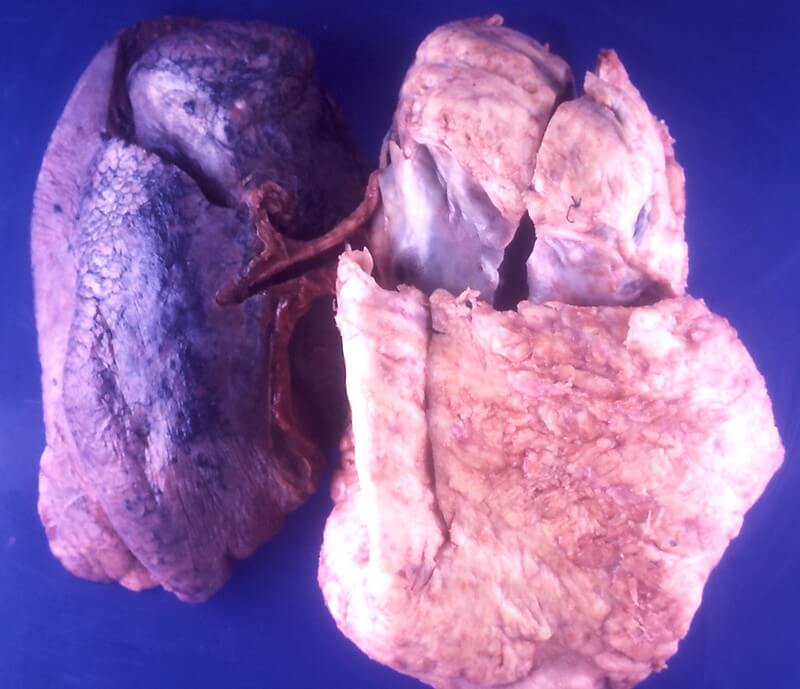
small cell cancer lung
“Small cell lung carcinoma simulating mesothelioma” by Pulmonary Pathology is licensed under CC BY-SA 2.0.

Growing rate (Doubling time)

Mnemonic: SmS LA

  1. Small cell carcinoma: 30 days
  2. Squamous cell carcinoma: 90 days
  3. Large cell carcinoma: 120 days
  4. Adenocarcinoma: 150-180 days
TNM and Staging of Lung Cancer Simplified

Management

1. Small cell lung cancer (SCLC): Chemotherapy +/- Radiotherapy

2. Non-small cell lung cancer (NSCLC):

  • Stage I, II, IIIA: Surgical resection +/- Chemo-radiotherapy
  • Stage IIIB, IV: Chemo-radiotherapy
    • >1 lobe involvement (ipsilateral or contralateral)
    • 2 sides local nodes involvement (contralateral mediastinal/hilar)
    • Mediastinal structure invasion
    • Distant lymph node metastases
    • Distant metastases

Contra-indications to lung surgery:

  1. SVC obstruction
  2. FEV1 <1.5
  3. Malignant pleural effusion
  4. Vocal cord paralysis
  • Facebook
  • Twitter
PGMEE, MRCS, USMLE, MBBS, MD/MS OncologyPathologyRespiratory system

Post navigation

Previous post
Next post

Related Posts

PGMEE, MRCS, USMLE, MBBS, MD/MS

Management of Anti-tubercular therapy (ATT) induced Hepatitis

May 21, 2022May 21, 2022

Definition of ATT induced hepatitis ALT > 3 X Normal + Symptoms OR ALT > 5 X Normal without Symptoms Management of ATT induced hepatitis 1. Hold all TB drugs for 7-10 days. Wait before restarting ATT until: Symptoms: Resolve ALT <2.5 X Normal For severe TB, patients should be…

Read More

Glaucoma Basics – Aqueous humor dynamics and Intraocular pressure

Jan 8, 2014

Volume of aqueous: 0.25 ml (Anterior chamber) + 0.06 ml (Posterior chamber) Composition of aqueous: similar to plasma except- higher concentration of ascorbate, pyruvate and lactate lower concentration of protein, urea and glucose Functions of aqueous: Maintains Intra-ocular Pressure (IOP) Provides nutrition to avascular lens and cornea Optical transparency Place…

Read More
PGMEE, MRCS, USMLE, MBBS, MD/MS

Proton Pump Inhibitors (PPI) Pharmacology : Mnemonics

Apr 28, 2021Apr 28, 2021

Relative Potency in Omeprazole Equivalent (OE) Mnemonic: PLOwER Pantoprazole (4.5 mg OE) Lansoprazole (13.5 mg OE) Omeprazole (20 mg OE) Esomeprazole (32 mg OE) Rabeprazole (36 mg OE) Side effects of PPI Mnemonic: KFC Kidney (Acute interstitial nephritis) Fractures (Hypochlorhydria leading to decreased serum calcium) C. difficile infection Besides, it…

Read More

Comment

  1. Kelvin says:
    Jun 22, 2024 at 8:22 am

    Awesome mnemonic thank you 🙏🏾

    Reply

Leave a Reply Cancel reply

Your email address will not be published. Required fields are marked *

This site uses Akismet to reduce spam. Learn how your comment data is processed.

Epomedicine. Lung Cancer : Mnemonics [Internet]. Epomedicine; 2024 Jun 20 [cited 2025 Dec 19]. Available from: https://epomedicine.com/medical-students/lung-cancer-mnemonics/.

Pre-clinical (Basic Sciences)

Anatomy

Biochemistry

Community medicine (PSM)

Embryology

Microbiology

Pathology

Pharmacology

Physiology

Clinical Sciences

Anesthesia

Dermatology

Emergency medicine

Forensic

Internal medicine

Gynecology & Obstetrics

Oncology

Ophthalmology

Orthopedics

Otorhinolaryngology (ENT)

Pediatrics

Psychiatry

Radiology

Surgery

RSS Ask Epomedicine

  • What to study for Clinical examination in Orthopedics?
  • What is the mechanism of AVNRT?

Epomedicine weekly

  • About Epomedicine
  • Contact Us
  • Author Guidelines
  • Submit Article
  • Editorial Board
  • USMLE
  • MRCS
  • Thesis
©2025 Epomedicine . All rights reserved.