Skip to content
Epomedicine

Mnemonics, Simplified Concepts & Thoughts

Epomedicine

Mnemonics, Simplified Concepts & Thoughts

Le Fort Fractures : Mnemonics

Epomedicine, Jun 21, 2023Aug 15, 2023

Le Fort fractures are the fractures that separate mid-face from the skull.
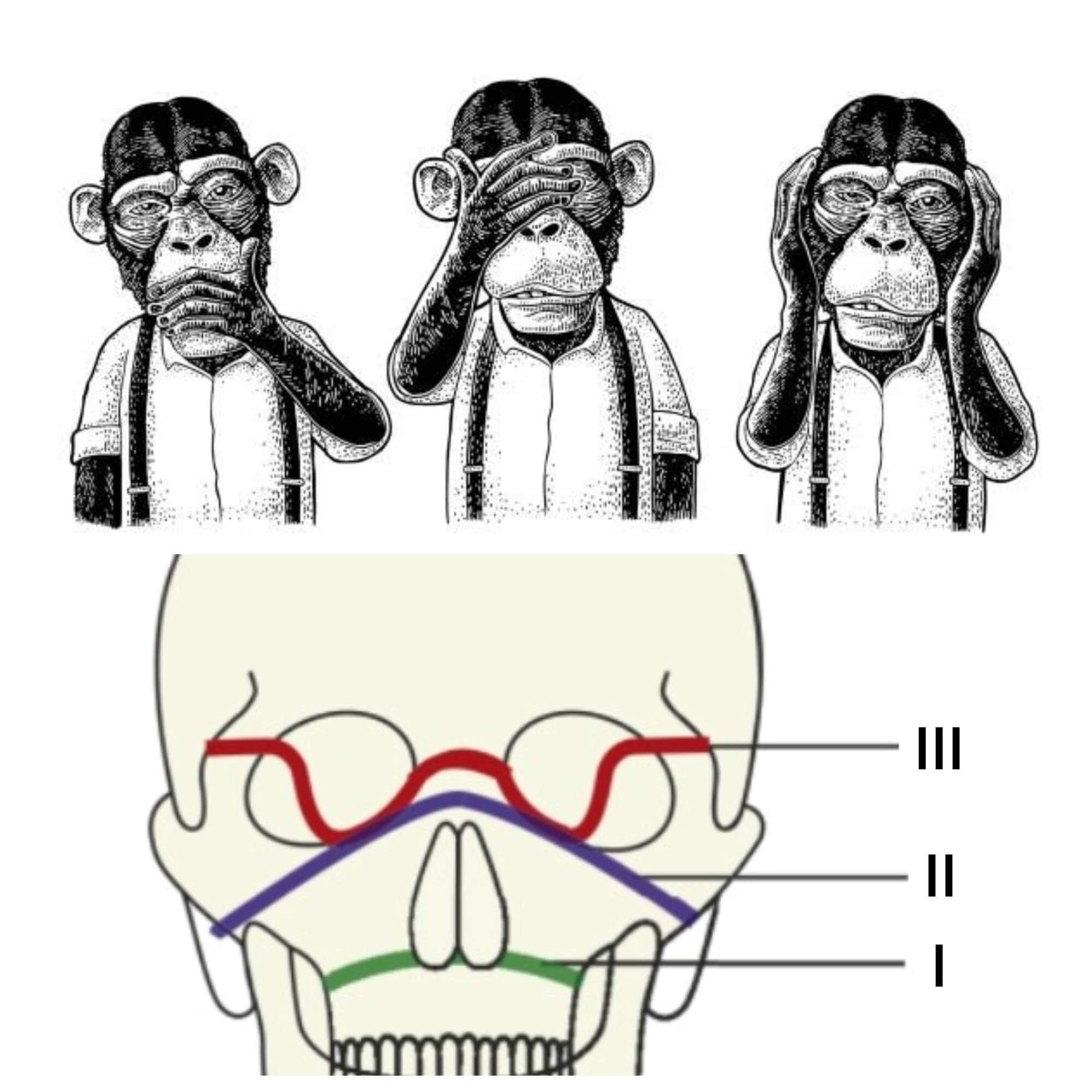
Classification

All of these subtypes involve a fracture of the pterygoid plate.

LeFort typeFracture configurationMnemonicMnemonic
IHorizontalFloating palateSpeak no evil – fracture through maxilla just above roots of teeth (affects speaking)
IIPyramidalFloating maxillaSee no evil – slightly higher; triangle around nasal cavity with apex into inferior part of orbit (also affects seeing)
IIITransverse a.k.a Craniofacial dysjunctionFloating faceHear no evil – higher; goes through middle of orbit and base of skull (also affects hearing)
IVLefort III + frontal bone involvement
CSF rhinorrhea occurs in type II and III due to injury in cribriform plate.

Reference: Type 1, 2, 3 Le Fort Fracture Classification Mnemonic: Maxillofacial Trauma Surgery and Radiology — EZmed (ezmedlearning.com)

Further reading: Lefort Fractures – EyeWiki (aao.org)
  • Facebook
  • Twitter
PGMEE, MRCS, USMLE, MBBS, MD/MS DentalOtorhinolaryngology

Post navigation

Previous post
Next post

Related Posts

PGMEE, MRCS, USMLE, MBBS, MD/MS

Middle Cranial Fossa : Mnemonics

Jun 3, 2023Apr 29, 2024

Boundaries The body of the sphenoid makes up the central portion of the middle fossa and houses the sella turcica, bounded by the anterior and posterior clinoid processes. List of Foramina from Anterior to Posterior Mnemonic: Old Rotund Owls Spin Lazily These foramina are in the Sphenoid bone. Contents of…

Read More
PGMEE, MRCS, USMLE, MBBS, MD/MS Henrique Durao

Some Neurology Mnemonics

Sep 20, 2019Sep 20, 2019

FALLS – indications for CT BRAIN A: Age > 65, Amnesia > 30 minutes before impact B: Bringing up = vomiting > 1 (once) C: Coagulopathy (hx) D: Dangerous mechanisms: > 1 m or 5 stairs, PVA, Cyclist, Ejection E: Epileptic fit (post traumatic) F: Fracture: open, depressed, skull base…

Read More
PGMEE, MRCS, USMLE, MBBS, MD/MS aion

Sudden Vision Loss : Simplified Approach

Aug 11, 2015Aug 18, 2015

Acute or sudden vision loss is due to one of the following causes: Opacification of normally transparent structures anterior to retina Retinal abnormalities Abnormalities of optic nerve and visual pathway Systematic history and ocular examination is necessary. Step 1: Unilateral or Bilateral Sudden vision loss ? Monocular loss of vision:…

Read More

Leave a Reply Cancel reply

Your email address will not be published. Required fields are marked *

This site uses Akismet to reduce spam. Learn how your comment data is processed.

Pre-clinical (Basic Sciences)

Anatomy

Biochemistry

Community medicine (PSM)

Embryology

Microbiology

Pathology

Pharmacology

Physiology

Clinical Sciences

Anesthesia

Dermatology

Emergency medicine

Forensic

Internal medicine

Gynecology & Obstetrics

Oncology

Ophthalmology

Orthopedics

Otorhinolaryngology (ENT)

Pediatrics

Psychiatry

Radiology

Surgery

RSS Ask Epomedicine

  • What to study for Clinical examination in Orthopedics?
  • What is the mechanism of AVNRT?

Epomedicine weekly

  • About Epomedicine
  • Contact Us
  • Author Guidelines
  • Submit Article
  • Editorial Board
  • USMLE
  • MRCS
  • Thesis
©2026 Epomedicine | WordPress Theme by SuperbThemes