Skip to content
Epomedicine

Mnemonics, Simplified Concepts & Thoughts

Epomedicine

Mnemonics, Simplified Concepts & Thoughts

Lasers in Ophthalmology – Mnemonic

Epomedicine, May 27, 2020May 27, 2020

Order of decreasing wavelength

Mnemonic: CHyNa PuRE

The laser tissue interaction can be remembered in the reverse order using the mnemonic ACiDiTy.

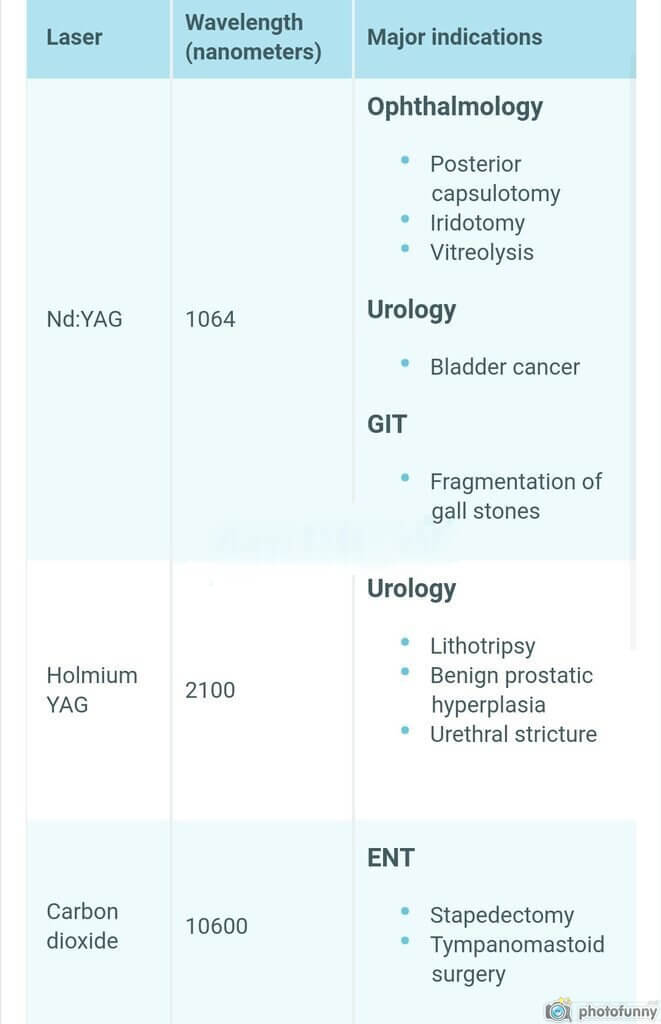
  1. Carbon dioxide (CO2): 10600 (photoThermal)
  2. Holmium YAG: 2100 (photoDisruption)
  3. Nd:YAG: 1064 (photoDisruption)
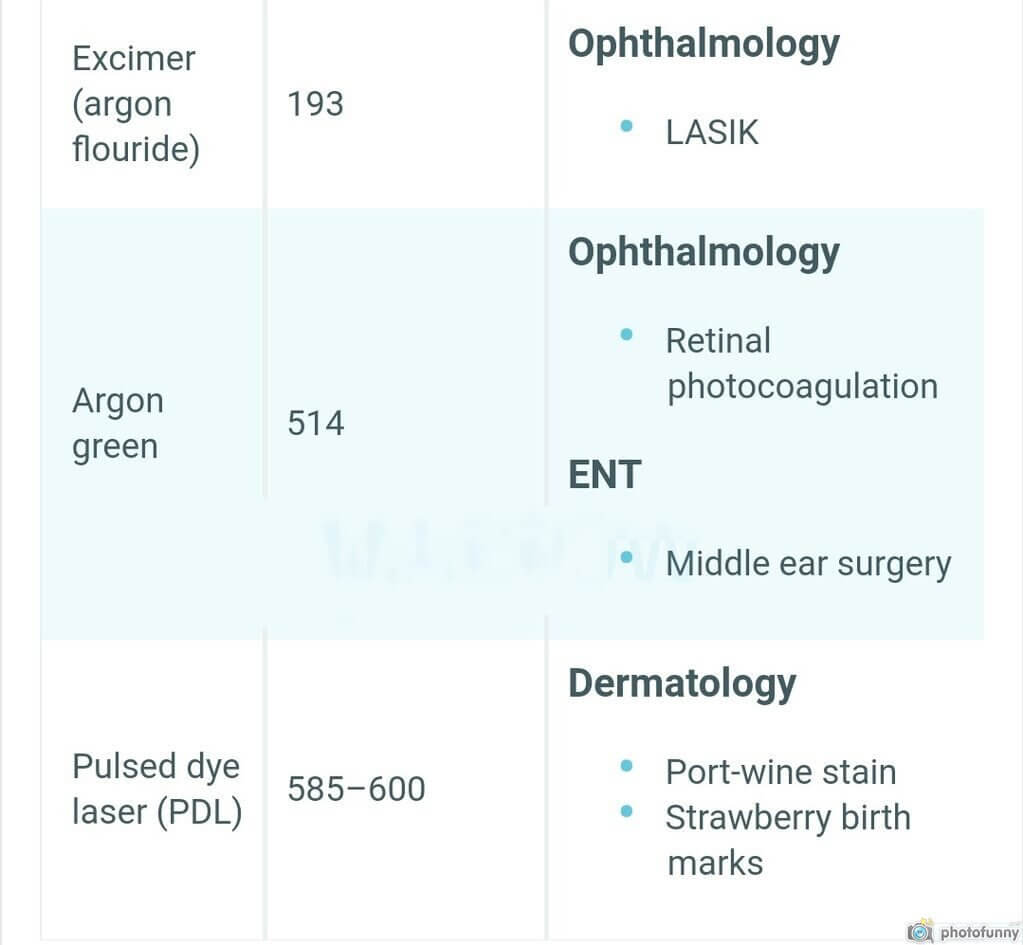
  4. Pulsed dye laser: 585-600 (photoChemical)
  5. aRgon green: 514 (photoChemical)
  6. Excimer: 193 (photoAblation)

Indications of Laser

aRgon

Mnemonic: R for aRgon and R for Retina

Used in retinal photocoagulation.

pulsed Dye laser

Mnemonic: D for Dye and D for Dermatology

  1. Used in port wine stain
  2. Used in strawberry birthmarks

Carbon-di-oxide

Mnemonic: C for CO2 and C for Central/middle ear

  1. Stapedectomy
  2. Tympanomastoidectomy

Holmium YAG laser

Mnemonic: H for Holmium and H for Hollow tube

  1. Hollow ureter blocked: Lithotripsy
  2. Hollow urethra blocked: BPH or Urethral stricture

Excimer

Mnemonic: Ex for ExCimer and Ex for External eye (Cornea)

  1. Corneoplasty using LASIK

Nd:YAG

Mnemonic: Its use is in eye other than Cornea (excimer is used) and Retina (argon is used).

  1. Posteiror capsulotomy
  2. Iridotomy
  3. Vitreolysis
  • Facebook
  • Twitter
PGMEE, MRCS, USMLE, MBBS, MD/MS Ophthalmology

Post navigation

Previous post
Next post

Related Posts

PGMEE, MRCS, USMLE, MBBS, MD/MS second messengers

Signaling Pathways of Hormones : Mnemonic

Jul 17, 2018

cAMP Mechanism Mnemonic: FLAT CAMP B-HCGS Remember “B-FLAT” mnemonic for hormones secreted by basophilic cells of the anterior pituitary. This is the same “FLAT” here. Also CAMP matches cAMP. Beta-HCG works by cAMP mechanism. All 2 except Beta 1 and 5-HT1 So, this is an easy mnemonic to remember. FSH…

Read More
PGMEE, MRCS, USMLE, MBBS, MD/MS pediatrician-patient

Pediatric History Taking – Structured format and Guide

May 19, 2019Oct 27, 2020

Identification (ID): Name Age/Date of Birth Sex Informant ( Reliability) Parent’s name, age, address, education, religion Chief Complaints (CC): Symptoms X Duration in Chronological order History of Presenting Illness (HPI): Symptoms: Location, quality, quantity, aggravating and alleviating factors Time course: Onset, duration, frequency, change over time Rx/Intervention: Medications, medical help…

Read More
PGMEE, MRCS, USMLE, MBBS, MD/MS key indicators nepal

Key Health Indicators of Nepal to Remember (NDHS, 2022)

May 26, 2019Aug 12, 2024

These rates, ratios and proportions are often questioned in PGMEE, pediatrics, obstetrics and preventive and social medicine (PSM) or community medicine examinations. NDHS = National Demographic and Health Survey a. Neonatal mortality rate (NMR): 21 per 1000 live births (i.e. 3/4 of infant deaths) b. Infant mortality rate (IMR): 28…

Read More

Leave a Reply Cancel reply

Your email address will not be published. Required fields are marked *

This site uses Akismet to reduce spam. Learn how your comment data is processed.

Epomedicine. Lasers in Ophthalmology – Mnemonic [Internet]. Epomedicine; 2020 May 27 [cited 2026 Jun 17]. Available from: https://epomedicine.com/medical-students/lasers-ophthalmology-mnemonic/.

Pre-clinical (Basic Sciences)

Anatomy

Biochemistry

Community medicine (PSM)

Embryology

Microbiology

Pathology

Pharmacology

Physiology

Clinical Sciences

Anesthesia

Dermatology

Emergency medicine

Forensic

Internal medicine

Gynecology & Obstetrics

Oncology

Ophthalmology

Orthopedics

Otorhinolaryngology (ENT)

Pediatrics

Psychiatry

Radiology

Surgery

RSS Ask Epomedicine

  • What to study for Clinical examination in Orthopedics?
  • What is the mechanism of AVNRT?

Epomedicine weekly

  • About Epomedicine
  • Contact Us
  • Author Guidelines
  • Submit Article
  • Editorial Board
  • USMLE
  • MRCS
  • Thesis
©2026 Epomedicine | WordPress Theme by SuperbThemes