Skip to content
Epomedicine

Mnemonics, Simplified Concepts & Thoughts

Epomedicine

Mnemonics, Simplified Concepts & Thoughts

Internal and External Jugular Veins with Mnemonics

Epomedicine, May 18, 2024

Jugular veins are the veins that take blood from the head to the heart via Superior Venacava (SVC).
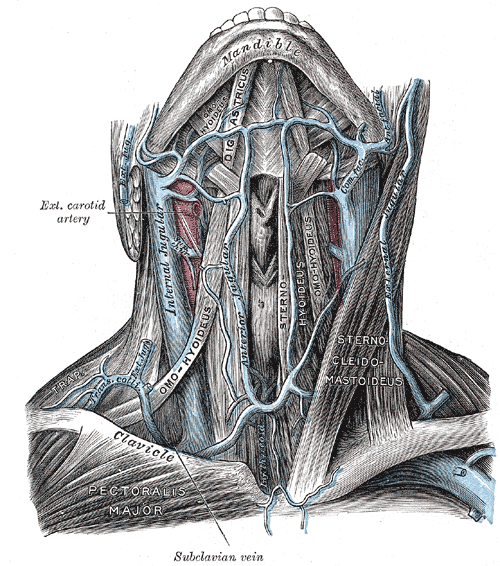
jugular veins
Henry Vandyke Carter, Public domain, via Wikimedia Commons
Internal Jugular Vein (IJV)External Jugular Vein (EJV)
Formation (Drains from)Inferior petrosal sinus + Sigmoid sinus (At or just distal to Jugular foramen)Posterior div. of retromandibular vein + Posterior auricular vein (Within parotid gland at the angle of mandible)
CourseCarotid sheath (lateral-most)Subcutaneous anterolateral neck (superficial then posterior to sternocleidomastoid)
TributariesMnemonic: Medical Schools Let Fun People InMnemonic: PAST
1. Middle thyroid vein
2. Superior thyroid vein
3. Lingual vein
4. common Facial vein (facial vein + ant. branch of retromandibular vein)
5. Pharyngeal plexus
6. Inferior petrosal sinus
1. Posterior external jugular vein
2. Anterior jugular vein
3. Suprascapular vein
4. Transverse cervical vein
Termination (Drains to)Brachiocephalic vein (posterior to sternal end of clavicle deep to sternocleidomastoid)Subclavian vein
Drainage areaMajor venous return from Brain, Upper face and NeckScalp, Face and part of Scapular region
Clinical significanceJugular venous pulse and pressureJugular vein distension
  • Facebook
  • Twitter
PGMEE, MRCS, USMLE, MBBS, MD/MS AnatomyCardiovascular system

Post navigation

Previous post
Next post

Related Posts

PGMEE, MRCS, USMLE, MBBS, MD/MS

Meckel’s Diverticulum : Rule of 2

Sep 7, 2023Sep 7, 2023

General description Rule of 2s 1. Occurs in 2% population 2. Symptomatic cases are 2 times more common in males 3. Located within 2 feet proximal to ileocecal valve 4. 2 inches long and 2 cm diameter 5. 2 types of ectopic mucosa: gastric and pancreatic 6. Symptomatic only in…

Read More

Basics of Fluid therapy

Nov 26, 2013

A. Anatomy and Physiology of Body Fluid Compartments: Remember the “60-40-20” rule of body water. 1. Total body water: 60% (50-70%) of Total Body Weight Greater in  lean individuals because fat contains little water Greatest percentage in newborns, then decreases with age 2. Intracellular fluid (ICF): 40% of Total Body…

Read More
PGMEE, MRCS, USMLE, MBBS, MD/MS

Fasciae of the Neck

Apr 29, 2024Apr 29, 2024

Superficial cervical fascia Contents: Deep cervical fascia or Fascia colli 1. Investing layer 2. Pretracheal layer 3. Carotid sheath: Formed anteriorly by pretracheal fascia and posteriorly by prevertebral fascia Encloses: Relations: 4. Pharyngobasilar fascia (deep to pharynx): lines the inner surface of pharyngeal muscles 5. Prevertebral layer Spread of Infections…

Read More

Leave a Reply Cancel reply

Your email address will not be published. Required fields are marked *

This site uses Akismet to reduce spam. Learn how your comment data is processed.

Pre-clinical (Basic Sciences)

Anatomy

Biochemistry

Community medicine (PSM)

Embryology

Microbiology

Pathology

Pharmacology

Physiology

Clinical Sciences

Anesthesia

Dermatology

Emergency medicine

Forensic

Internal medicine

Gynecology & Obstetrics

Oncology

Ophthalmology

Orthopedics

Otorhinolaryngology (ENT)

Pediatrics

Psychiatry

Radiology

Surgery

RSS Ask Epomedicine

  • What to study for Clinical examination in Orthopedics?
  • What is the mechanism of AVNRT?

Epomedicine weekly

  • About Epomedicine
  • Contact Us
  • Author Guidelines
  • Submit Article
  • Editorial Board
  • USMLE
  • MRCS
  • Thesis
©2026 Epomedicine | WordPress Theme by SuperbThemes