Skip to content
Epomedicine

Mnemonics, Simplified Concepts & Thoughts

Epomedicine

Mnemonics, Simplified Concepts & Thoughts

fetal skull transverse

Fetal Skull Dimensions : Mnemonic

Epomedicine, Jul 27, 2018

Anteroposterior Diameters

Mnemonic:

  1. Larger the alphabets, larger the diameter (V>F>B)
  2. Diameters with “sub” prefix are smaller than counterpart without it.
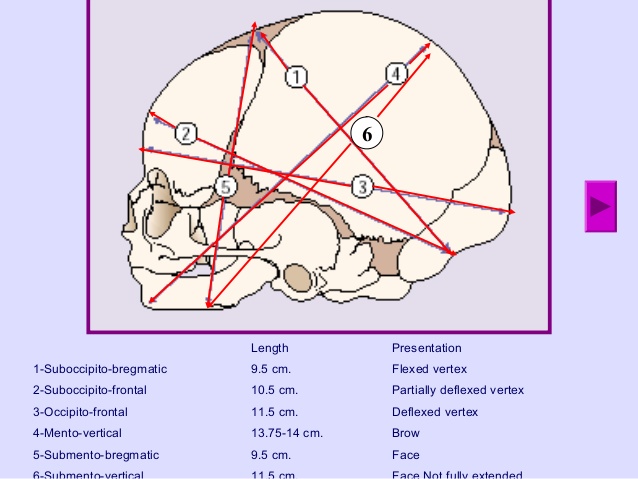
fetal skull AP

  1. mento-Vertical: 14 cm
    • SUB-mento-Vertical: 11.5 cm
  2. occipito-Frontal: 11.5 cm
    • SUB-occipito-Frontal: 10.5 cm
  3. sub-occipito-Bregmatic: 9.5 cm
  4. sub-mento-Bregmatic: 9.5 cm

Transverse Diameters
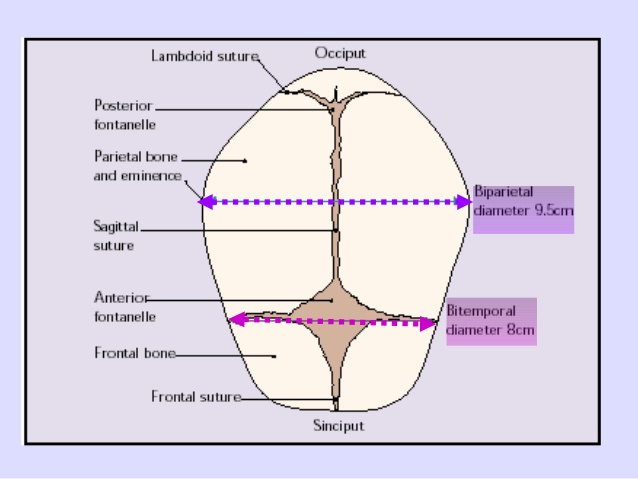
fetal skull transverse

Mnemonic: MTP (Medical Termination of Pregnancy) in increasing order.

  1. bi-Mastoid: 7.5 cm
  2. bi-Temporal: 8 cm
  3. bi-Parietal: 9.5 cm
34 shares
  • Facebook18
  • Twitter
PGMEE, MRCS, USMLE, MBBS, MD/MS AnatomyObGynReproductive system

Post navigation

Previous post
Next post

Related Posts

PGMEE, MRCS, USMLE, MBBS, MD/MS

Urea Cycle and Defects with Mnemonics

Jan 30, 2016Aug 11, 2018

Mnemonic for Urea Cycle Intermediates Orange Cola, Coffee, Alcohol of Argentina For Aggressive Urine Orange: Ornithine Cola: Carbamoyl Phosphate Coffee: Citrulline Alcohol: Aspartate (enters cycle) Argentina: Arginosuccinate For: Fumarate (leaves cycle) Aggressive: Arginine Urine: Urea (leaves cycle) Structure of Urea NH2-CO-NH2 (1 amide from aspartate and 1 from ammonia) Amide…

Read More
PGMEE, MRCS, USMLE, MBBS, MD/MS myeloid differentiation aml

Concept of Acute Myeloid Leukemia (AML) FAB Classification

Aug 23, 2016Mar 10, 2018

There is no need of mnemonics to remember the FAB classification of Acute Myeloid Leukemia (AML); just remember the process myeloid differentiation. A simple schematic diagram with few intermediate processes and stimulating factors eliminated will meet our purpose here. The cells belonging to the myeloid lineage are: Granulocytes: Neutrophils, Eosinophils…

Read More
PGMEE, MRCS, USMLE, MBBS, MD/MS renal embryology schematic

Renal (Kidney) Development – Embryology Made Easy

Aug 7, 2016Aug 8, 2016

Kidney development occurs chronologically from cranial to caudal direction from urogenital ridge (intermediate mesoderm) in 3 different phases. Intermediate mesoderm → urogenital ridge (longitudinal elevation along dorsal body wall) → nephrogenic cord → Pronephros, Mesonephros and Metanephric mesoderm/blastema Remember the embryology of brain – from cranial to caudal, the primordial…

Read More

Comments (6)

  1. Tajmina parbin says:
    Sep 7, 2019 at 9:10 am

    Very useful information

    Reply
  2. samikshya lama says:
    Jan 21, 2020 at 3:52 pm

    why is submentovertical diameter less than mentovertical

    Reply
    1. Taha says:
      Nov 27, 2020 at 3:30 pm

      Because it is measured from a closer point to the back of the head.

      Reply
    2. Dr Ankit says:
      Mar 20, 2021 at 2:11 am

      Bcz it is made by God n we can not change it

      Reply
    3. lakshmi says:
      Jun 11, 2023 at 11:05 pm

      submento is from the side of the chin to vertex.so that is why it is smaller than mento vertical.

      Reply
  3. Dushyant says:
    Nov 24, 2021 at 7:28 am

    Pic is informative, could have been more clear graphically

    Reply

Leave a Reply Cancel reply

Your email address will not be published. Required fields are marked *

This site uses Akismet to reduce spam. Learn how your comment data is processed.

Epomedicine. Fetal Skull Dimensions : Mnemonic [Internet]. Epomedicine; 2018 Jul 27 [cited 2026 Aug 9]. Available from: https://epomedicine.com/medical-students/fetal-skull-dimensions-mnemonic/.

Pre-clinical (Basic Sciences)

Anatomy

Biochemistry

Community medicine (PSM)

Embryology

Microbiology

Pathology

Pharmacology

Physiology

Clinical Sciences

Anesthesia

Dermatology

Emergency medicine

Forensic

Internal medicine

Gynecology & Obstetrics

Oncology

Ophthalmology

Orthopedics

Otorhinolaryngology (ENT)

Pediatrics

Psychiatry

Radiology

Surgery

RSS Ask Epomedicine

  • What to study for Clinical examination in Orthopedics?
  • What is the mechanism of AVNRT?

Epomedicine weekly

  • About Epomedicine
  • Contact Us
  • Author Guidelines
  • Submit Article
  • Editorial Board
  • USMLE
  • MRCS
  • Thesis
©2026 Epomedicine | WordPress Theme by SuperbThemes