Skip to content
Epomedicine

Mnemonics, Simplified Concepts & Thoughts

Epomedicine

Mnemonics, Simplified Concepts & Thoughts

Fasciae of the Neck

Epomedicine, Apr 29, 2024Apr 29, 2024

Superficial cervical fascia

Contents:

  1. Platysma muscle
  2. Cutaneous nerves, blood vessels and lymphatics
  3. Superficial lymph nodes
  4. Fat
deep cervical fascia

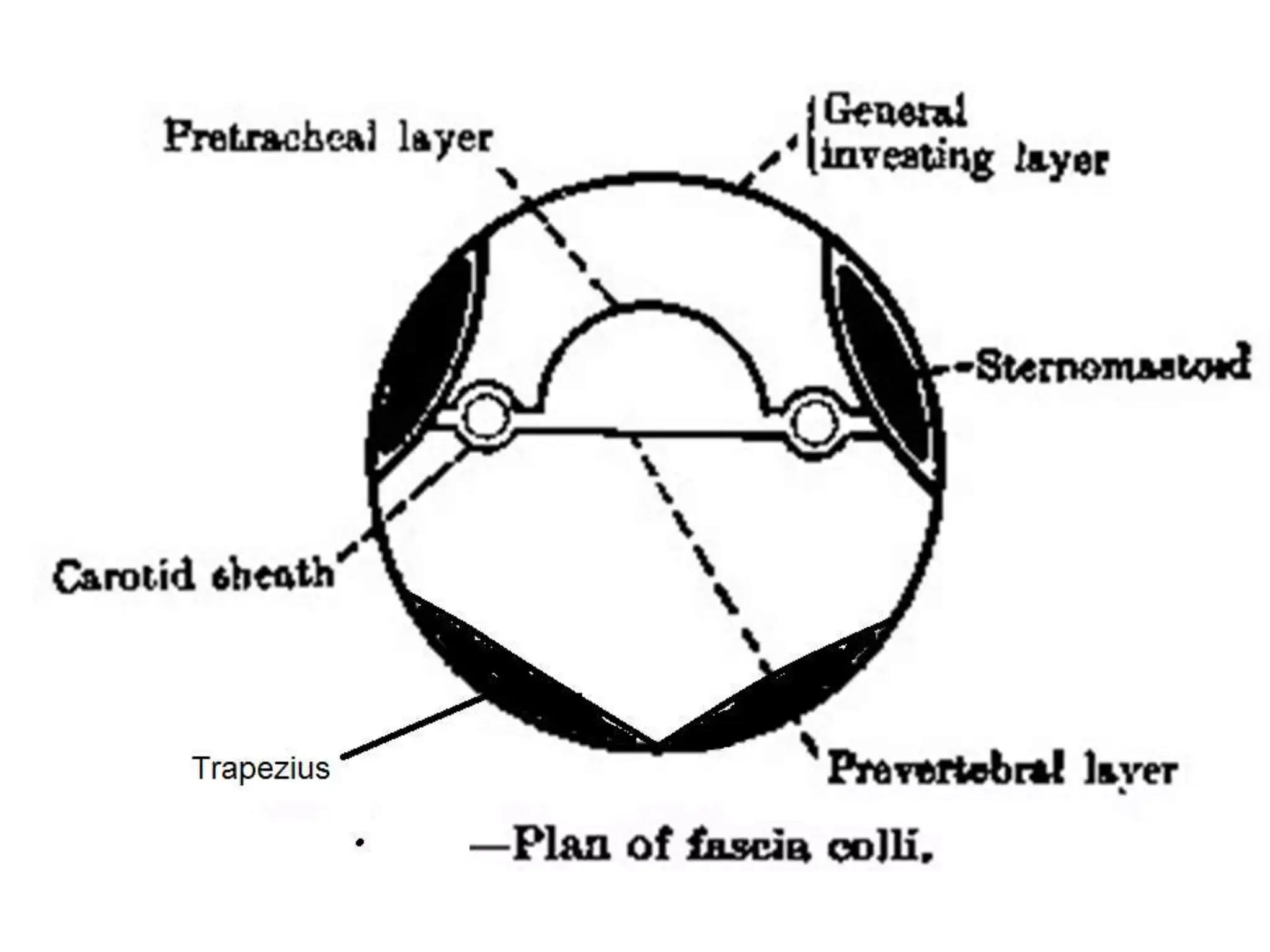
Deep cervical fascia or Fascia colli

1. Investing layer

  • Mnemonic: Encloses 2 muscles, 2 salivary glands and 2 spaces
  • 2 muscles: Sternocleidomastoid and Trapezius
  • 2 glands: Submandibular and Parotid
  • 2 spaces: Suprasternal and Supraclavicular

2. Pretracheal layer

  • Muscular layer: encloses infrahyoid muscles
  • Visceral layer: encloses thyroid gland (forms false capsule and posteriorly suspensory ligament of Berry), trachea and esophagus
    • Posterior part: form buccopharyngeal fascia (outside pharyngeal muscles)

3. Carotid sheath: Formed anteriorly by pretracheal fascia and posteriorly by prevertebral fascia

Encloses:

  • CCA
  • IJV
  • CN X
  • CN IX, XI and XII also present in upper part, but they pierce out

Relations:

  • Anteriorly: Ansa cervicalis (CN XII + C1, C2, C3 spinal nerves)
  • Posteriorly: Cervical sympathetic chain

4. Pharyngobasilar fascia (deep to pharynx): lines the inner surface of pharyngeal muscles

  • Retropharyngeal space exists between buccopharyngeal fascia and pharyngobasilar fascia

5. Prevertebral layer

  • Encloses vertebrae and prevertebral muscles
  • Forms floor of posterior triangle of neck
  • Extends with brachial plexus as axillary sheath (subclavian and axillary veins lie outside the sheath)
  • Alar fascia: between buccopharyngeal fascia and prevertebral fascia
fascia colli neck

Spread of Infections

1. Infection between investing layer and muscular layer of pretracheal fascia: Upto superior edge of manubirum

2. Infection between investing layer and visceral layer of pretracheal fascia: Into thoracic cavity anterior to pericardium

3. Retropharyngeal space infections (suppuration of retropharyngeal lymph nodes): Through the superior mediastinum into the posterior mediastinum

4. Infection behind prevertebral fascia (vertebral TB): May spread to various directions –

  • Anterior: Chronic retropharyngeal abscess
  • Lateral: Through axially sheath and point in posterior triangle or lateral wall of axilla
  • Inferior: Superior mediastinum
  • Facebook
  • Twitter
PGMEE, MRCS, USMLE, MBBS, MD/MS AnatomyOtorhinolaryngology

Post navigation

Previous post
Next post

Related Posts

PGMEE, MRCS, USMLE, MBBS, MD/MS henrique durao

Some Mnemonics for Physical Examination

Sep 18, 2019Sep 18, 2019

CAUSES OF­ INCREASED PIGMENTATION S: Systemic sclerosis H: Hemochromatosis 1* A: Alkaptonuria K: Kala azar A: Arsenicosis H: Hemochromatosis 2* A: Addison’s N: Nelson’s D: Drugs Amiodarone Busulfan Bleomycin Phenytoin Phenothiazine Psoralen SADDLE NOSE S: Sarcoid, Syphilis congenital, Sponastrine dysplasia, Steward granuloma (extranodal NK/T lymphoma, EBV+), Stickler syndrome (chromos 12 mutation, short nose,…

Read More
PGMEE, MRCS, USMLE, MBBS, MD/MS pregnancy

Why is hepatitis E dangerous during pregnancy?

May 20, 2019May 20, 2019

Hepatitis E Virus (HEV) infection is usually a self-limiting disease with a low rate of fulminant hepatic failure but maternal hepatitis E during the third trimester of pregnancy is a cause of fulminant hepatic failure with a mortality rate of upto 20%. Severe liver injury due to HEV in pregnancy…

Read More
PGMEE, MRCS, USMLE, MBBS, MD/MS

BIND score in severe hyperbilirubinemia

Oct 27, 2022Oct 27, 2022

Bilirubin-induced neurologic dysfunction (BIND) Score is used to assess bilirubin induced encephalopathy in neonates with severe hyperbilirubinemia. Johnson et al developed the BIND score to help identify an infant who requires more aggressive monitoring and management. The scoring system has 3 parameters: 1. Cry pattern 2. Behavior and mental status…

Read More

Leave a Reply Cancel reply

Your email address will not be published. Required fields are marked *

This site uses Akismet to reduce spam. Learn how your comment data is processed.

Pre-clinical (Basic Sciences)

Anatomy

Biochemistry

Community medicine (PSM)

Embryology

Microbiology

Pathology

Pharmacology

Physiology

Clinical Sciences

Anesthesia

Dermatology

Emergency medicine

Forensic

Internal medicine

Gynecology & Obstetrics

Oncology

Ophthalmology

Orthopedics

Otorhinolaryngology (ENT)

Pediatrics

Psychiatry

Radiology

Surgery

RSS Ask Epomedicine

  • What to study for Clinical examination in Orthopedics?
  • What is the mechanism of AVNRT?

Epomedicine weekly

  • About Epomedicine
  • Contact Us
  • Author Guidelines
  • Submit Article
  • Editorial Board
  • USMLE
  • MRCS
  • Thesis
©2026 Epomedicine | WordPress Theme by SuperbThemes