Skip to content
Epomedicine

Mnemonics, Simplified Concepts & Thoughts

Epomedicine

Mnemonics, Simplified Concepts & Thoughts

Dengue : Mnemonics

Epomedicine, Oct 23, 2024Oct 23, 2024

Pathophysiology

Mnemonic: ABC

  1. Antibody-Dependent Enhancement: Non-neutralizing antibodies (Pre-M-specific antibodies and NS1-specific antibodies) forms virus-antibody complex, which enters the host cells and replicates generating high virus titers in blood
  2. Bleeding manifestations:
    • Endothelial dysfunction and plasma leakage (Anti-NS1 antibody acts as autoantibodies and cross-react with non-infected endothelial cells)
    • Coagulopathy
    • Thrombocytopenia (Bone marrow suppression + Platelet destruction)
  3. Cytokine storm: CD4+ and CD8+ T cells, specific to the dengue virus, cause lysis of virus-infected cells and produce cytokines such as IFN-gamma, TNF-alpha, and lymphotoxin

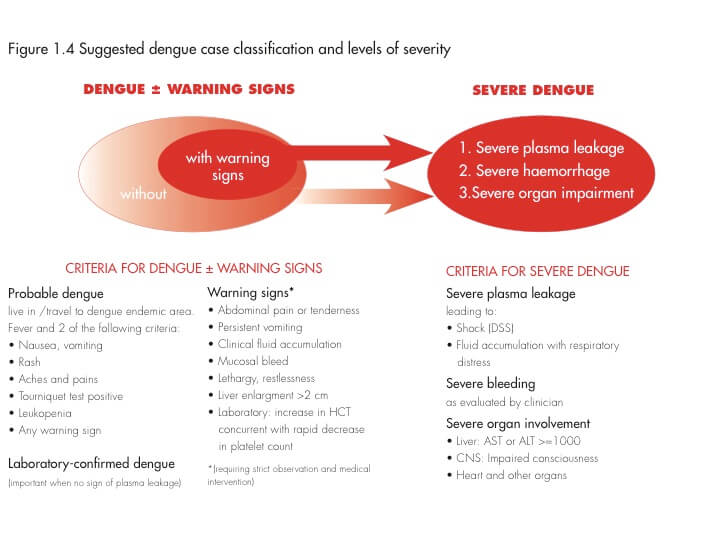
Classification

Dengue Classification : Mnemonic

Lab Diagnosis

  1. NS1 antigen and RNA PCR – Detectable from day 1
  2. IgM antibody:
    • Rises after 2 days of symptom onset
    • Peaks at 2 weeks
    • Normalizes by 2 months
  • Facebook
  • Twitter
PGMEE, MRCS, USMLE, MBBS, MD/MS Infectious diseaseInternal medicinePediatrics

Post navigation

Previous post
Next post

Related Posts

PGMEE, MRCS, USMLE, MBBS, MD/MS

Paraplegia in Extension and Flexion

Feb 4, 2021

Paraplegia in extension and paraplegia in flexion occur only after the spinal shock has ceased. Paraplegia in extension indicates an increase in the extensor muscle tone owing to the overactivity of gamma efferent nerve fibers to muscle spindles as the result of the release of these neurons from the higher…

Read More
PGMEE, MRCS, USMLE, MBBS, MD/MS

Appendix, Appendicitis and Appendicectomy

Feb 8, 2020May 23, 2020

Inflammation of the Appendix is one of the most common causes of Pain Abdomen presenting in the Emergency Room. Since its first description in the texts, there has been a lot of improvement in the quality of management due to the availability of resources and technology. Appendix, in the initial…

Read More
PGMEE, MRCS, USMLE, MBBS, MD/MS heme synthesis pathway

Heme Synthesis and Defects Simplified

Jul 9, 2016Oct 4, 2016

Structure of Heme Heme is a ferro-proto-porphyrin. Heme = Protoporphyrin IX ring + Iron (Fe) in center Protoporphyrin IX = porphyrin with attachment to 4 Methyl, 2 Propionyl and 2 Vinyl groups. Porphyrin = Cyclic structure with 4 pyrrole rings Pyrrole rings are derived from Porphobilinogen (PBG) Hydroxymethylbilane = Linear…

Read More

Leave a Reply Cancel reply

Your email address will not be published. Required fields are marked *

This site uses Akismet to reduce spam. Learn how your comment data is processed.

Pre-clinical (Basic Sciences)

Anatomy

Biochemistry

Community medicine (PSM)

Embryology

Microbiology

Pathology

Pharmacology

Physiology

Clinical Sciences

Anesthesia

Dermatology

Emergency medicine

Forensic

Internal medicine

Gynecology & Obstetrics

Oncology

Ophthalmology

Orthopedics

Otorhinolaryngology (ENT)

Pediatrics

Psychiatry

Radiology

Surgery

RSS Ask Epomedicine

  • What to study for Clinical examination in Orthopedics?
  • What is the mechanism of AVNRT?

Epomedicine weekly

  • About Epomedicine
  • Contact Us
  • Author Guidelines
  • Submit Article
  • Editorial Board
  • USMLE
  • MRCS
  • Thesis
©2026 Epomedicine | WordPress Theme by SuperbThemes